
For most beginners searching for cheap CDJs, a two-channel controller such as the Pioneer DJ DDJ-FLX4 is the more practical place to start: it offers hands-on deck controls and beginner-friendly blending features. The products below include controllers, a mixer, and a standalone media player, so they are not interchangeable. The DDJ-FLX4 is best suited to new learners; the Pyle mixer is for setups needing mic and audio inputs; and the CDJ-3000X is a dedicated media player, not a budget beginner system.
| Product | Best suited to | Type |
|---|---|---|
| Pioneer DJ DDJ-FLX4 | First-time learners | Two-channel controller |
| Pyle PMX8BU | Mic-focused events and audio mixing | Three-channel mixer |
| AlphaTheta DDJ-GRV6 | Beginners seeking a four-channel layout | Four-channel controller |
| AlphaTheta CDJ-3000X | Dedicated media-player users | DJ media player |
| Pioneer DJ DDJ-FLX10 | Advanced hobbyists and mobile DJs | Four-channel controller |
Pioneer DJ DDJ-FLX4

Best for: Beginners who want a straightforward controller for learning two-deck mixing. Its 2-channel, 2-deck layout provides a manageable starting point, while its layout is described as drawing on professional Pioneer DJ gear.
The DDJ-FLX4 includes 16 Performance Pads for functions such as Hot Cues, Pad FX, Beat Jump, and Sampler. Smart Fader can adjust volume, bass, and BPM to help blend tracks by moving one fader. That makes it a useful option for a learner who is not yet comfortable beatmatching manually.
Why it was selected: Among these choices, it has the clearest beginner-focused features and a relatively simple two-channel setup. It is a controller rather than a standalone CDJ media player, so choose it if controller-based learning suits your goal.
Limitation: It has two channels and two decks, so it is less suited to someone who specifically needs four-channel control or a standalone media player.
Pyle PMX8BU DJ Mixer

Best for: A beginner or event operator who needs a mixer with multiple audio inputs and microphone controls. The PMX8BU has three channels, dual balanced microphone inputs with independent gain and talkover, and a crossfader.
Its built-in phono preamp on channels one and two supports direct turntable connections, while switching to Line accommodates CDJs or media players. Cue headphone monitoring lets the operator pre-listen to a channel before it reaches the master output, with separate headphone volume. The listed features also include a USB-A MP3 player and Bluetooth.
Why it was selected: It offers a distinct option for buyers focused on mixing external sources, microphones, or event audio rather than learning on an all-in-one controller.
Limitation: This is a mixer, not a complete DJ player or controller. It needs audio sources, such as turntables or media players, for playback; it does not provide the same integrated deck controls as the DDJ-FLX4.
AlphaTheta DDJ-GRV6 Controller
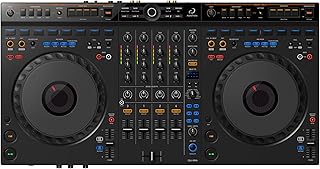
Best for: Learners who want a more club-oriented layout and room to explore performance features. Its four-channel controller format is a step beyond the simpler two-channel DDJ-FLX4 in the options compared here.
The DDJ-GRV6 has a layout inspired by the CDJ-3000 and DJM-A9, which the product description presents as a way to build muscle memory that transfers to a booth. Groove Circuit swaps drum parts for loops from other genres for live remixes. In Serato DJ Pro, the related tools become Stems FX for isolating and applying effects to vocals, drums, and melody.
Why it was selected: It suits buyers who already know they want four-channel controls and creative remix functions, rather than the most basic beginner arrangement.
Limitation: Its added channels and performance features may be more than a first-time learner needs. Choose the FLX4 instead if a simpler two-deck starting point is the priority.
AlphaTheta CDJ-3000X Media Player

Best for: Buyers specifically seeking a dedicated DJ media player rather than a beginner controller. The CDJ-3000X includes a 10.1-inch touchscreen, rekordbox integration, and an NFC touchpoint, according to its listed features.
This is the only product in this selection identified as a CDJ-style professional media player. That makes it relevant to shoppers whose search specifically names CDJs, but its product description identifies it as a professional unit rather than a low-cost starter choice.
Why it was selected: It provides a direct comparison point for the difference between a standalone media player and controller-based beginner equipment. It may be considered by buyers who have already decided on a dedicated-player setup.
Limitation: The supplied product information describes a media player, not a complete multi-unit DJ setup. Do not treat it as a direct substitute for an all-in-one controller when you need integrated controls for two decks.
Pioneer DJ DDJ-FLX10 Controller

Best for: Serious hobbyists, mobile DJs, or experienced beginners who want four-channel control and track-separation tools. The product description positions it as a performance controller with an open-format workflow.
Track Separation can split a song into vocals, drums, and instruments for live mashups without advance preparation. Its four-channel layout and pro effects are described as translating to a CDJ and DJM booth setup, making it a more feature-rich choice than the two-channel FLX4.
Why it was selected: It gives buyers who have outgrown entry-level layouts a clear upgrade path within this list. It is better suited to someone who will use its extra channels and remix functions than to a learner who only needs basic mixing practice.
Limitation: Its four-channel design and advanced functions can be unnecessary for a first purchase. Choose a simpler two-channel controller if your immediate goal is learning basic transitions.
Buying Guide: How To Choose Beginner DJ Equipment
Do you mean CDJs or a DJ controller?
CDJs are dedicated media players, while a DJ controller provides hands-on controls for DJ software or a controller-based setup. The CDJ-3000X is a media player. The DDJ-FLX4, DDJ-GRV6, and DDJ-FLX10 are controllers. The Pyle PMX8BU is a mixer. Identifying the equipment type first helps avoid buying a component that cannot perform the role you need on its own.
For many new DJs, a two-channel controller is the clearest starting point in this selection. It combines controls for two decks in one controller format, while a standalone player or separate mixer belongs to a different system approach.
How many channels should a beginner get?
Choose two channels if you expect to learn basic two-deck mixing and want a simpler layout. The DDJ-FLX4 is the two-channel choice here. Consider four channels if you specifically want to control more sources or prefer the larger layout of the DDJ-GRV6 or DDJ-FLX10. More channels are not automatically better if you will not use them.
Which features matter most for learning?
Prioritize controls that support the skills you want to practice. The FLX4’s Smart Fader can assist with blending, while its Performance Pads cover Hot Cues, Pad FX, Beat Jump, and Sampler functions. These features offer a guided entry point, but they do not replace learning how to structure a mix and control transitions.
If live remixing is a priority, compare the DDJ-GRV6’s Groove Circuit and Serato Stems FX with the DDJ-FLX10’s track separation. These are more specialized tools than a basic two-deck layout, so choose them for a clear use case rather than feature count alone.
When do microphone inputs or a mixer matter?
Choose the Pyle PMX8BU when your setup needs two balanced microphone inputs, talkover, cue monitoring, or phono and line inputs. Its role is mixing incoming audio sources. It does not replace a controller with integrated deck controls, so check which playback sources you plan to use before selecting a mixer.
How can you compare setup complexity?
Start by listing the equipment functions you need: playback, deck control, audio mixing, microphones, or standalone operation. A controller is the most direct fit among these products for learning hands-on deck control. A media player and a mixer serve separate roles, so buyers choosing that style of setup should plan around the required components rather than assuming one product covers everything.
Finally, compare the layout with your intended practice. A two-channel controller favors a focused start; a four-channel controller adds room for more complex performance workflows; and a dedicated media player serves shoppers committed to a standalone-player approach. Product features alone do not establish what other equipment, software, or connections a complete setup may require, so confirm those needs before purchase.
Frequently Asked Questions
Are DJ controllers the same as CDJs?
No. A controller provides DJ controls in a controller-based setup, while a CDJ is a dedicated media player. The products in this list include both types, plus a separate mixer.
Which product is the simplest starting point here?
The Pioneer DJ DDJ-FLX4 is the most directly beginner-focused option listed. It has two channels, two decks, 16 Performance Pads, and a Smart Fader feature for assisted blending.
Is the Pyle PMX8BU a CDJ?
No. It is a three-channel DJ mixer with microphone, phono, line, and cue-monitoring features. It mixes audio sources but is not a standalone media player.
Should a beginner choose a four-channel controller?
Choose four channels if you expect to use the extra control or want a layout closer to the workflow described for the DDJ-GRV6 or DDJ-FLX10. For basic two-deck learning, the DDJ-FLX4 has a simpler channel layout.
Which product is the dedicated media player?
The AlphaTheta CDJ-3000X is the dedicated DJ media player in this selection. Its listed features include a 10.1-inch touchscreen, rekordbox integration, and an NFC touchpoint.