
The best low-cost MIDI keyboard with drum pads depends on whether you prioritize wireless use, hands-on controls, or a guided workflow. The DaierTek is the clearest fit for Bluetooth and USB connectivity, while the Vangoa offers knobs, sliders, and customizable pad lighting. The Donner adds scale and performance modes. Akai’s MPK Mini MK3 and MPK Mini Plus are alternatives for buyers interested in their listed keyboard and control features, though the supplied product details do not specify drum pads for those models.
| Product | Best For | Key Listed Features |
|---|---|---|
| DaierTek 25-Key Controller | Wireless portability | Eight velocity-sensitive RGB pads, Bluetooth, USB |
| Vangoa Worlde Panda Mini | Assignable hands-on controls | Drum pads, knobs, sliders, memory banks |
| Donner DMK 25 Pro | Scale and performance tools | Eight pads, 16 scales, arpeggio, note repeat |
| Akai MPK Mini MK3 | Compact keyboard-focused production | 25 keys, thumbstick, arpeggiator |
| Akai MPK Mini Plus | More keys and gear connections | 37 keys, MIDI I/O, CV/Gate |
DaierTek 25-Key Bluetooth MIDI Controller
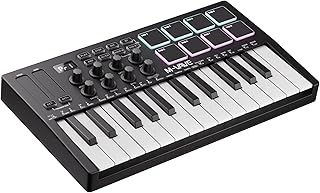
Best for: Producers who want a compact controller with both wireless and wired connection options. This model combines 25 velocity-sensitive keys with eight RGB-backlit pads that support velocity sensitivity and aftertouch.
Its listed controls also include eight assignable encoders, a mini-display, and two capacitive touch-stripes for pitch bend and modulation. The product information says it connects through Bluetooth or USB, and its built-in 2,000 mAh battery is described as providing about 16 hours of operation. That makes it a strong match for buyers who want to make music away from a fixed desk.
The manufacturer lists Windows, Mac OS, Android, and iOS compatibility, along with DAWs that support BLE MIDI or USB MIDI, including Ableton Live, FL Studio, Cubase, and GarageBand for iOS. Choose this if wireless operation and a broad set of onboard controls matter. Limitation: Bluetooth MIDI and DAW support depend on the connected device and software; check those requirements before buying.
Vangoa Worlde Panda Mini Controller

Best for: Beginners and home-studio producers who want physical controls for shaping software instruments and production settings. The listed features include drum pads with seven assignable RGB colors, plus four knobs and four sliders.
The controller also has four memory banks and program, modulation, and octave buttons. Those controls can provide quick access to saved preferences after the controller has been mapped to music software. Its compact, USB-powered design is described as portable and plug-and-play, making it suitable for a small desk or a basic beat-making setup.
Choose the Vangoa if you prefer tactile knobs and sliders alongside pads, rather than relying only on a keyboard and mouse. Its colored pad lighting also offers visual feedback during use. Limitation: the listed features say controls need to be mapped to software, so buyers should be prepared to configure assignments for their preferred setup. The product details do not specify wireless connectivity.
Donner DMK 25 Pro MIDI Controller

Best for: Players who want built-in musical aids for composing melodies, bass lines, and short performance parts. This 25-key controller lists eight drum pads, an OLED display, 16 smart scales, and arpeggio, note-repeat, and chord functions.
The dynamic scale mode is intended to help users play within selected scales, while the multi-mode controls provide ways to create and repeat musical phrases. The listing also mentions four DAW software options and 40 teaching courses. These features make the Donner a useful candidate for learners who want more guidance than a basic keyboard-and-pad layout provides.
Choose it if scale assistance and performance functions are more important than wireless operation. Important limitation: Donner states that the DMK 25 Pro does not produce sound by itself. It must connect to a computer or mobile device running DAW software, so it is not a standalone keyboard instrument.
Akai Professional MPK Mini MK3

Best for: Buyers seeking a compact, USB-powered keyboard controller with performance controls for software instruments. The listing identifies 25 velocity-sensitive mini keys, a four-way thumbstick for pitch and modulation, and a built-in arpeggiator with adjustable resolution, range, and modes.
Akai also describes Native Kontrol Standard integration for the MPK controller series. This model may suit a producer who values a small footprint and wants to control notes, pitch, modulation, and arpeggiated patterns from the keyboard itself.
For this roundup, it is a keyboard-focused alternative rather than a confirmed drum-pad pick: the supplied product features do not mention drum pads. Choose it if its listed keyboard and arpeggiator features fit your workflow, but avoid it if having specified drum pads is essential. The listing also does not provide enough detail here to compare its pad layout or pad functions with the other options.
Akai Professional MPK Mini Plus

Best for: Producers who want more keys and connections for external music equipment. Its 37-key keybed spans three full octaves, and the listed connections include MIDI I/O and CV/Gate, along with USB power and DAW connectivity.
The additional keys may be useful for players who want more room for melodic or harmonic parts than a 25-key controller provides. MIDI I/O and CV/Gate are relevant for buyers connecting MIDI devices, modular gear, sound modules, or synthesizers, as described in the product features. The listing also notes Native Kontrol Standard integration.
Limitation: the supplied product details do not mention drum pads. If pads are a must-have for beat production, confirm the exact control layout before choosing this model or consider one of the listings that explicitly specifies pads. Choose the MPK Mini Plus when its 37-key range and external-gear connections are the priority.
Buying Guide: How to Choose a MIDI Keyboard With Drum Pads
Do you need drum pads specifically?
Start by confirming that the product information explicitly lists pads if triggering drum sounds is central to your setup. In this group, the DaierTek, Vangoa, and Donner descriptions specify drum pads. The supplied details for the two Akai models do not. A keyboard controller sends MIDI performance information; it does not necessarily include every control shown on other models in the same product family.
Pad count is only one part of the decision. The DaierTek specifies eight RGB-backlit pads with velocity sensitivity and aftertouch. The Vangoa listing highlights pads with assignable RGB colors. The Donner lists eight pads, but its supplied features focus more on scales and performance modes. Compare the pad functions you need rather than assuming all pads respond or behave identically.
Should you choose 25 or 37 keys?
A 25-key controller is a compact choice for basic melodies, short parts, and desk setups with limited room. The DaierTek, Vangoa, Donner, and MPK Mini MK3 all list 25 keys. A shorter keyboard may require octave changes when playing parts that span a wider range.
The MPK Mini Plus lists 37 keys across three octaves. That gives the player more note range on the keybed, but the supplied description does not identify drum pads. Decide whether extra keys or a clearly specified pad section matters more to your workflow.
Is wireless operation important?
The DaierTek is the only product in this selection whose supplied details specifically describe Bluetooth connectivity and a built-in battery. It also supports USB connection. This may suit mobile production, but compatibility depends on the device and software supporting BLE MIDI. The other product details describe USB-powered or USB-connected operation, not Bluetooth.
Which controls help with beat-making?
Knobs, sliders, encoders, touch-stripes, and assignable controls can reduce the need to make every adjustment with a mouse. The Vangoa lists knobs, sliders, and memory banks. The DaierTek lists assignable encoders and touch-stripes. The Donner emphasizes arpeggio, note-repeat, chord, and scale modes. Choose based on the tasks you want to control directly, and check whether your DAW can map the controls as needed.
Will a MIDI keyboard make sound on its own?
Do not assume that a MIDI controller is a standalone instrument. The Donner listing explicitly says the DMK 25 Pro does not produce sound on its own and needs a phone or computer running DAW software. The other products are also presented as MIDI controllers for music production, but the supplied descriptions do not establish that they have built-in sound engines. Plan to use suitable software or sound equipment.
What compatibility details should you verify?
Check the operating system, connection method, and DAW support before purchase. DaierTek lists Windows, Mac OS, Android, and iOS, and states that compatible software must support BLE MIDI or USB MIDI. The Akai MPK Mini MK3 listing describes USB-powered use and NKS integration. For every controller, verify the requirements for your specific device and production software rather than assuming that a general compatibility statement covers every version or setup.
Frequently Asked Questions
Which listed controller explicitly includes drum pads?
The DaierTek, Vangoa Worlde Panda Mini, and Donner DMK 25 Pro product descriptions explicitly list drum pads. The supplied descriptions for the Akai MPK Mini MK3 and MPK Mini Plus do not specify pads.
Which option lists wireless MIDI?
The DaierTek lists Bluetooth connectivity as well as USB. Its Bluetooth operation requires a compatible device and software that support BLE MIDI.
Can a MIDI controller be used without a computer?
Not necessarily. The Donner DMK 25 Pro listing says it does not produce sound by itself and needs a phone or computer running DAW software. Check the individual product details and intended setup before expecting standalone sound.
Which controller has the most keys in this selection?
The Akai Professional MPK Mini Plus lists 37 keys. The DaierTek, Vangoa, Donner, and Akai MPK Mini MK3 each list 25 keys.
Which model offers scale-assistance features?
The Donner DMK 25 Pro lists a smart dynamic scale mode and 16 scale tones. It also includes arpeggio, note-repeat, and chord functions according to its product description.
What should a beginner prioritize?
A beginner can start by choosing between explicit drum pads, wireless use, extra keys, or built-in performance aids. Also check whether the controller requires a DAW, whether that software works with the user’s device, and whether controls need to be mapped before use.