
The products listed here are monoblock Class D car amplifiers, not Class A amplifiers. The Skar Audio RP-1200.1D is best for systems needing 1,200 watts RMS at 1 ohm; the RP-2000.1D is better for higher output, while the RP-800.1D suits lower power needs. The AUDIOZERONE ZE1000.1 offers power figures at several impedance levels, and the ORION CBA2000.1D is a lower-output option with a bass knob listed in its name.
| Product | Best suited for | Listed output information |
|---|---|---|
| Skar Audio RP-1200.1D | Higher-output subwoofer systems | 1,200W RMS at 1 ohm |
| Skar Audio RP-2000.1D | Systems requiring the highest listed RMS output | 2,000W RMS at 1 ohm |
| Skar Audio RP-800.1D | Moderate-output systems | 800W RMS at 1 ohm |
| AUDIOZERONE ZE1000.1 | Buyers comparing output across impedances | 1,000W RMS at 1 ohm |
| ORION CBA2000.1D | Lower-output systems wanting a bass knob | 500W RMS, as stated in the product name |
Skar Audio RP-1200.1D

The Skar Audio RP-1200.1D is a monoblock Class D MOSFET amplifier rated at 1,200 watts RMS at 1 ohm. Its listed peak output at that impedance is 1,600 watts. The product information also specifies a 20Hz–250Hz frequency response and an onboard bass EQ switch offering +6 or +12dB of boost at 45Hz.
Best for: Buyers whose subwoofer system calls for about 1,200 watts RMS at a 1-ohm load. It is a middle option between the listed 800-watt and 2,000-watt Skar models, making its stated output a useful point of comparison.
The included remote subwoofer level control lets the driver adjust subwoofer level from the listening position, according to the product name. Choose this if that feature and the stated output fit the system plan. Avoid assuming the peak rating is the same as continuous RMS output; compare RMS ratings when matching an amplifier and subwoofer.
Skar Audio RP-2000.1D

The RP-2000.1D is the highest-output Skar amplifier in this selection. Its listed ratings are 2,000 watts RMS and 2,800 watts peak at 1 ohm. It is a Class D MOSFET monoblock with a 20Hz–250Hz frequency response and an onboard bass EQ switch that boosts 45Hz by +6 or +12dB.
Best for: Buyers building a subwoofer setup that requires up to 2,000 watts RMS at 1 ohm and can be matched to that output. The remote subwoofer level control is also included according to the product name. Compared with the RP-1200.1D and RP-800.1D, this model has the greatest stated RMS rating at 1 ohm.
Choose this amplifier only after checking the subwoofer’s RMS power handling and final wired impedance. Its higher output is not automatically preferable for a system designed for less power. The listed ratings do not establish the power it delivers at other impedance levels.
Skar Audio RP-800.1D

The Skar Audio RP-800.1D is rated at 800 watts RMS at 1 ohm, with a listed peak rating of 1,200 watts at the same load. It shares the RP series features provided for the other Skar choices: Class D MOSFET design, 20Hz–250Hz frequency response, a remote subwoofer level control in the product name, and onboard +6 or +12dB bass EQ at 45Hz.
Best for: Buyers who need less stated output than the RP-1200.1D or RP-2000.1D. Its 800-watt RMS rating gives shoppers a clear comparison point when selecting an amplifier for a lower-power subwoofer setup.
Choose this model if 800 watts RMS at 1 ohm aligns with the subwoofer and wiring configuration. A limitation is that the supplied specifications give an RMS rating only at 1 ohm, so they do not establish output at other loads. Verify the intended final impedance before purchase.
AUDIOZERONE ZE1000.1
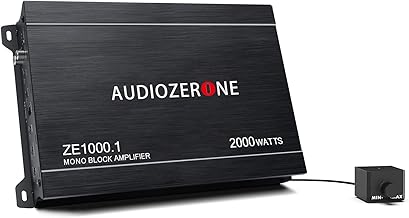
The AUDIOZERONE ZE1000.1 is listed as a Class D MOSFET monoblock amplifier that is stable at 1, 2, and 4 ohms. Its stated output is 1,000 watts RMS at 1 ohm, 650 watts RMS at 2 ohms, and 400 watts RMS at 4 ohms. The product listing also gives a 2,000-watt maximum rating at 1 ohm, plus a low-pass crossover and MOSFET power supply.
Best for: Buyers who want listed RMS output figures at several impedance levels. Those figures make it easier to compare the stated output across 1-, 2-, and 4-ohm configurations than products whose supplied data only identifies a 1-ohm rating.
The listing describes its Class D design as reducing power loss and size compared with less efficient approaches. Do not treat the 2,000-watt maximum figure as its RMS output: the listed RMS rating at 1 ohm is 1,000 watts. Check the subwoofer’s final impedance and power handling before choosing a load.
ORION CBA2000.1D Cobalt

The ORION CBA2000.1D Cobalt is described in its product name as a one-channel Class D amplifier with 2,000 watts maximum and 500 watts RMS. The name also lists 1-, 2-, and 4-ohm stability, an adjustable low-pass filter with bass boost, MOSFET power, and an included bass knob.
Best for: Buyers looking for a stated 500-watt RMS monoblock option with a bass knob and adjustable low-pass control. It is a lower-output choice than the Skar RP-800.1D by the supplied RMS figures, so it may be a better comparison for systems that do not call for the higher listed Skar output.
The provided product information does not give separate RMS output figures for 1, 2, and 4 ohms. Confirm the output at the intended impedance and compare it with the subwoofer’s requirements before deciding. The 2,000-watt maximum number should not be read as the RMS rating.
Buying Guide: How to Choose a Monoblock Amp
Does “Class A” mean the same thing as “Class D”?
No. Class A and Class D refer to different amplifier designs. Every product in this selection is identified as Class D, so this list is relevant if the intended search is for a monoblock Class D car amplifier. If a system specifically requires a Class A amplifier, these products do not meet that stated requirement.
Monoblock describes an amplifier with one channel, commonly used to power a subwoofer. Class D describes the amplifier design. A product can therefore be both monoblock and Class D, as the five products here are described.
How much RMS power should the amp have?
Start with the subwoofer’s RMS power handling, not the amplifier’s peak or maximum number. Compare RMS-to-RMS specifications and select an amplifier output that suits the subwoofer and system design. The listed Skar options provide 800, 1,200, or 2,000 watts RMS at 1 ohm; the AUDIOZERONE lists 1,000 watts RMS at 1 ohm, and the ORION name states 500 watts RMS.
More power is not automatically better. An amplifier with an output rating beyond what the subwoofer can safely handle may be a poor match if its output is not managed appropriately. Conversely, a system’s target output may not be met by a lower-rated amplifier. Use the manufacturer’s specifications for both components to make the comparison.
Why does impedance matter?
Impedance, measured in ohms, affects the load presented to the amplifier. The subwoofer’s voice coils and wiring determine the final load, so check the intended configuration before buying. An amplifier’s stability rating tells you which loads it is designed to support; it does not by itself tell you the RMS output at every load.
The AUDIOZERONE listing provides separate RMS figures at 1, 2, and 4 ohms. The ORION product name lists stability at those impedance levels but does not provide separate RMS figures for each. The supplied Skar specifications state RMS output at 1 ohm. Do not assume unlisted output ratings.
What is the difference between RMS and peak power?
RMS is the more useful figure for comparing continuous amplifier and subwoofer power handling. Peak or maximum power is a separate rating and should not replace RMS when matching components. For example, the ZE1000.1 listing gives 2,000 watts maximum at 1 ohm but 1,000 watts RMS at 1 ohm. Those figures describe different ratings.
Do bass boost and remote controls matter?
Bass boost changes emphasis at a frequency or range; it does not change the basic compatibility requirements between an amplifier and subwoofer. The Skar models list an onboard +6 or +12dB boost at 45Hz. The ORION product name lists adjustable low-pass control with bass boost and an included bass knob. The Skar product names identify a remote subwoofer level control.
These controls can be useful for adjusting subwoofer level or sound settings, but they should not be a substitute for checking RMS output and impedance. If a particular control is important, confirm that the exact product listing includes it.
What should buyers check before installation?
- Match the amplifier’s RMS output to the subwoofer’s RMS power handling.
- Confirm the final impedance produced by the subwoofer and wiring configuration.
- Check that the amplifier’s listed stability supports that impedance.
- Separate RMS ratings from peak and maximum ratings when comparing models.
- Review installation and electrical requirements in the product documentation; the supplied product details do not specify all installation needs.
- Choose bass controls based on the adjustments you want, rather than treating them as a substitute for suitable power matching.
Frequently Asked Questions
Are the products in this list Class A amplifiers?
No. All five are described as Class D monoblock amplifiers. They are suitable to compare for a search seeking a monoblock Class D car amp, but not for a requirement specifically calling for Class A.
Which listed amp has the highest stated RMS output?
The Skar Audio RP-2000.1D has the highest stated RMS output in this selection: 2,000 watts at 1 ohm.
Which product gives RMS ratings at multiple impedances?
The AUDIOZERONE ZE1000.1 lists 1,000 watts RMS at 1 ohm, 650 watts RMS at 2 ohms, and 400 watts RMS at 4 ohms.
Should I compare peak watts when choosing an amp?
Use RMS ratings as the primary comparison for continuous output and power handling. Peak and maximum ratings are not interchangeable with RMS ratings.
Does an amplifier’s ohm stability rating show its output at every load?
No. Stability indicates supported impedance loads, while output ratings state power at a particular load. Check both details, and do not infer output at an impedance where it is not listed.