
Best Coaxial to Toslink Cable and Converter Solutions for Home Audio
In today’s home theater and audio setups, the key is reliable digital-to-digital conversion between coaxial and optical (Toslink) channels. This guide highlights five practical options that fit common needs: simple passive adapters, built-in cable converters, bi-directional units, and HDMI-ARC related extractors. This selection targets buyers seeking lossless or near-lossless digital audio for TVs, soundbars, amplifiers, and game consoles. Each product is evaluated for who it’s best for, plus practical limits to consider before buying.
Quick comparison table of chosen products:
| Product | Best For | |
|---|---|---|
| LiNKFOR 192kHz Coaxial to Optical Converter | Older TV/DVD setups needing built-in cables | Plug-and-play with integrated Toslink and coaxial cables |
| MOSWAG Optical Toslink Cable | Direct optical connection needs | Durable fiber-core design for minimal distortion |
| PROZOR 192K Bi-Directional Optical Converter | Flexible direction switching | Bi-directional with simple input toggle |
| LUKFOCAB Bi-Directional Converter | Extendable distance and simple switching | Amplified, driver-free, USB-powered |
| DigitConvert DAC 192K | Coaxial/Toslink to analog conversion | Simultaneous RCA/3.5mm outputs for amps and readers |
LiNKFOR 192kHz Coaxial to Optical Converter
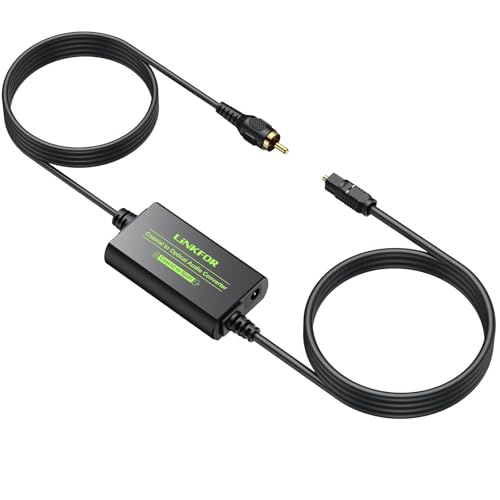
The LiNKFOR device converts coaxial digital signals to optical SPDIF Toslink, with a built-in 1-meter Toslink and a 1-meter coaxial cable for easy setup. It supports sampling rates of 32, 44.1, 48, 96, and 192 kHz at 24-bit, making it suitable for older TVs or DVD players that require a straightforward, lossless path to a Toslink input on a soundbar or AV receiver. Best for budget-conscious buyers who want an all-in-one conversion solution without extra cables.
Who it’s best for: users with legacy equipment needing a simple coax-to-Toslink conversion in a compact package. Why selected: it provides a complete, plug-and-play solution with long enough built-in cables to reduce cable clutter. Caution: built-in cables may limit mounting flexibility in tight spaces.
MOSWAG Optical Toslink Cable 2M/6.6FT
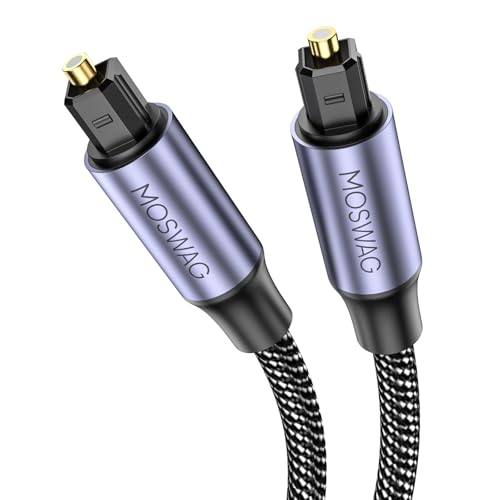
This option is a direct optical cable, ideal when you already have a digital-to-analog converter or DAC in your setup. It supports standard Toslink connections, multi-channel audio formats, and PCM with a fiber-core design to minimize distortion. Best for users who want a robust, long optical run between a TV or game console and a soundbar or DAC without worrying about electrical interference.
Who it’s best for: people who need a reliable optical link rather than a converter. Why selected: it delivers clean digital audio with compatibility across common surround and PCM formats. Caution: does not convert optical to coaxial; use with a separate converter if you need two-way conversion.
PROZOR 192K Bi-Directional Optical Converter

PROZOR offers a bi-directional converter for coaxial and optical signals, with a simple switch to choose input type. It supports LPCM 2.0, DTS, Dolby AC3 and up to 192 kHz at 24-bit, allowing lossless conversion in either direction. Best for households that need flexibility in swapping between inputs without swapping hardware. Caution: operation depends on a stable power supply to maintain signal integrity at higher sampling rates.
Best for: users who need a flexible two-way converter for versatile home theater layouts. Why selected: clear direction switching supports dynamic setups. Limitation: a single switch may require you to reconfigure inputs when devices change.
LUKFOCAB Bi-Directional Coax/Toslink Converter
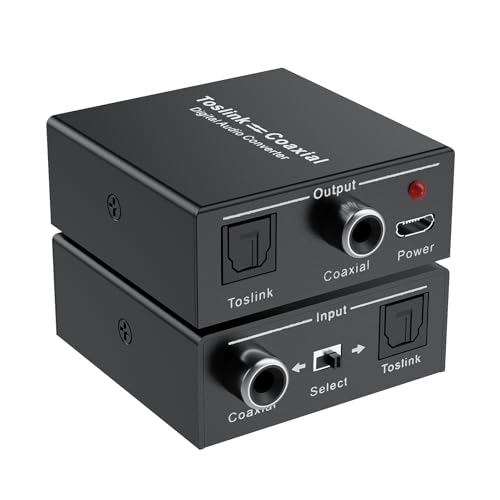
The LUKFOCAB unit is a bi-directional digital audio converter with an input-switching button and built-in amplification to extend signal distance. It supports 192 kHz sampling, 16-bit word length, and various PCM formats, making it suitable for extending reach between a TV and a more distant receiver or DAC. Best for: buyers who need a powered extender with two-way capability. Caution: ensure the USB power supply is stable to avoid dropouts at high sample rates.
DigitConvert DAC 192K Optical to Analog Converter

This DAC device converts optical or coaxial digital audio to analog RCA and 3.5mm outputs, suitable for connecting a TV or gaming console to an older stereo system. It handles 32–192 kHz sample rates and 24-bit depth on the digital input, delivering synchronized, low-latency analog audio. Best for: systems that require an analog feed from a digital source. Caution: not capable of analog-to-digital conversion.
Buying Guide
What should I consider when choosing coaxial to Toslink gear?
Key factors include direction (uni-directional vs. bi-directional), whether you need a built-in cable, and supported sampling rates up to 192 kHz at 24-bit. If you have legacy equipment, a converter with a built-in cable reduces setup complexity. If you often swap between devices, bi-directional models simplify connections without extra adapters.
Do I need a converter or a simple cable?
Use a converter when you must translate between coaxial and Toslink signals. A pure optical cable suffices if all devices already share the same interface and the goal is clean transmission without conversion.
What about power and distance?
Some units require external power via USB or micro-USB. If your setup spans longer distances, models with built-in repeaters or longer cables may help preserve signal quality. Check maximum cable length and the need for powered operation in your installation.
Which formats matter most?
Most home systems rely on LPCM, Dolby Digital, and DTS. Ensure your chosen device supports these formats and that the sampling rate and bit depth align with your equipment’s capabilities for lossless audio.
Common pitfalls to avoid
- Assuming more inputs equal better sound; match devices to your actual source and destination.
- Overlooking compatibility with HDMI-ARC extractors if using TV audio as a source.
- Choosing passive adapters when active conversion is required for signal translation.
Quick reference: what to buy for common setups
- Legacy TV or DVD to soundbar: LiNKFOR or PROZOR Bi-Directional units
- TV to speaker system with long runs: MOSWAG optical cable plus a separate DAC if needed
- Analog-ready amplifiers: DigitConvert DAC 192K for coaxial/toslink to RCA/3.5mm
FAQ
- Q: Do these devices add latency? A: They generally introduce minimal latency, mostly imperceptible in standard playback.
- Q: Can I use a Toslink cable for high-resolution audio? A: Yes, Toslink supports high-resolution formats up to 192 kHz in typical configurations.
- Q: Do I need drivers for these converters? A: No, most are plug-and-play without drivers.
- Q: Are bi-directional converters universally compatible? A: They work with common formats like LPCM, DTS, and Dolby but always verify supported sample rates and bit depths.
- Q: Can I power a converter from a USB port on my TV? A: Many units use a micro-USB power input; a TV USB port often provides sufficient power.
- Q: Will these work with HDMI ARC devices? A: HDMI ARC devices require ARC-to-Toslink or ARC extraction solutions; ensure the product supports ARC if that’s your goal.