
A deep-cycle marine AGM battery can help power a car audio system when the engine is off, but the right choice depends on capacity, current demand, terminal layout, and available installation space. The Interstate Group 24 is best for buyers who want a marine dual-purpose battery; the Newport 50Ah is a lighter, dedicated marine option; and the XSPower D3100 is better suited to demanding audio systems that need more stated capacity. Confirm that any battery fits the vehicle and charging setup before buying.
| Product | Best suited for | Stated capacity |
|---|---|---|
| Interstate Marine/RV Group 24 AGM | Marine dual-purpose use | 70Ah |
| Newport 12V50Ah AGM | Lightweight marine installations | 50Ah |
| XSPower D3100 AGM | Higher-demand audio systems | 127Ah |
| XS Power D3400 AGM | Compact high-output setups | 65Ah |
| OPTIMA D34/78 YELLOWTOP | Dual-terminal flexibility | 55Ah |
Interstate Marine/RV Group 24 AGM

Best for: Buyers who want a battery designed for marine and RV service, with stated capacity that may also suit some auxiliary audio applications. It is a 12-volt, 70Ah AGM battery with 750 CCA. Interstate describes it as a dual-purpose battery for starting and deep-cycle accessory loads, and lists thick plates and faster recharging among its features.
Its combination of starting and accessory-power functions makes it a relevant option for a vehicle audio build that also needs starting capability. The manufacturer describes it as sealed AGM, a format that avoids the routine fluid checks associated with flooded batteries.
Limitation: Its marine/RV design does not by itself confirm fitment or charging compatibility in a car. Check the Group 24 dimensions, terminals, and vehicle charging requirements before choosing it.
Newport 12V50Ah Deep-Cycle AGM
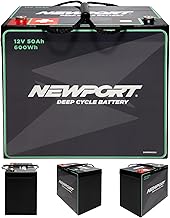
Best for: Buyers prioritizing a lighter marine deep-cycle battery for a modest auxiliary load. Newport lists this 12-volt battery at 50Ah and 32 pounds, and describes it as sealed AGM and compatible with trolling motors. Those details make it a straightforward marine-oriented option for an audio system where portability and a dedicated deep-cycle design matter.
Compared with the 70Ah Interstate, its listed capacity is lower, so it may be better for less demanding or shorter-duration use. Its sealed construction is a practical feature for marine installations, although the product information does not establish vehicle-specific fitment.
Limitation: The 50Ah rating offers less stated capacity than the larger options in this guide. Estimate your audio system’s current draw and listening duration before selecting it.
XSPower D3100 127Ah AGM Battery

Best for: Buyers comparing high-demand audio setups that need substantial stated capacity. This 12-volt Group 31 AGM battery lists 127Ah, 5,000A maximum amps, and 1,564 CA. Its product information says it can support a 4,000-watt system as a primary battery or a 5,000-watt system as a secondary battery.
The listed 127Ah capacity is the largest among the products here, making the D3100 the strongest capacity-focused choice in this group. Its stated system guidance also gives audio buyers a useful starting point for comparison, but it is not a substitute for calculating the actual load and checking the full electrical system.
Limitation: The product data does not provide dimensions or terminal details. Confirm that the Group 31 battery fits the intended location and can be connected safely before purchase.
XS Power D3400 AGM Battery

Best for: Buyers seeking a sealed high-output battery with a stated 65Ah capacity. The D3400 is a 12-volt AGM battery with 1,000 CA and an M6 terminal bolt. XS Power describes it as spill-proof, valve-regulated, sealed, and vibration-resistant, features relevant to installations where battery movement or orientation is a concern.
It offers a lower listed capacity than the D3100 and Interstate, but its high-output positioning may suit buyers who are comparing compact audio-system battery options. The M6 terminal detail is especially important when checking cable and connector fit.
Limitation: The supplied product information does not identify it as a marine battery. Choose it only after confirming the intended installation environment, dimensions, terminals, and charging requirements.
OPTIMA D34/78 YELLOWTOP AGM

Best for: Buyers who need the listed combination of SAE and GM terminals and a battery described for both starting and power needs. The D34/78 is a 12-volt sealed AGM battery rated at 55Ah, with 750 CCA and 120 minutes of reserve capacity. OPTIMA also lists SpiralCell technology and faster-charging capability.
The dual terminal types can be useful when a setup requires one of the listed connection styles, but buyers should confirm the specific cable arrangement. Its reserve-capacity figure provides another comparison point alongside amp-hours, though neither figure alone predicts listening time without knowing the system’s draw.
Limitation: At 55Ah, it has less stated capacity than the 70Ah Interstate and 127Ah D3100. It may be a weaker fit for buyers whose main priority is maximizing listed capacity.
Buying Guide: Choosing a Marine Battery For Car Audio
How much capacity does the audio system need?
Start with the system’s expected current draw and how long it will play with the engine off. Amp-hour capacity is a useful comparison measure: among these five choices, the D3100 lists 127Ah, the Interstate lists 70Ah, the D3400 lists 65Ah, the OPTIMA lists 55Ah, and the Newport lists 50Ah. A larger Ah rating can indicate more stored charge, but real-world runtime depends on the audio system, battery condition, usable discharge limits, temperature, and charging.
Do not select a battery solely from an amplifier’s advertised wattage. Check the equipment specifications and have the complete electrical load assessed. Product guidance that mentions a supported system wattage is useful context, but it does not replace installation-specific calculations.
Should you choose a marine deep-cycle or dual-purpose battery?
A dedicated deep-cycle battery is intended for sustained accessory use, while a dual-purpose battery is designed to provide both starting power and accessory power. The Newport is described as a marine deep-cycle battery. Interstate describes its Group 24 product as dual-purpose for cranking and deep-cycle loads. If the battery must also start an engine, verify that its starting specifications meet the vehicle or boat requirements.
Some products in this list are AGM batteries aimed at high-output or vehicle applications rather than explicitly identified as marine batteries. Do not assume that every AGM battery is suitable for every boat or car installation. Review the product’s stated application and installation instructions.
What do AGM, CCA, and reserve capacity tell you?
- AGM: Absorbed glass mat construction holds electrolyte in a glass-fiber material. The D3400 is specifically described as spill-proof, sealed, and valve-regulated; the other listed products also identify AGM construction.
- CCA: Cold-cranking amps indicate starting performance under a standardized cold-temperature test. CCA is relevant when the battery must start an engine, but it does not directly tell you how long the battery will run an audio system.
- Reserve capacity: OPTIMA lists 120 minutes of reserve capacity. This can help compare batteries, but it should not be treated as a guaranteed audio playback time.
- Ah: Amp-hours are a capacity rating useful for comparing stored charge. Ratings are not a direct guarantee of runtime in a particular installation.
Will the battery fit and connect correctly?
Check the available battery tray or enclosure, battery height, hold-down arrangement, ventilation needs, cable reach, and terminal type. The D3100 is identified as Group 31, the Interstate as Group 24, and the D3400 lists an M6 terminal bolt. OPTIMA lists both SAE and GM terminals. The supplied Newport details do not specify a group size or terminal configuration, so verify those details with the product information before ordering.
Also consider battery weight. Newport lists 32 pounds, while OPTIMA lists 43.5 pounds. The other product details provided do not state weight. Make sure the vehicle or vessel’s mounting location can support the selected battery securely.
How should a buyer compare these five options?
- Choose the Interstate if a marine/RV dual-purpose design and 70Ah rating are priorities.
- Choose the Newport if you want a marine deep-cycle battery with a stated 50Ah capacity and 32-pound weight.
- Consider the D3100 if higher listed capacity is the main comparison point and its Group 31 format fits.
- Consider the D3400 if its 65Ah rating, M6 terminal bolt, and sealed, vibration-resistant construction match the installation.
- Consider the OPTIMA if its dual terminal types, 55Ah capacity, and listed reserve capacity suit the setup.
What should you check before installation?
Confirm that the battery chemistry and charging profile are compatible with the vehicle’s alternator or any external charger. Check manufacturer instructions for connection, fusing, cable sizing, mounting, and safe battery handling. A high-output audio system may require more than a battery change; the alternator, wiring, grounds, and protection devices all affect safe operation. If the battery will be used in a marine setting, follow applicable vessel installation requirements.
Frequently Asked Questions
Can a marine deep-cycle battery run car audio?
It can serve as an auxiliary power source when its voltage, capacity, terminals, installation, and charging arrangement suit the system. Confirm the battery’s intended application and have the electrical setup checked before use.
Is a higher amp-hour rating always better for car audio?
A higher Ah rating means a greater stated capacity for comparison, but it does not guarantee longer playback in every installation. Actual runtime depends on current draw, battery condition, charging, and operating conditions.
Can I use a dual-purpose marine battery as a car battery?
A dual-purpose marine battery is designed to provide starting and accessory power, but that description does not confirm compatibility with every car. Check the vehicle’s fitment, required starting specifications, terminal arrangement, and charging system.
Does CCA tell me how long music will play?
No. CCA describes cold-starting performance, not audio playback duration. Compare amp-hour capacity and reserve capacity, then estimate runtime from the system’s actual power draw.
Do all AGM batteries work in marine installations?
No. AGM construction alone does not establish suitability for every marine installation. Verify the product’s stated application, mounting requirements, and the vessel’s charging and safety requirements.