
Best 4-Channel DI Boxes for Clean, Flexible Instrument Routing
If you need reliable four-channel DI (direct injection) boxes to convert instrument signals to balanced XLR, this guide highlights five strong options. These models suit live sound engineers, studio owners, and multi-instrument setups where clean signal paths and flexibility matter. Read on to see which DI box fits your needs, from passive multi-channel units to active boxes with per-channel pads and ground lift. The comparison table below summarizes key details to help you decide quickly.
| Product | Type | Best For |
|---|---|---|
| Independent padding and ground lift per channel for versatile stage use | ||
| Hybrid setups needing many independent channels with per-channel controls | ||
| Multi-output stage routing from a single instrument | ||
| Comprehensive 4-channel DI with multiple inputs/outputs |
ART PDB4 Four Channel Passive Direct Box

The ART PDB4 provides four fully isolated, passive direct box channels with switchable input attenuation (0 dB, -20 dB, -40 dB). This model is best for users who want a simple, no-power solution with quiet operation and straightforward signal conversion to balanced outputs. It suits smaller venues or studio racks where a compact, cost-efficient option is preferred. A potential limitation is that it relies on instrument or line-level sources without active gain, so extremely hot signals may require prior attenuation.
dbx DI4 Active 4-Channel Direct Box With Line Mixer

The dbx DI4 combines four independent DI channels in a compact 1/2RU package, each with its own 20 dB pad and ground lift per channel. This configuration is ideal for stage setups or studios requiring per-channel control over level and hum elimination. Best for performers who regularly connect active instruments or keyboards and need reliable isolation. A potential caveat is that the unit’s complexity may require a stable power source and proper setup to maximize per-channel pads and lifts.
Bolanle DI8000 Pro 8-Channel Direct Active DI Box

The Bolanle DI8000 Pro consolidates eight independent active DI channels into one box. Each channel includes input, THRU, and balanced XLR output, plus per-channel PAD and GND LIFT options. This model is best for large multi-instrument rigs or churches and studios needing many simultaneous connections with per-channel control. A limitation to consider is the unit’s size and potential power requirements if used across multiple on-stage channels.
Radial 4-Play 4-Channel Output

Radial’s 4-Play combines a 1-channel active DI with four balanced outputs and an output select switch plus a mute option. This setup is ideal when you need a single instrument to drive multiple outputs or stages with precise routing. It’s well-suited for musicians or venues that require fast, clear switching between feeds. A consideration is that you’ll be working with a more feature-rich box, which may be more than needed for simple DI tasks.
Behringer ULTRA-DI PRO DI4800A
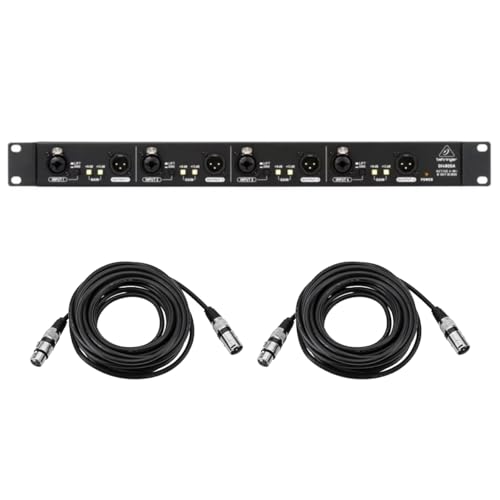
The Behringer DI4800A is a compact 4-channel active DI box bundle, featuring a DC power supply, a user manual, and a warranty. It offers four XLR outputs and 4 XLR-1/4″ combo inputs, providing flexible integration for stage or studio. Best for value-conscious buyers who want a feature-rich, multi-input DI solution, though some users may prioritize higher-performance specs over entry-level pricing.
ART DualZDirect Dual Passive Direct Box

The ART DualZDirect is a dual passive DI with a high-performance transformer design. It converts 50k ohm inputs to 600 ohm balanced outputs and offers switchable input attenuation (0, -20, -40 dB) plus a switchable low pass filter. Best for users who want simple passive isolation with adjustable input levels. A limitation is that this model is described as dual channels rather than a full four-channel unit, so it’s best when you need fewer channels or a compact rack solution.
SONICAKE Junction Box

SONICAKE’s Junction Box offers four passive TRS stereo channels for flexible signal routing on pedalboards or small rigs. It emphasizes organized layouts and convenient true bypass routing. Best for pedalboard setups or smaller studios where space-saving, clean passive distribution matters. Limitations include its passive nature, which may require careful gain staging for noisy environments.
Buying Guide: Key Considerations For 4-Channel DI Boxes
- Active vs Passive: Active DI boxes provide gain and better handling of hot signals; passive DI boxes rely on transformer isolation and are less likely to introduce noise if inputs are properly matched.
- Per-Channel Controls: Look for independent pads and ground lift per channel if you routinely work with a mix of passive and active sources.
- Input/Output Options: Check for XLR outputs, instrument inputs, and optional TRS or combo jacks to fit your gear.
- Number Of Channels: Ensure the unit covers your current needs and offers room to expand without rack clutter.
- Portability and Rack Space: For live use, consider form factor (1/2 RU vs 1U) and weight.
- Sound Quality And Noise: Frequency response and signal-to-noise ratio influence clarity in mixes and live feeds.
- Reliability And Power: Active DI boxes require power; ensure stable supply and compatibility with your power setup.
- Budget vs Features: Balance essential features with price to maximize value without sacrificing crucial capabilities.
Frequently Asked Questions
- What is a direct box (DI) used for?
A DI converts instrument-level signals to balanced audio signals suitable for mixing consoles, reducing hum and noise over long cable runs.
- When should I choose a passive vs active DI?
Choose passive for robust, noise-resistant operation with guitar and bass signals. Choose active for high output sources or long cable runs where gain is needed.
- Do I need per-channel pads and ground lift?
Per-channel pads help prevent clipping with hot sources; ground lift helps eliminate hum from ground loops on stage.
- Can a 4-channel DI also serve as a small mixer?
Some models include line/mixer features, but most DI boxes primarily isolate and convert signals rather than mix them.
- Is measurement or testing required before purchasing?
Yes. Consider your typical instruments, expected gain, noise environment, and the number of simultaneous connections you need.
- Are these DI boxes rack-mountable?
Many are designed for rack use, but models vary. Check form factor if rack space is a constraint.