
Best Digital Audio Out Converter Options for Clear Optical to Analog Sound
Looking for a reliable digital-to-analog audio converter to upgrade your home theater or gaming setup? This guide highlights top options that convert SPDIF Toslink signals to analog RCA or 3.5mm outputs. Each product is suited for different living rooms, TVs, consoles, or home cinemas. Choose based on output options, supported sample rates, and ease of use. The table below summarizes the featured picks to help you compare at a glance.
| Product | ||
|---|---|---|
| PROZOR 192KHz Optical to RCA Converter (7ft) | RCA L/R, Optical In | Built-in amplifier for higher RCA level |
| AUTOUTLET 192kHz DAC Optical to RCA (7ft) | RCA L/R, Optical In | Professional input signal processing with 24-bit/192kHz |
| PROZOR 192KHz DAC with 3.5mm Output | RCA L/R, 3.5mm | Simultaneous RCA and 3.5mm output for multi-device use |
| Rybozen 192KHz DAC Optical to RCA + 3.5mm | RCA L/R, 3.5mm | Includes power/optical cable; versatile for various setups |
| eSynic 192KHZ Optical to RCA Adapter | RCA L/R | Studio-grade 24-bit DAC for high-resolution sound |
PROZOR 192KHz Optical to RCA Converter with Built-in Amplifier

This converter transforms SPDIF digital audio into analog L/R RCA outputs with a built-in amplifier. It is best for readers who want a simple, one-cable solution from a TV or Blu-ray player to an RCA-powered speaker or amplifier. The device supports 192kHz sampling and 24-bit depth, offering detailed sound for movies and music. Note that optical output itself is not supported for other forms of loop-through, so use this when you need a straightforward RCA path. Best for: TV-connected sound systems or compact home theaters where RCA output is preferred.
Key considerations: Ensure TV audio output is set to PCM to avoid compatibility issues; TV volume may need adjustment through settings. A caution is that optical output compatibility is limited to PCM/A PCM formats, not multi-channel surround in many setups.
AUTOUTLET 192kHz DAC Optical to RCA

The AUTOUTLET model is designed for professional audio signal processing with 192 kHz capability. It reliably converts optical/Toslink digital audio to analog RCA, then connects to a stereo amplifier. It includes a built-in amplifier and a dual-channel operational amplifier to boost RCA output levels, making dialogue and music clearer on conventional speakers. Best for: users who need strong RCA output levels from optical sources and want robust signal processing. Caution: This model emphasizes 2-channel PCM signals; it may not support surround formats from certain sources without compatible decoders.
PROZOR 192KHz DAC with 3.5mm Jack Output
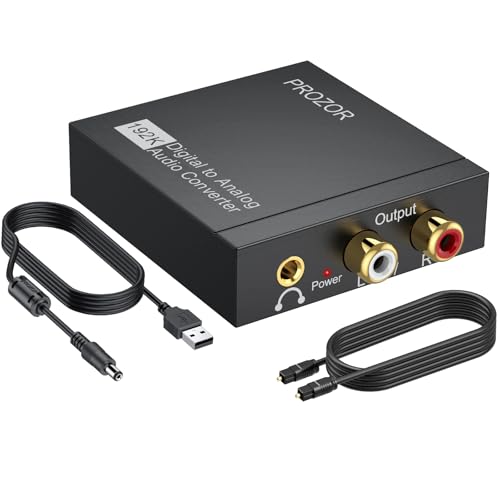
This PROZOR model adds a 3.5mm jack alongside RCA outputs, letting you feed two types of analog audio to different devices. It converts Toslink/SPDIF digital PCM to both L/R RCA and 3.5mm simultaneously, making it versatile for TVs, game consoles, and soundbars. Best for: setups requiring both RCA and 3.5mm outputs from a single digital source. Caution: Optical output is not supported in this variant for multi-channel formats; ensure PCM output is selected on the source device.
Rybozen 192KHz Optical to RCA + 3.5mm Audio Converter

The Rybozen unit ships with an optical cable and power adapter, converting optical PCM to RCA and 3.5mm simultaneously. It supports 24-bit/192kHz sampling, making it suitable for high-fidelity listening. It is best for users who want a ready-to-use kit with cables included. Considerations: Confirms it does not support 5.1-channel output; ideal for stereo configurations. Best for: home theaters or media centers prioritizing dual-output convenience.
eSynic 192KHZ Optical to RCA Audio Adapter

The eSynic adapter targets audiophiles seeking studio-grade sound with 24-bit depth at 192kHz. It uses a PCM decoding approach and is designed for direct optical-to-RCA conversion with minimal latency. Best for: users prioritizing high-resolution audio quality, particularly in TV-to-amplifier paths. Limitation: PCM-only support; not suitable for Dolby/DTS multi-channel streams in some configurations.
Buying Guide
What should I consider when choosing a digital audio out converter?
- Output options: Do you need RCA only, or do you also require 3.5mm or additional outputs? Some models offer multiple analog paths for versatility.
- Supported sample rates and bit depth: For high-fidelity music and gaming, look for 192kHz/24-bit support.
- Source compatibility: Ensure the device can handle PCM/LPCM and confirm whether your source supports PCM mode to avoid distortion.
- Power and latency: Some units draw power from the optical port; others require a separate power supply. Consider any latency if you’re syncing audio with video.
- Built-in amplification: If your speakers have low sensitivity, a model with a built-in amplifier can improve volume without external gear.
- Ease of use: Models with straightforward setup and clear indicator lights help minimize configuration time.
Which type is best for different setups?
- Best for simple TV-to-speaker setups: A single-output RCA converter with PCM compatibility.
- Better for multi-device living rooms: A model offering RCA and 3.5mm outputs allows connecting diverse audio gear.
- Choose this if you need ready-to-use cables: Includes optical cables or power adapters in the package.
- Avoid this if you’re playing surround sound: These converters are primarily for 2-channel PCM; 5.1/Dolby formats may require a dedicated decoder.
What configuration tips help maintain sound quality?
- Set the source to PCM/LPCM rather than automatic or bitstream modes.
- Match the device’s sampling rate to the DAC’s capabilities to avoid potential distortion.
- Avoid placing the converter near strong electromagnetic devices to minimize interference.
FAQ
- Q: Do these converters support Dolby or DTS formats?
A: Most listed models are PCM/LPCM focused. Check each model’s specs for multi-channel capabilities. - Q: Will I notice a difference in sound quality with a built-in amplifier?
A: A built-in amplifier can provide higher RCA output levels, which may improve perceived loudness and clarity with certain speakers. - Q: Is optical output required for all connections?
A: No, several models offer RCA and/or 3.5mm outputs from Toslink input, depending on the product. - Q: Can these converters be used with gaming consoles?
A: Yes, most models are compatible with consoles that output PCM via Toslink or SPDIF. - Q: Do I need drivers to use these devices?
- A: No drivers are typically required; many are plug-and-play with optical input providing power.
- Q: Are items included in the package?
- A: Some listings include cables or power adapters; verify the product page for contents.