
The TASCAM DR-05XP is the strongest fit here for recording music because it is a handheld stereo recorder with omnidirectional condenser microphones, multiple recording formats, and support for loud sources up to 125dB SPL. The Tonfarb recorders are better suited to speech and long-duration capture, while the Comu Action Pro focuses on meeting notes and transcription. Compare the recording features below to choose a device that matches your source and workflow.
| Recorder | Best For | Key Distinction |
|---|---|---|
| TASCAM DR-05XP | Music and field audio | 32-bit float recording and stereo microphones |
| Tonfarb 136GB | Long sessions and speech | Large listed storage and up to 68 hours of recording |
| Tonfarb 64GB | Portable voice capture | One-click operation and WAV PCM recording |
| Comu Action Pro | Meetings and transcripts | AI-generated documents and multilingual transcription |
| Sunlan 16GB | Simple voice recording | Basic controls and voice-activated recording |
TASCAM DR-05XP For Music Recording

The TASCAM DR-05XP is the most directly music-oriented choice in this group. Its built-in omnidirectional condenser microphones record stereo audio, and the listed maximum sound-pressure handling of 125dB SPL makes it relevant for louder sources. Recording modes include 32-bit float, 24-bit, and 16-bit, with sample rates up to 96kHz; MP3 is also supported.
- Best for: Musicians, songwriters, and field recordists who want a portable recorder for performances, rehearsals, or environmental audio.
- Why it stands out: Its stereo microphone setup and range of recording formats are more aligned with music capture than the speech-focused features of the other products here.
- Useful distinction: It can also function as a USB-C audio interface, according to the product name.
Limitation: The listed features describe built-in microphones but do not specify external microphone inputs or accessories. Check the product details if your recording setup depends on connecting other microphones.
Tonfarb 136GB For Long Recording Sessions
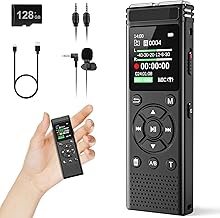
This Tonfarb voice recorder emphasizes storage capacity and extended operation. Its listed 136GB capacity combines 8GB of built-in storage with an included 128GB TF card. The product description states up to 68 hours of continuous recording and supports PCM recording at up to 1536 kbps, as well as MP3 and WAV formats.
- Best for: People who need to capture long interviews, classes, meetings, or repeated practice sessions without frequently transferring files.
- Why it was selected: It offers high stated capacity, one-click recording and saving, USB-C file transfer, and a noise-reduction feature.
- For music use: WAV and PCM support can be useful for keeping recordings in those formats, but the product is presented primarily as a voice recorder.
Limitation: Voice-activated recording is described as responding to speech. It may not be the best choice for music with quiet openings, pauses, or gradual changes in volume.
Tonfarb 64GB For Portable Voice Capture

The Tonfarb 64GB recorder combines a built-in TF card with simple physical controls. The listed features include one-click recording and saving, WAV recording at up to 1536 kbps PCM, automatic noise reduction, and up to 48 hours of continuous use at MP3 32kbps. Its stated maximum storage is up to 4,600 hours of recordings.
- Best for: Students, interviewers, and musicians who want a small recorder for spoken notes, rehearsal reminders, or basic sound capture.
- Why it was selected: The WAV PCM option and straightforward start-and-save control give it more audio-format flexibility than a basic dictation-only device.
- Choose it if: You value quick operation and a listed 64GB capacity more than dedicated music-production controls.
Limitation: The stated 48-hour battery figure is specifically tied to MP3 recording at 32kbps. The supplied details do not give an equivalent duration for higher-quality WAV recording.
Comu Action Pro For Meeting Audio

The Comu Action Pro is designed around conversations and the documents that follow them, rather than music recording. Its listed six-microphone setup includes four omnidirectional microphones, one directional microphone, and one bone-conduction microphone. The product also describes AI transcription and summaries in 113 languages, plus generated items such as email drafts, reminders, and presentation slides.
- Best for: Professionals and teams who need meeting capture, searchable transcripts, or summaries of spoken discussions.
- Why it was selected: It offers an alternative for buyers whose meaning of “audio recorder” includes organizing and converting recordings into text and work documents.
- Better for: Meetings, interviews, and phone-call-related workflows than recording songs or live instruments.
Limitation: The supplied details do not list music-focused recording formats, sample rates, or an audio file workflow. Choose a dedicated field recorder if those specifications are central to your music setup.
Sunlan 16GB For Basic Voice Recording

The Sunlan 16GB recorder uses a simple control layout: press record to start, stop to end, and play to listen. Its listed features include a built-in speaker, noise reduction, a sensitive microphone, and voice-activated recording. An A-B playback function lets a listener select a section to repeat.
- Best for: Buyers who want an uncomplicated device for lectures, interviews, meetings, or spoken musical ideas.
- Why it was selected: The direct controls and playback functions make it accessible for basic recording without a more elaborate workflow.
- Useful for practice: A-B repeat can help replay a short passage or spoken instruction.
Limitation: The supplied features do not state a music-oriented sample rate, WAV/PCM support, or stereo microphone configuration. It is a less specified choice for capturing finished music than the TASCAM.
Buying Guide: How To Choose A Digital Audio Recorder For Music
Do you need a music recorder or a voice recorder?
Start with the sound source. Recording a song, rehearsal, or live instrument calls for a device with clearly stated audio formats and microphone details. In this selection, the TASCAM DR-05XP is the clearest match because it lists stereo omnidirectional condenser microphones, 32-bit float and other recording modes, and handling for sources up to 125dB SPL.
Voice recorders can be suitable for spoken notes, interviews, and practice reminders. Features such as voice activation, automatic noise reduction, and speech transcription are aimed at speech workflows. They do not by themselves establish that a recorder is optimized for musical dynamics or fidelity.
Which recording format and quality should you look for?
Check the formats and settings listed for the specific device. The TASCAM lists 32-bit float, 24-bit, and 16-bit modes, sample rates up to 96kHz, and MP3. The Tonfarb 64GB and 136GB models list PCM recording up to 1536 kbps and WAV support. These specifications are not directly interchangeable: compare the exact mode you plan to use, not just a headline number.
For a quick spoken memo, MP3 can be convenient. For music or archiving, buyers may prefer to confirm that the recorder supports the desired uncompressed or higher-quality format and that the chosen settings fit their editing workflow.
How much storage and battery life do you need?
Estimate how long each session will be and how often you can transfer files. The Tonfarb 136GB model lists the greatest capacity here and up to 68 hours of continuous recording. The 64GB Tonfarb lists up to 48 hours at a specified low-bitrate MP3 setting. Do not assume those maximum runtimes apply to every format or recording mode.
Storage estimates also depend on audio format, bitrate, and recording duration. If you record long performances, check whether the device’s stated capacity and battery claims cover the settings you intend to use.
Are built-in microphones enough?
Built-in microphones are convenient for quick capture and field recording. For a straightforward portable setup, the TASCAM’s listed stereo microphones are a relevant feature. If you need to use a particular external microphone, instrument connection, or multichannel setup, verify supported inputs and connection details before buying. The provided product information does not specify those details for every model.
Will noise reduction or voice activation help?
Noise reduction can be useful when the priority is intelligible speech in a busy setting. Voice activation can save storage during pauses in lectures or interviews. For music, however, quiet introductions, rests, and softer passages may be important. Choose continuous recording when those details matter, and confirm how the recorder’s settings behave before relying on automatic activation.
What workflow do you want after recording?
Consider how you will listen to, transfer, and use your files. The Tonfarb 136GB model lists USB-C transfer, while the Comu Action Pro emphasizes transcription, summaries, and generated documents. The latter may suit meeting productivity, but it is not the strongest match for music recording based on the specifications supplied. Match the device to the job after capture, not only the microphone.
Frequently Asked Questions
What is the best recorder in this list for music?
The TASCAM DR-05XP is the most suitable option based on the listed features. It has stereo omnidirectional condenser microphones, multiple recording modes, sample rates up to 96kHz, and stated handling for sources up to 125dB SPL.
Can a digital voice recorder record music?
Many voice recorders can capture sound, but their features may prioritize speech. Check for the recording formats, microphone configuration, and sound-level handling needed for your music source.
Is 32-bit float necessary for recording music?
It is not necessary for every recording. The TASCAM lists 32-bit float alongside 24-bit and 16-bit modes, giving buyers a choice of recording formats. Select a mode based on your workflow and the product’s documented capabilities.
Is voice-activated recording a good choice for music?
It can be less suitable when a performance includes quiet passages or pauses, because the feature is designed to start recording when sound is detected. Continuous recording is generally the safer approach when preserving the full performance matters.
Which recorder is best for meetings and transcripts?
The Comu Action Pro is the most meeting-focused option in this group. Its listed features include AI transcription and summaries in 113 languages and tools for turning conversations into documents and action items.