
Digital drums are usually the better choice for quiet practice, headphones, sound variety, and compact home use; acoustic drums are better for natural playing response, unamplified sound, and traditional ensemble performance. Among these options, the Alesis Nitro Pro suits players seeking a mesh-head electronic kit with Bluetooth, while the Roland VAD103 offers an acoustic-style design and the Donner DED-70 is aimed at younger beginners. The right choice depends on where you play, how much volume you can make, and what feel you want.
| Product | Best For | Notable Feature |
|---|---|---|
| Alesis Nitro Pro | Home practice and sound variety | Mesh pads, Bluetooth, and BFD sounds |
| AKLOT Acoustic-Style Electric Kit | Players wanting acoustic-style components | Wooden bass drum and independent hi-hat |
| Roland VAD103 | Acoustic-style appearance and adjustable sounds | TD-07 module with editing tools |
| Donner DED-70 | Young beginner drummers | Included accessories and 150 sounds |
| Donner DED-200 | Players wanting a broad sound selection | 31 kits and more than 450 sounds |
Alesis Nitro Pro Electronic Drum Set

The Alesis Nitro Pro is a strong fit for drummers who want digital flexibility in a home-practice kit. Its eight-piece configuration has mesh heads, a PRO 8-inch kick tower that supports a double-kick pedal, a dual-zone 10-inch snare, and three 8-inch toms. The cymbal setup includes a hi-hat, a ride with choke, and a crash with choke.
Choose this kit if you want varied electronic drum sounds alongside a relatively quiet mesh playing surface. The module includes Bluetooth and built-in BFD drum sounds, including Zildjian cymbal sounds. The product information also notes that additional sounds can be downloaded through BFD Player or BFD3.5 software.
Compared with an acoustic kit, this is better suited to practice where controlling room volume matters, especially when using headphones or another appropriate monitoring setup. The limitation is that mesh heads and electronic cymbal pads do not reproduce the exact physical response and acoustic sound of a traditional drum set.
AKLOT Acoustic-Style Electric Drum Set

The AKLOT is best for players who want an electronic kit with larger, acoustic-inspired components. Its listed configuration includes a 16-inch wooden bass drum, a 12-inch wooden snare, two 10-inch toms, and a 12-inch floor tom. Full mesh pads and adjustable snare-head tension give players a way to tailor the playing response.
The two-piece hi-hat has separate top and bottom cymbals, and the 14-inch ride has bell, bow, and edge zones. Two crash cymbals have choke functions. These details make the AKLOT a better fit than a compact beginner kit for drummers who value a more extensive, acoustic-style layout and expressive cymbal articulation.
Choose this option if component size and a standalone hi-hat system matter more than a minimal footprint. Its limitation is that an acoustic-style configuration does not make it an acoustic drum set: it remains an electronic instrument, and its listed wooden drum components should not be taken as evidence that it produces unamplified acoustic-kit volume.
Roland VAD103 V-Drums Kit

The Roland VAD103 is best for players drawn to the look and setup of an acoustic-style kit but who want an electronic module. Its four-piece configuration includes a 12-inch snare, 10-inch rack tom, 12-inch floor tom, and 18-inch kick drum. Tension-adjustable, double-ply mesh heads are included on the snare and tom pads.
The TD-07 module provides 25 preset kits, 25 user kits, and 143 instruments. Its editing features include V-Edit, EQ, ambience, and 30 multi-effects, so players can shape kit sounds rather than rely only on presets. The snare has independent head and rim zones, while the toms also have separate head and rim zones.
Choose the VAD103 if editable sounds and an acoustic-inspired arrangement are priorities. It is better suited to players who want more sound-shaping options than a simple entry-level module may provide. A limitation is that the listed configuration is a four-piece kit, so players seeking a larger number of drums and cymbals should compare its component count with other options.
Donner DED-70 Beginner Drum Kit
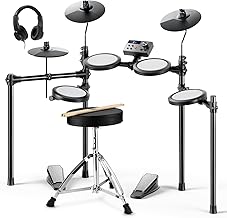
The Donner DED-70 is best for younger beginners who need a compact electronic kit with learning-oriented features. It has four 6.5-inch dual-layer mesh drum heads and three 9-inch silicone cymbals. The module includes 150 sounds, 15 customizable kits, and 10 demo songs, giving a new player options for exploring different styles.
The listed package includes a throne, sticks, headphones, and two pedals. It also supports USB MIDI and is described as compatible with smartphones, tablets, and music apps for play-along or recording. These included accessories and beginner-focused sound options make it a practical choice for starting at home without assembling a separate set of basic items.
Choose the DED-70 if the player is a beginner, particularly within the stated target age range of 6 to 14. One important limitation is that the product listing says an amplifier is required for sound output; the included headphones offer a separate way to listen. As with other electronic kits, pad impacts can still be heard in the room.
Donner DED-200 Mesh Drum Set

The Donner DED-200 is best for players who want a broad selection of electronic kit sounds in a mesh-pad setup. Its eight-piece arrangement includes a dual-zone 8-inch mesh snare, three 8-inch mesh toms, a 6-inch kick drum, a hi-hat, a crash, and a ride with choke. The kick drum is listed as compatible with a double pedal.
The module offers 31 drum kits and more than 450 sounds. The package also lists a throne, headphones, sticks, USB MIDI, and Melodics lessons. Compared with the DED-70, the DED-200 emphasizes a larger sound library and a full mesh-pad configuration rather than a junior beginner setup.
Choose this kit if sound variety, mesh drum pads, and a multi-piece arrangement are more important than an acoustic appearance. Its limitation is that the provided product details do not specify every setup or connection requirement, so check the listing for current configuration information before buying. Its electronic pads still will not create the same unamplified sound as acoustic drums.
Digital Drums vs Acoustic: What Changes?
The main difference is how the sound is produced. Acoustic drums create sound through vibrating drumheads and cymbals. Digital drums use pads and sensors to trigger sounds from a module or connected equipment. This changes the volume, feel, sound options, setup needs, and ways each kit fits into a home or band setting.
| Consideration | Digital Drums | Acoustic Drums |
|---|---|---|
| Room volume | Can be played through headphones or an output system; pad strikes still make physical noise. | Produce sound directly from the heads and cymbals, with no headphone-only playing mode. |
| Sound selection | Often offers multiple kits and instruments through a module. | Sound depends on the drums, cymbals, tuning, playing, and room. |
| Playing response | Depends on pad material, size, zones, and module response. | Comes from acoustic heads and cymbals, with a traditional physical response. |
| Space and setup | May use a rack and electronic module; check the kit’s footprint and connections. | Requires room for its shells, stands, pedals, and cymbals. |
| Performance use | May require headphones, an amplifier, or another sound system for audible output. | Can be heard directly, though microphones or amplification may be needed in some settings. |
Buying Guide: How To Choose Between Digital And Acoustic Drums
Where will you practice?
Start with the room and people nearby. Digital drums are often the more practical choice for shared homes, apartments, or practice at times when full acoustic volume is not appropriate. Headphones can let the drummer hear the module, but the physical sound of sticks and pedals remains. A mesh head is not silent, so consider the room below and around the kit too.
Acoustic drums are a better fit when you have a suitable practice space and can play at full volume. If sound restrictions are a primary concern, compare the digital kit’s pad types and listening options rather than assuming all electronic kits are equally quiet.
Do you want traditional feel or electronic flexibility?
Acoustic drums provide the direct response of drumheads and cymbals. Digital kits vary: mesh heads, pad size, tension adjustments, zones, and pedal design all affect the experience. For a more acoustic-style digital layout, compare the AKLOT and Roland configurations. For a compact beginner option, the DED-70 has smaller pads.
Digital modules can offer multiple sounds and kits. The Alesis Nitro Pro, Roland VAD103, and Donner DED-200 list different sound libraries and controls. Compare the exact module features that matter to you, such as Bluetooth, editing options, number of kits, or USB MIDI, rather than relying only on the product’s overall sound count.
How much equipment and space do you need?
Check the complete kit layout, not just the number of pieces. A larger snare, independent hi-hat, or full-size-style kick component can affect the space needed. Also consider where the module, throne, pedals, and cables will sit. Product listings do not always provide a full room footprint, so verify dimensions and included components before arranging a practice area.
Acoustic kits generally need shells, hardware, and cymbal stands. Electronic kits use pads and racks, but they still need stable placement and may require headphones or external sound equipment. Confirm whether accessories shown or mentioned in a listing are included.
Will you use headphones, speakers, or recording software?
Decide how you want to hear the kit. Headphones suit private practice when the kit supports them. For other people to hear a digital kit, you may need an amplifier, speaker, or other output equipment; the DED-70 listing specifically notes that an amplifier is required for sound output. Check each product’s connection details for your intended setup.
For recording or app-based practice, look for the connections and software support listed for the specific kit. USB MIDI is named for the AKLOT and Donner models in this selection. Do not assume that every electronic kit has the same connections or works with every device.
What should a beginner compare first?
Beginners should prioritize comfortable pad reach, a manageable number of controls, a suitable stool and pedal setup, and a clear way to hear the kit. The DED-70 includes several starter accessories and demo songs, while the DED-200 provides a larger listed sound library. Experienced players may put more weight on dual-zone pads, cymbal articulation, hi-hat response, and sound editing.
Frequently Asked Questions
Are digital drums quieter than acoustic drums?
Digital drums can reduce audible kit volume when used with headphones, but striking pads and operating pedals still make physical noise. Acoustic drums produce their full sound directly in the room.
Can digital drums be played without headphones?
Yes, if the kit is connected to an appropriate speaker, amplifier, or other sound output. Check the individual product’s connection requirements; the DED-70 listing says an amplifier is required for sound output.
Do digital drums feel like acoustic drums?
They can offer some similar playing features, but the feel varies by pad material, size, tension, and pedal design. Mesh heads and acoustic-style components do not make an electronic kit identical to an acoustic set.
Are digital drums a good choice for beginners?
They can be a practical beginner option when volume control, built-in sounds, or included learning features are priorities. Compare pad sizes, included accessories, listening options, and the amount of setup required.
Which type is better for playing with a band?
Acoustic drums are audible without electronic amplification, while digital drums need an appropriate sound output for other people to hear them. The best choice depends on the performance setting and available sound equipment.
Do digital drum pads make no noise?
No. Headphones control the sound heard from the module, but the physical impact of sticks and pedals can still be heard. Mesh pads may be quieter than acoustic drums, but they are not silent.