
The best digital optical cable extender depends on the connection you need: choose a male-to-female extension cable to lengthen an existing Toslink cable, or a female-to-female coupler to join two cables. The EMK 6.6-foot extender suits a larger distance gap, while its 3.3-foot version is better for a modest extension. Bangun offers 3- and 6-foot options for relocating equipment, and Togconn provides couplers for joining cables or routing around tight spaces.
| Product | Connection type | Best for |
|---|---|---|
| EMK 6.6-foot | Male to female cable | Longer reach and braided protection |
| EMK 3.3-foot | Male to female cable | Short extensions |
| Bangun 6-foot | Male to female cable | Relocating a soundbar or extending an installed cable |
| Togconn two-pack couplers | Female to female adapters | Joining two Toslink cables |
| Togconn angled extension set | Male to female cables | Wall-mounted devices and restricted space |
EMK 6.6-Foot Optical Extension Cable

This EMK cable is a male-to-female Toslink extension with a 6.6-foot length. It is designed to extend a connection between equipment such as a TV, Blu-ray or DVD player, receiver, preamp, soundbar, or home theater system. Its nylon braided jacket has a listed 6.0 mm outer diameter and is intended to help protect the cable from kinks and everyday wear.
Best for: Buyers who need more reach than a short adapter provides and prefer a flexible, braided cable. It is also a practical choice when the existing cable can remain connected to one device while the extender reaches a relocated audio component.
Why it was selected: The 6.6-foot length addresses a larger placement gap, while the male-to-female design makes it suitable for extending an existing Toslink lead rather than joining two cables with a separate coupler.
Limitation: This is longer than necessary for a small gap and may leave extra cable to route or manage. Confirm that the source and audio device both have Toslink optical ports.
EMK 3.3-Foot Optical Extension Cable
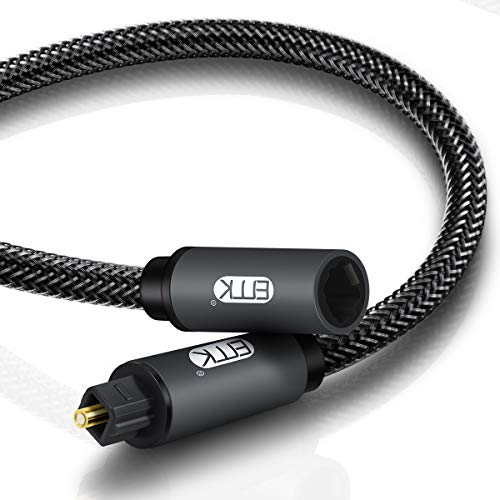
This EMK male-to-female extension measures 3.3 feet and is made to extend connections among soundbars, home theater systems, Blu-ray or DVD players, receivers, and preamps. The listed features describe digital audio transmission for stereo or surround sound use and a nylon braided jacket with a 6.0 mm outer diameter. The jacket is intended to help resist kinks, bending, and daily wear.
Best for: Anyone who needs a modest extension without adding several extra feet of cable. It is better suited than the longer EMK option when the equipment is already close together and the existing optical lead only needs a little more reach.
Why it was selected: Its compact length gives buyers a shorter cable choice while retaining the braided construction and male-to-female format found in the longer EMK model.
Limitation: A 3.3-foot cable may not provide enough reach for a soundbar or receiver positioned well away from the TV. Measure the route, including the slack needed for bends, before choosing.
Bangun 6-Foot Optical Cable Extension

The Bangun extension is a 6-foot male-to-female optical cable for extending an existing Toslink connection. Its listed use cases include extending a cable that has already been routed through a wall, moving a soundbar, and improving cable management when the original lead is too short. The product is described for setups involving a soundbar, TV, game console, or home theater equipment.
Best for: Buyers who need a straightforward, longer extension, particularly when replacing an installed cable would be inconvenient. The 6-foot reach can also help when rearranging audio components to create a cleaner layout.
Why it was selected: The product description specifically addresses two common extension needs: a cable that is already routed and a soundbar that needs to be repositioned. That makes it a useful alternative to the braided EMK options for buyers prioritizing those setup scenarios.
Limitation: The supplied feature information does not specify a braided jacket or particular audio format support. Choose it for the stated extension purpose, and check the connector type and required length before ordering.
Togconn Two-Pack Optical Cable Couplers

These Togconn adapters use female-to-female Toslink connections to join two optical audio cables. Unlike a male-to-female extension cable, a coupler does not provide a cable of its own; it connects the male plugs at the ends of two separate cables. The product is sold as a two-pack and has a compact aluminum-alloy shell with internal PVC material, according to the listed features.
Best for: Buyers who already have two shorter Toslink cables and want to combine them to create a longer run. Choose this type if the cable ends that need to meet are both male plugs.
Why it was selected: It offers a different solution from a single extension cable and can make use of optical cables already on hand. The two-pack also provides a spare adapter for another connection.
Limitation: A coupler cannot extend a cable by itself, and it adds a connection point between the two cables. It is not the right choice if you need a male-to-female cable or have only one cable.
Togconn Angled Optical Extension Set

This Togconn product is a two-pack of 2-foot optical extension adapters: one straight and one with a 90-degree right-angle design. Both are male-to-female extensions, according to the supplied description. The right-angle cable is described as rotatable through 360 degrees, allowing its direction to be adjusted around a wall-mounted device or other tight space. The cables have nylon jackets and dust covers.
Best for: Buyers with limited clearance behind a TV, soundbar, or other device, or anyone who wants both a straight and an angled routing option. The right-angle connector may help reduce strain at a port when a straight plug would press against a wall.
Why it was selected: The set combines two cable-routing styles and also extends an existing optical connection. That makes it more adaptable to constrained installations than a standard straight extender.
Limitation: Each extension is 2 feet, so this set is not the best fit for a long-distance gap. Check the port orientation and available clearance before relying on the angled design.
Buying Guide: How to Choose a Digital Optical Cable Extender
Do you need an extension cable or a coupler?
Start by looking at the ends of your current cable and the connection you need. A male-to-female extension cable has a male Toslink plug at one end and a female socket at the other. Plug the existing cable into the female end, then connect the extension’s male plug to the device. This is the usual choice when you need to add length to one cable.
A female-to-female coupler joins two cables that both have male Toslink plugs. It is a connector, not a cable, so you need two suitable cables to make a longer run. Check the connector gender before buying; an extender with the wrong connection type will not solve the problem.
How much extra length should you choose?
Measure the actual route between the equipment, not just the straight-line distance. Allow some slack so the cable does not have to pull tightly around furniture or against a device. A 3.3-foot extension is suited to a smaller gap, while 6- or 6.6-foot options provide more reach for a relocated soundbar or a longer route.
Extra length can create a loose loop that needs to be managed, so the longest option is not automatically the best. If you are extending a cable installed in a wall, confirm where its accessible end emerges and how much additional reach is needed from that point.
When is a right-angle optical extension useful?
A straight plug may be awkward where a device sits close to a wall or inside a shallow cabinet. A right-angle extension can redirect the cable along a different path and may reduce pressure on the optical port. Compare the angle and direction with the device’s port location. A straight extension is simpler when there is enough space behind the equipment.
What should you check for audio compatibility?
Confirm that both connected devices have Toslink or optical digital audio ports. An optical extender carries a signal between compatible connections; it does not convert optical audio to HDMI, analog RCA, or another format. The EMK product descriptions mention support for PCM and surround formats, while other listings emphasize general digital audio extension. Check your equipment’s audio output settings if a desired format does not play.
Do jacket and connector materials matter?
A braided jacket, such as the one listed for the EMK cables, can help protect a cable from everyday bending and wear. Dust covers can help keep unused connectors covered. These features do not replace careful routing: avoid sharp bends, crushing the cable behind furniture, or pulling on the connector when disconnecting it.
Gold-plated connectors are listed on some products, but the main buying decision should be whether the cable length and connector arrangement match your equipment. Optical audio travels through fiber rather than as an electrical audio signal, so an optical extension is not the same as a conventional analog audio cable.
How can you avoid installation problems?
Remove protective caps from the optical plug and port before connecting, if present. Align the plug with the port rather than forcing it, and seat the connector fully. Route the cable with gentle curves and leave enough slack for the device to move without pulling on the connection. If audio does not play, verify that the source is set to optical output and that the receiving device is set to the corresponding input.
Frequently Asked Questions
Can I connect two Toslink cables to make one longer cable?
Yes. Use a female-to-female Toslink coupler when both cables have male plugs. The coupler joins the cable ends but does not supply additional cable length by itself.
Is a male-to-female extension different from a coupler?
Yes. A male-to-female extension includes cable and is designed to extend one existing cable connection. A female-to-female coupler joins two separate male-ended cables.
Will an optical extender convert my TV audio to HDMI?
No. A Toslink extender carries optical digital audio between compatible optical ports. It does not convert the signal to HDMI or another connection type.
Should I choose a 3-foot or 6-foot extension?
Choose the shortest length that reaches along your intended route with enough slack to avoid tension. A shorter extension is easier to manage for a small gap; a longer one is more suitable when relocating equipment or extending a distant connection.
Can I use an optical extender with a soundbar?
Yes, if the soundbar and the connected source have compatible Toslink optical ports. Match the extender’s connector arrangement to the cable and equipment, then select the optical input on the soundbar if needed.