
No listed amplifier is identified as a 20,000-watt model, so buyers seeking that exact output should verify power specifications before purchasing. The five options below are lower-rated alternatives based on the supplied product information: the Gemini XGA-3000 is labeled 3000 watts, while Pyle lists 2000 watts for the PTA1000BT and 3000 watts for the PWMA4004BT. The Rockville RPA5 and RPA9 are two-channel DJ amplifiers, but no wattage is provided here. Choose by confirmed power, channel needs, and input features—not by a large number in a product name alone.
| Product | Best suited for | Listed power or key distinction |
|---|---|---|
| Gemini XGA-3000 | Buyers comparing a two-channel power amp | 3000 watts; 4/8Ω |
| Rockville RPA5 | Buyers seeking a two-channel rack-mount DJ amp | Wattage not supplied |
| Pyle PTA1000BT | Buyers who want Bluetooth and multiple input options | 2000 watts; bridgeable |
| Rockville RPA9 | Buyers comparing another two-channel rack-mount option | Wattage not supplied |
| Pyle PWMA4004BT | Buyers needing a multi-channel hybrid system | 3000 watts; wireless microphone features |
Gemini XGA-3000 Two-Channel Power Amplifier

The Gemini XGA-3000 is a two-channel power amplifier listed at 3000 watts and identified for 4/8Ω operation. Those specifications make it a relevant comparison for a buyer looking for a conventional DJ or professional-style power amplifier rather than an all-in-one receiver.
Best for: Buyers who want a clearly stated wattage and impedance figure to compare with their speaker requirements. It was selected because the product name provides both a power rating and 4/8Ω reference.
Keep in mind: The listed 3000-watt figure is not 20,000 watts. The supplied information does not explain how the rating is measured or divided between channels, so confirm the detailed manufacturer specifications and speaker matching requirements before buying.
Rockville RPA5 Rack-Mount DJ Amplifier

The Rockville RPA5 is described as a two-channel professional/DJ rack-mount power amplifier. The supplied product information does not give a wattage, impedance range, input list, or bridging capability. Its defining details in this comparison are its two-channel format and rack-mount positioning.
Best for: DJs or sound-system buyers who are specifically comparing two-channel rack-mount amplifiers and are prepared to check the full specifications before deciding. It was included because it is explicitly presented as a professional/DJ power amplifier.
Keep in mind: Do not assume the RPA5 meets a 20,000-watt requirement based on its product category. Confirm its output rating and whether that rating suits your speakers and intended setup.
Pyle PTA1000BT Bluetooth Power Amplifier
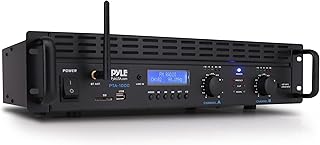
The Pyle PTA1000BT is described as a 2000-watt, two-channel rack-mount power amplifier with bridge mode. Its listed connections and playback features include TRS and XLR inputs, Speakon outputs, Bluetooth, a USB-A input with MP3 player, LED level meters, and a cooling fan.
Best for: Buyers who want several ways to connect or play audio, including Bluetooth and USB, alongside professional-style input and output connections. It was selected for its unusually broad set of named input and playback features.
Keep in mind: The listed 2000 watts is far below a 20,000-watt search target. The product name says it is bridgeable, but buyers should verify the detailed bridged output rating, supported speaker load, and connection instructions before using bridge mode.
Rockville RPA9 Two-Channel DJ Amplifier

The Rockville RPA9 is identified as a two-channel professional/DJ rack-mount power amplifier. The information provided for this product does not specify its wattage, inputs, outputs, impedance range, or whether it supports bridged operation.
Best for: Buyers who are comparing two-channel, rack-mount amplifiers and want to investigate a second Rockville model alongside the RPA5. It was selected because it is directly labeled for professional and DJ use.
Keep in mind: No output figure is included in the supplied product details. If your goal is a high-output system, check the amp’s full specifications rather than treating the RPA9 model name as a power rating.
Pyle PWMA4004BT Multi-Channel Hybrid System

The Pyle PWMA4004BT is described as a 3000-watt Bluetooth multi-channel hybrid pre-amplifier system and home-audio rack-mount stereo receiver. Its listed features include radio, USB, UHF, and dual wireless karaoke microphones.
Best for: Buyers who value multiple playback and microphone features in one system, especially for karaoke or home audio use. It was selected as a feature-rich alternative to a basic two-channel power amplifier.
Keep in mind: Its description emphasizes a hybrid receiver and microphone system, so it is not the same type of product as a straightforward DJ power amp. The listed 3000 watts does not meet a 20,000-watt target; confirm channel layout and speaker specifications for your intended use.
Buying Guide: How to Choose a DJ Amplifier
A search for “20,000-watt DJ amplifier” can refer to a desired system output, a product’s advertised peak figure, or a shorthand estimate of how much power a large event needs. Those meanings are not interchangeable. The products in this list do not establish that any model can deliver 20,000 watts of continuous output. Start by identifying the power rating you actually need and checking how the manufacturer defines it.
Does the amplifier actually need to be rated at 20,000 watts?
First determine whether 20,000 watts is a required amplifier rating or a number taken from a product listing. Compare like with like: a peak or maximum figure is not necessarily equivalent to a continuous or RMS rating. Look for the manufacturer’s output specifications for each channel and for any bridged configuration. If the listing does not state the measurement conditions, seek clarification before relying on the number.
None of the supplied product details confirms a 20,000-watt amplifier. The Gemini is named as a 3000-watt model; Pyle lists 2000 watts for the PTA1000BT and 3000 watts for the PWMA4004BT. The RPA5 and RPA9 wattages are not provided. Buyers with a strict 20,000-watt requirement should compare other models with complete, verifiable specifications.
How many channels do your speakers require?
A two-channel amplifier can serve a stereo system with left and right channels, but the right choice depends on the number and arrangement of speakers. The Gemini, RPA5, RPA9, and PTA1000BT are identified as two-channel models. The PWMA4004BT is described as multi-channel, but the supplied information does not state an exact channel count. Check the full product specification if channel quantity is central to your setup.
Do not choose by channel count alone. Confirm that the amplifier’s output arrangement matches the speakers and any signal-processing equipment in your system. An amplifier with more inputs or playback options does not automatically provide more speaker channels or greater output.
What should you check about speaker impedance?
Impedance is a key compatibility detail. The Gemini’s name specifies 4/8Ω, but the supplied descriptions do not state impedance details for the other four products. Before connecting speakers, check the amplifier’s supported load and the speaker impedance. If you plan to connect more than one speaker to a channel, verify the resulting load against the amplifier’s instructions rather than guessing.
For any model without a stated impedance range, treat that as an unanswered specification, not as proof that it supports your speakers. Confirm the detail in the full manufacturer information or product documentation.
When is bridge mode useful?
Bridge mode combines amplifier channels in a configuration intended to provide a different output arrangement. The PTA1000BT is explicitly described as bridgeable and includes a bridge-mode feature. The supplied information does not provide its bridged wattage or minimum supported load. Check both before using the feature.
Do not assume the same bridge capability for the Gemini, Rockville models, or PWMA4004BT because it is not stated in the details supplied here. Use bridge mode only when the manufacturer’s instructions and the connected speaker specifications support it.
Which inputs and playback features matter?
For a DJ setup, consider how the amplifier will receive audio. The PTA1000BT lists TRS and XLR inputs, along with Bluetooth and USB-A playback. Those options may suit buyers who need both wired connections and built-in playback. The PWMA4004BT lists Bluetooth, radio, USB, UHF, and dual wireless karaoke microphones, making its described feature set more oriented toward a hybrid home-audio or karaoke system.
The supplied descriptions do not list inputs for the Gemini, RPA5, or RPA9. Check those models’ connection details before choosing one for a mixer or other equipment. Match the connection types at both ends of the signal chain, and do not assume Bluetooth is included unless the product information says so.
Do rack-mount design and cooling affect your choice?
Several products are explicitly described as rack-mount models: the Rockville RPA5 and RPA9, the Pyle PTA1000BT, and the Pyle PWMA4004BT. Rack-mount wording can help identify products intended for rack-based systems, but it does not establish exact dimensions or installation requirements. Check those details if the amplifier must fit an existing rack.
The PTA1000BT description specifically names a cooling fan. The supplied information does not describe cooling systems for the other models. For a long-running or enclosed setup, consult the manufacturer’s ventilation and installation guidance. Do not block vents or assume that one model’s cooling design applies to another.
How should you compare the five models?
- For a stated 3000-watt, two-channel option: Compare the Gemini XGA-3000, while verifying how its power rating is specified and checking its 4/8Ω reference.
- For Bluetooth and varied connections: The Pyle PTA1000BT lists Bluetooth, USB-A playback, TRS and XLR inputs, Speakon outputs, and bridge mode.
- For wireless microphones and hybrid playback: The Pyle PWMA4004BT lists dual wireless karaoke microphones, UHF, radio, USB, and Bluetooth.
- For a rack-mount DJ amplifier with unknown listed power: The Rockville RPA5 and RPA9 require further specification checks before a power-based comparison.
These distinctions are based only on the supplied product descriptions. They do not establish sound quality, event coverage, durability, or suitability for a particular venue. Those judgments require additional specifications about the amplifier, speakers, room, and audio system.
Frequently Asked Questions
Is any amplifier in this list rated at 20,000 watts?
No. The supplied information lists the Gemini at 3000 watts, the Pyle PTA1000BT at 2000 watts, and the Pyle PWMA4004BT at 3000 watts. Wattage for the Rockville RPA5 and RPA9 is not provided.
Which listed amplifier includes Bluetooth?
The Pyle PTA1000BT and Pyle PWMA4004BT descriptions explicitly include Bluetooth. The supplied details do not state Bluetooth support for the Gemini XGA-3000 or either Rockville model.
Which product lists bridge mode?
The Pyle PTA1000BT is described as bridgeable and includes bridge mode. Confirm its bridged output rating and supported speaker load in the detailed specifications before using that configuration.
Which model lists dual wireless microphones?
The Pyle PWMA4004BT description lists dual wireless karaoke microphones and UHF. It is described as a multi-channel hybrid pre-amplifier system, rather than simply a two-channel DJ power amplifier.
What should I verify before buying a high-power DJ amplifier?
Verify the continuous and peak power ratings, channel output, supported speaker impedance, connection types, and any bridged-mode limits. Make sure the amplifier’s specifications match the speakers and intended system. If a 20,000-watt rating is essential, choose a product with an explicit, clearly defined specification rather than inferring output from its name.