
A double male headphone cable—also called a 3.5mm male-to-male aux cable—connects a headphone or other audio device with a 3.5mm jack to a second device with a compatible audio port. The Syncwire cable is best for a short, durable connection; the Nanxudyj is better for tight spaces and extra reach; and the CableCreation is suited to compact setups. Check your device ports and the cable length before choosing.
| Product | Best For | Length | Notable Feature |
|---|---|---|---|
| Syncwire Nylon Braided Aux Cable | Short everyday connections | 3.3 ft | Gold-plated connectors and braided exterior |
| Nanxudyj Right-Angle AUX Cord | Tight ports and longer reach | 6 ft | Right-angle connector |
| CableCreation 3.5mm Aux Cable | Compact car or speaker setups | 18 in | Short cable length |
| PPTVC Male-to-Male Stereo Cable | General-purpose use | 3 ft | Double-braided nylon exterior |
| LDKCOK 3.5mm Male-to-Male Cable | Connections that need extra reach | 6 ft | Smooth PVC exterior |
Syncwire Nylon Braided Aux Cable

The Syncwire cable is a 3.3-foot male-to-male 3.5mm aux cord for connecting compatible headphones, phones, tablets, car stereos, speakers, and other audio devices. Its length is a practical middle ground for a nearby source without excess cable to manage.
It is best for buyers who want a general-purpose short cable with a braided exterior. The listed features include 24K gold-plated connectors, which the manufacturer says help reduce signal loss and noise, and a stated bend lifespan of more than 15,000 bends. Choose this model for routine listening when both devices have 3.5mm ports.
Limitation: At 3.3 feet, it may not reach comfortably between devices placed far apart. The listing also notes incompatibility with Lifeproof and OtterBox cases.
Nanxudyj Right-Angle AUX Cord

This six-foot stereo cable has a 90-degree right-angle connector at one end and a nylon-braided exterior. The angled plug can be useful when an audio port sits in a cramped location, such as near a car console, or when a straight plug would protrude awkwardly from a connected device.
It is best for buyers who need extra reach and want to reduce bending around the connected port. The product listing describes pure copper cores, triple shielding, reinforced connectors, and a stated test of more than 20,000 bends. Choose this cable when its longer length and angled connector suit your setup better than a compact straight cable.
Limitation: The six-foot length can leave extra cable in a close-range setup. The listing describes it as a TRS auxiliary cable, so check that your devices’ ports and intended audio functions match that connection type.
CableCreation Compact 3.5mm Aux Cable
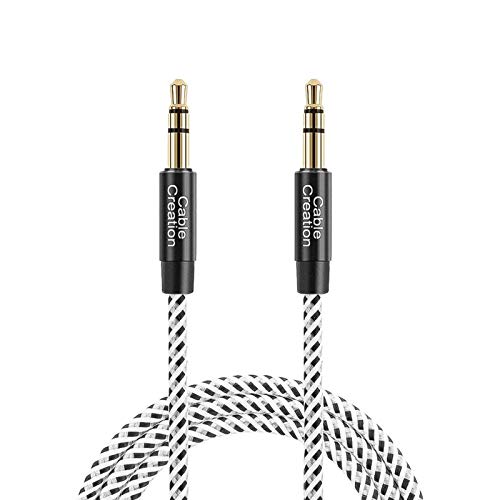
The CableCreation cord is an 18-inch, male-to-male 3.5mm audio cable. Its short length makes it a fit for nearby devices, including a source connected to a car audio input or speaker. It can also reduce the amount of loose cable around a compact setup.
This model is best for buyers who specifically want a short connection rather than extra movement or reach. It was selected because the listing clearly identifies the length and explains the situations it is intended to serve. Choose it when the two ports are close together and a longer cable would be inconvenient.
Limitation: The product listing says the cable has no microphone and is not suitable for long-distance use. It also says phones without a 3.5mm jack need a separate appropriate adapter. Insert the plug fully to help avoid poor contact, noise, or a connection that does not work.
PPTVC 3-Foot Stereo Auxiliary Cable

The PPTVC cable connects devices with 3.5mm ports and is three feet long. The listed examples include phones, headphones, tablets, laptops, car stereos, MP3 players, and portable speakers. Its double-braided nylon exterior is intended for durability and tangle-free handling.
It is best for buyers who want a straightforward cable for common nearby audio connections. The listing also specifies 24K gold-plated connectors and a claimed bend lifespan of more than 15,000 bends. Choose this cable when three feet is enough and you prefer a braided outer covering.
Limitation: The listing requires a 3.5mm port on each connected device. A newer phone or tablet without that jack needs a separate compatible adapter, which is not identified as included in the provided product information.
LDKCOK 6-Foot Male-to-Male Cable

The LDKCOK cable is a six-foot male-to-male aux cord with a smooth PVC exterior. The listing describes use with devices that have a standard 3.5mm audio jack or aux-in port, including car stereos, headphones, PCs, MP3 players, and game controllers.
It is best for buyers who need more distance between an audio source and headphones or another device. The six-foot length can provide more flexibility than the 18-inch, three-foot, or 3.3-foot options in this roundup. Its smooth exterior is described as easy to clean, and the listing states a bend lifespan of more than 15,000 bends.
Limitation: A six-foot cable may be unnecessarily long for a close connection. Devices without a 3.5mm jack require an Apple Lightning or USB-C to 3.5mm adapter, as applicable; the listing says the adapter is not included.
Buying Guide: How To Choose A Double Male Headphone Cable
What does “double male” mean?
A double male cable has a male plug at each end. In this roundup, that means a 3.5mm plug on both ends, allowing the cable to connect a compatible headphone jack or audio output to another compatible audio input. It is often sold as an aux cable, auxiliary cord, or male-to-male audio cable.
Check the actual ports on both devices before buying. A 3.5mm cable does not directly connect to a USB-C or Lightning port. If a device lacks a 3.5mm jack, you may need an appropriate separate adapter. Also distinguish a cable for audio from a cable intended to carry microphone or headset controls; the CableCreation listing explicitly says its short cable has no microphone.
How long should the cable be?
Measure the path between the two ports and allow some slack so the cord is not pulled tight. A short cable can keep a car or speaker setup tidy, but it may not work for headphones when the source is farther away. The 18-inch CableCreation model is the shortest option here, while the three-foot PPTVC and 3.3-foot Syncwire cables suit moderate nearby distances.
For more room between devices, compare the six-foot Nanxudyj and LDKCOK options. A longer cable offers more reach but can create extra slack to coil or store. Choose the shortest length that comfortably reaches your devices without putting strain on the plugs.
When is a right-angle plug useful?
A right-angle plug can help when a port is close to a wall, car console, or another surface. It changes the direction in which the cable exits the connection and may reduce awkward protrusion in a tight space. The Nanxudyj cable is the listed option with a 90-degree connector.
A straight plug may be more suitable if the port is unobstructed or the cable needs to route in a different direction. Check which end has the angled connector and whether that orientation works with your device placement.
Do materials and shielding matter?
The products vary in their listed exterior and construction. Syncwire, Nanxudyj, and PPTVC describe braided nylon coverings; PPTVC specifies double braiding. LDKCOK uses a smooth PVC exterior, and Nanxudyj lists copper cores and triple shielding. These details can help compare construction, but they do not remove the need to check length, plug fit, and device ports.
Several listings state a bend-life figure, but these are manufacturer-provided specifications, not a guarantee that a cable cannot be damaged. Avoid repeatedly bending the cord sharply at the plug, and unplug it by holding the connector rather than pulling on the cable.
Will a 3.5mm male-to-male cable improve sound?
A cable carries the audio signal between compatible devices; it does not make an incompatible connection work. Listings may describe features such as gold-plated connectors, copper cores, or shielding, but the information provided does not establish that one model will sound better in every setup. If you hear crackling or no sound, check that the cable is fully inserted, the correct input is selected, and the ports are clean and undamaged.
Frequently Asked Questions
Can I use a double male headphone cable with any headphones?
No. The headphones and the other device need compatible 3.5mm connections for a direct connection. Some headphones use different connectors or require a cable with additional functions, so check the headphone’s port and requirements.
Can I connect a phone without a headphone jack?
Not directly with a standard 3.5mm male-to-male cable. You need a compatible Lightning-to-3.5mm or USB-C-to-3.5mm adapter, depending on the phone. The adapter is separate unless the product listing specifically says otherwise.
Is a longer aux cable better?
A longer cable is better when the connected devices are farther apart. For a close connection, a shorter cord can be easier to manage. Measure the distance first and select enough length for comfortable routing.
Does a male-to-male aux cable include a microphone?
Not necessarily. A basic stereo cable may carry audio without microphone support. The CableCreation listing specifically says its 18-inch cable has no microphone. Check the product details if you need calls, headset controls, or microphone input.
What should I do if the cable produces static or no sound?
Push both plugs fully into the correct ports and confirm that the source and receiving device are set to the intended output and input. If the phone lacks a 3.5mm jack, use a compatible adapter. Try checking the devices and cable separately to identify which connection is causing the problem.