Best Electric Guitar Distortion Pedals for Rich Tones
Answer: Distortion pedals add grit, sustain, and aggressive bite to electric guitars, helping you dial in everything from sharp rhythm chugs to soaring lead tones. This guide highlights five versatile options suited for different players—from beginners seeking reliable classic tones to players chasing high-gain metal textures. Below, you’ll find a quick product comparison, detailed sections for each pedal, and practical buying tips to help you choose the right distortion pedal for your rig.
| Product | |||
|---|---|---|---|
| Boss DS-1 Distortion Bundle | Analog Distortion | Rockers needing classic bite and reliability | Bundled accessories included |
| Donner Morpher Mini Distortion | High-Gain Distortion | Shredders and heavy metal players | 3 modes for tonal variety |
| MOOER GE100 | Multi-Effects Pedal | Players needing many tones in one unit | 80 presets, 66 effects |
| JOYO JF-04 High Gain Distortion | Analog Distortion | Classic rock to metal tones | Full-range EQ for tone shaping |
| Boss DS-1 Distortion | Analog Distortion | Classic hard-rock tones | Legendary, widely used |
Boss DS-1 Distortion Bundle with Gearlux Power Supply
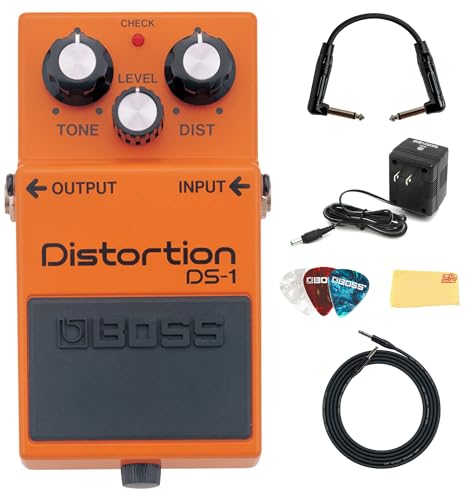
The Boss DS-1 bundle centers on a classic distortion tone with bright, cutting character and tight lows. It offers versatile tone shaping, enabling sharp highs or warm lows to cover both rhythm and lead parts. The all-metal chassis adds rugged reliability for practice, gigs, and touring. This bundle is best for players who want a dependable, widely compatible distortion foundation with practical extras.
Best for: Beginners to intermediate players seeking an iconic sound without complex setup. The bundled accessories help establish a ready-to-play pedalboard setup.
Limitations: The DS-1’s core sound is a single, classic voice. It may require additional pedals for more modern high-gain textures or explicit lo-fi effects.
Donner Morpher Mini Distortion

The Donner Morpher Mini provides high-gain distortion with three distinct modes: Natural, Tight, and Classic Crunch. It suits players aiming for hair metal, glam metal, or modern heavy metal textures. The aluminum-alloy build offers durability, and indicator lights clearly show operation status. This pedal is best for players who want a compact unit with notable tonal variety and strong output for both stage and studio use.
Best for: Players chasing a metal-leaning, high-gain voice with quick mode switching. Choose this if you want aggressive tones without stepping up to a larger multi-effect rig.
Caution: High-gain settings can favor strong pickups and well-tuned power supply to avoid noise or hum in some setups.
MOOER GE100 Multi-Effects Pedal

The MOOER GE100 combines a broad library of effects with a distortion engine, offering 80 presets and 66 effects, plus a dedicated drum rhythm and expression pedal support. It’s designed for players who want an all-in-one solution for practice, songwriting, and live performance. The interface emphasizes quick preset access and flexible routing for complex tones.
Best for: Players who need a versatile all-in-one unit, especially those who experiment with multiple genres and tones in a single session.
Limitation: With many options, the learning curve is steeper than single-pedal setups, and some users may prefer dedicated pedals for streamlined live rigs.
JOYO High Gain Distortion Pedal (JF-04)

The JOYO JF-04 delivers a wide range from bluesy crunch to aggressive high gain. It features dedicated Treble and Mid controls for precise tone sculpting, plus a dynamic analog circuit response that reacts to picking dynamics and volume changes. This makes it a strong choice for players who want a classic, responsive distortion with straightforward controls.
Best for: Players wanting a flexible, analog-sounding pedal with clear midrange shaping for punchy leads and tight rhythm parts.
Caution: While robust, the pedal’s gain can be unforgiving on lower-output pickups without careful gain staging.
Boss DS-1 Distortion Bundle with Gearlux Accessories

This bundle centers on the classic DS-1 tone—bright, cutting distortion with a balanced low end and smooth sustain. The package includes essentials like cables and a polishing cloth, making it a practical starter kit for players who want the DS-1’s iconic sound with reliable setup basics. It’s best for players who value a proven, widely compatible distortion voice and a ready-to-run pedalboard.
Best for: Players seeking the traditional Boss distortion voice in a comprehensive starter bundle with practical accessories.
Limitation: The DS-1 is a single, classic voice; for newer or more extreme tonal options, additional pedals may be necessary.
Boss DS-1 Distortion | Classic Benchmark

The DS-1 Distortion is a staple in guitar tone history. It provides hard-edged attack with smooth sustain, suitable for heavy rhythms and cutting solos. Its enduring design ensures compatibility with a wide range of amps and effects setups, making it a reliable choice for players prioritizing a well-known distortion voice.
Best for: Players who want a legendary distortion tone with predictable performance and broad compatibility.
Limitation: The single-voice character may not satisfy players seeking modern, high-gain flexibility without additional pedals.
Buying Guide
What should I consider when choosing a distortion pedal?
- Gain range and voice: Determine whether you need classic rock crunch, high-gain metal, or a mix. Some pedals offer multiple modes or presets to cover these scenarios.
- Tone shaping controls: Look for pedals with dedicated EQ or voice controls (e.g., Treble, Mid, Bass) to sculpt presence, bite, and body.
- Build and reliability: For stage use, a sturdy chassis and dependable footswitching reduce on-tour downtime.
- Power and compatibility: Check power requirements and whether you need a battery or 9V DC supply. Consider true bypass for noise reduction in complex rigs.
- Presets and memory (for multi-effects): If you value quick tone changes, consider pedals with preset banks or easy patch switching.
- Size and routing: Compact boards save space; multi-effects can consolidate gear but may complicate setup.
FAQs
- What does high-gain distortion sound like? It delivers a saturated, heavy tone with strong sustain, suitable for metal styles.
- Do I need a distortion pedal if I already have an amp with distortion? A pedal can offer a distinct, controllable voice and external effects routing on your board.
- Is true bypass important? True bypass minimizes signal loss when the pedal is off, beneficial in a long signal chain.
- Can distortion pedals be used for clean tones? With the right gain and EQ settings, some pedals can provide lightly overdriven or bluesy crunch tones.
- Should I choose a multi-effects unit or individual pedals? Multi-effects save space and provide versatility; individual pedals often deliver purer, tweakable tones and tactile control.
- How should I power distortion pedals on tour? Use a reliable 9V center-negative adapter or a power supply with isolated outputs to minimize noise.