
The best entry-level hi-fi system depends on whether you want an all-in-one stereo, a compact component set, or speakers you can connect directly to your devices. The Denon D-M41 is a convenient compact system with speakers, CD playback, radio, and Bluetooth; the Philips FX10 combines a CD player, radio, USB playback, and speakers; and the Edifier R1280DBs is a straightforward powered-speaker option. The Sony STR-DH190 suits buyers planning to choose separate speakers, while the Pyle PDA7BU is better for karaoke and multi-channel use.
| System | Best For | What It Includes |
|---|---|---|
| Sony STR-DH190 | Building a system around separate speakers | Stereo receiver with Bluetooth and phono input |
| Philips FX10 | CD, USB, and FM playback in one system | Stereo system with speakers and remote |
| Denon D-M41 | Compact-room listening with multiple sources | Mini amplifier, bookshelf speaker pair, CD player, radio, and Bluetooth |
| Edifier R1280DBs | Simple powered-speaker setup | Bluetooth bookshelf speakers with optical input |
| Pyle PDA7BU | Karaoke and multi-channel audio | Five-channel amplifier with microphone inputs and media features |
Sony STR-DH190 Stereo Receiver

Best for: Buyers who want to choose their own passive speakers and connect several audio sources. This is a receiver rather than a complete system, so you will need compatible speakers to listen to it.
The STR-DH190 is a two-channel stereo receiver with Bluetooth, a phono input, four stereo RCA audio inputs, a 3.5 mm input, and a stereo RCA output. Its listed output is 100 watts per channel at 8 ohms and 1 kHz. The listed speaker impedance range is 6–16 ohms, which gives buyers a specification to check when choosing speakers.
Choose this model if you want a conventional receiver-based system, including a direct phono connection for a turntable with a suitable output. Its range of inputs can also help when connecting more than one source. Bluetooth provides a wireless playback option.
Limitation: The receiver does not include speakers. It is a less direct choice if you want a ready-to-play system without selecting and connecting separate components.
Philips FX10 Bluetooth Stereo System

Best for: Listeners who want a packaged stereo for CDs, USB audio, FM radio, and Bluetooth without assembling a receiver-and-speaker system.
The FX10 product listing names a CD player, MP3 playback, USB, FM radio, Bluetooth, bass-reflex speakers, and an included remote control. Its listed output is 230 watts. These built-in sources make it a practical format for a household that still uses discs or USB files but also wants wireless playback.
Choose this system if you prefer one matched package and want several playback methods available from the same unit. The included speakers mean you do not need to shop separately for a pair of passive speakers, unlike with the Sony receiver. The remote is useful when the system is placed across a room.
Limitation: The listing does not provide detailed connection specifications or speaker configuration information. Check the product details against your intended sources before buying, particularly if you need inputs beyond those named in the listing.
Denon D-M41 Compact Hi-Fi System

Best for: Buyers looking for a compact, supplied-speaker system for a small room or a home cinema listening area.
The product name describes the D-M41 as a mini amplifier and bookshelf speaker pair, with CD playback, an FM/AM tuner, and Bluetooth. That combination suits listeners who want physical-disc playback, radio, and wireless audio in one compact setup. Because the speaker pair is included, it is a more complete starting point than a receiver sold without speakers.
Choose the Denon if you want a traditional stereo layout with separate speakers and a central component, rather than a single compact speaker cabinet. Its listed sources cover several common listening needs without requiring a separate CD player or radio tuner.
Limitation: The listing identifies FM/AM radio and Bluetooth but does not specify other digital or analog input connections. If you plan to connect a television or additional equipment, verify that the available connections meet your needs before purchase.
Edifier R1280DBs Powered Speakers

Best for: Buyers who want powered bookshelf speakers with Bluetooth and optical input, without adding a separate stereo receiver.
The R1280DBs listing describes a 2.0 speaker system with Bluetooth, optical input, 42 watts RMS, wood-grain finish, and a subwoofer line out. Powered speakers combine amplification with the speakers, simplifying the basic setup compared with passive speakers that need a separate amplifier or receiver.
Choose this option if your priority is a compact two-speaker arrangement and your source can connect through Bluetooth or optical input. The subwoofer line out is a useful feature to consider if you want the option of adding a compatible subwoofer later. It is a more direct desktop or small-room starting point than a component-based receiver system.
Limitation: The listed features do not include a CD player, radio tuner, or phono input. Buyers who need those sources should compare the Denon, Philips, or Sony options and confirm the exact connections required.
Pyle PDA7BU Multi-Channel Amplifier
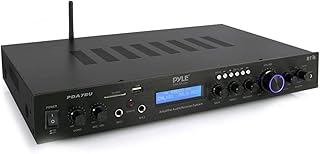
Best for: Buyers who prioritize karaoke, microphone connections, and multi-channel amplification over a conventional two-channel hi-fi setup.
The PDA7BU listing describes a five-channel Bluetooth amplifier with 200 watts into five channels, a subwoofer output, dual microphone inputs, USB and SD playback, MP3 support, RCA input, FM radio, and an LCD display. Its karaoke features distinguish it from the other products in this roundup. It may suit a household that wants music playback alongside microphone use and media-card options.
Choose this amplifier if its microphone and USB/SD functions match your intended use and you want a multi-channel component. It is not the simplest pick for someone seeking a compact, ready-to-use stereo package: the listed product is an amplifier, and the features do not say that speakers are included.
Limitation: The five-channel design and karaoke functions are not necessary for a basic stereo setup. Confirm speaker requirements and the intended channel configuration before choosing it for ordinary music listening.
Buying Guide: How to Choose an Entry-Level Hi-Fi System
Do you want a complete system or separate components?
A complete system is usually the more straightforward route when you want to unpack a matching set of electronics and speakers. The Denon D-M41 and Philips FX10 are described as systems that include speakers. The Edifier R1280DBs is also a speaker-based option, with amplification built into its powered-speaker design.
A receiver gives you more component choice but requires additional planning. The Sony STR-DH190 is a two-channel receiver, not a speaker package. Before buying it, select speakers that match the receiver’s listed 6–16 ohm impedance range and confirm that you have the cables and sources you need.
Which sources do you need to play?
Make a list of your current sources before comparing systems. For CDs, the Philips and Denon product names specify a CD player. For FM radio, the Philips lists FM and the Denon lists FM/AM. The Sony has a phono input for a suitable turntable connection, along with RCA and 3.5 mm inputs. The Edifier lists Bluetooth and optical input.
Bluetooth is convenient for wireless playback, but it does not replace every physical connection. If you plan to connect a television, turntable, or older audio device, check the precise input type your source requires. Product listings may not provide every connection detail, so verify specifications when a particular port is essential.
Is a powered speaker or receiver-based system a better fit?
Powered speakers such as the Edifier combine speakers and amplification in one setup. They can reduce the number of separate components, but buyers should check whether the available inputs support their sources. A receiver-based system, such as the Sony paired with compatible speakers, separates amplification from speakers and lets the buyer select each component.
The Denon sits between these approaches as a compact package with an amplifier and speaker pair. The Philips offers a more integrated source list, including CD, USB, FM, and Bluetooth. Match the system type to how much setup and future component selection you want.
What room and listening habits should guide your choice?
For a small room or desk, consider the footprint of the speakers and main unit, not only the headline power figure. The Denon listing specifically describes its system as compact and suitable for small rooms. The Edifier is a 2.0 bookshelf-speaker set, while the Sony requires separate speakers chosen for the space.
Think about everyday use, too. A remote may be useful for a system placed across the room; the Philips listing specifies one. A turntable-focused listener may prefer the Sony’s phono input. A household that expects to use microphones may find the Pyle’s dual mic inputs relevant, while someone seeking uncomplicated stereo playback may not need its five-channel and karaoke functions.
How should you compare power specifications?
Do not treat wattage figures as a direct ranking of sound quality. The listed numbers are presented in different formats: the Sony specifies 100 watts per channel at 8 ohms and 1 kHz, the Edifier specifies 42 watts RMS, and the Philips lists 230 watts. The Pyle describes 200 watts into five channels. These figures do not establish which product will sound best in your room.
Compare the full system configuration, speaker requirements, inputs, and intended use. For a receiver, check speaker impedance and whether speakers are included. For a powered or packaged system, check that the supplied speakers and connections suit the room and sources you have.
Frequently Asked Questions
What is the easiest entry-level hi-fi system to set up?
A system with speakers included can reduce component selection. The Philips FX10 and Denon D-M41 are described as systems with speakers, while the Edifier R1280DBs is a powered-speaker set. The Sony receiver requires separate speakers.
Which option includes a CD player?
The product names for the Philips FX10 and Denon D-M41 specify CD playback. Check the current product details to confirm the configuration and included components before ordering.
Which system has a phono input?
The Sony STR-DH190 listing specifies a phono input. The supplied details for the other products do not specify a phono input, so verify their connections if you need to connect a turntable.
Can I use Bluetooth with these systems?
Bluetooth is listed for the Sony receiver, Philips system, Denon system, Edifier speakers, and Pyle amplifier. The exact Bluetooth functions and connection details can differ, so check the product specifications for your source device.
Which option is designed for karaoke?
The Pyle PDA7BU is the karaoke-oriented choice in this selection. Its listed features include dual microphone inputs, Bluetooth, USB/SD playback, and an FM radio.
Do I need to buy speakers separately?
The Sony STR-DH190 is a receiver and does not include speakers in the supplied product description. The Denon and Philips are described as systems with speakers, and the Edifier is a powered-speaker pair. The Pyle listing describes an amplifier, so confirm whether speakers are included before purchase.