
Best External Sound Card for Music Production
If you’re building a home studio or upgrading a laptop to handle music production, an external sound card can dramatically improve audio input and output. This guide compares five well-suited options, highlighting who each product is best for, and why. Whether you’re recording vocals, layering synths, or mixing with headphones, these USB and USB-C sound cards offer practical upgrades without opening your PC. The buyer-friendly summaries below help you choose based on compatibility, channel support, and portability.
| Product | Best For | Key Benefit |
|---|---|---|
| StarTech ICUSBAUDIO7D | Desktop or laptop users needing 7.1 surround and digital output | 7.1 channels via USB with 44.1/48 kHz playback |
| SABRENT AU-MMSA | Plug-and-play on multiple OS without drivers | Two jacks, simple setup, widely compatible |
| CableCreation USB Audio Adapter | Budget-friendly, reliable 3.5mm output/input | HS-100B chip for stable sound |
| HUANGENG USB External Sound Card | Audophile-level 5.1/7.1 with aluminum housing | True multi-channel support via USB |
| Cubilux 7.1 USB Surround | Hi-res music lovers and gamers | Supports up to 384 kHz/24-bit |
StarTech 7.1 USB Audio Adapter ICUSBAUDIO7D
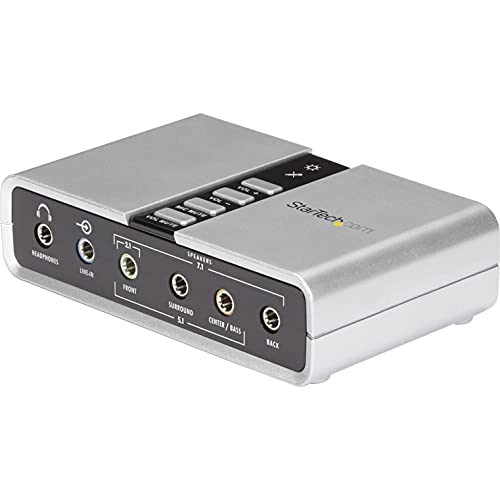
Best for: Desktop or laptop users who need multi-channel output and basic SPDIF passthrough. This bus-powered device supports 7.1, 5.1, and 2-channel outputs via 3.5mm jacks, plus a headphone port, line-in, and stereo mic input. It’s a solid upgrade for existing computer audio when you want more channels without internal cards.
- 7.1 channel output via USB
- Analog and digital stereo to 7.1 support
- 44.1/48 kHz playback; SPDIF passthrough at 48 kHz
Best for: Users seeking an easy upgrade to surround sound for music production on a budget. Limitation: SPDIF is limited to 48 kHz for digital output, which may not satisfy high-resolution digital workflows.
SABRENT USB External Stereo Sound Card AU-MMSA

Best for: Musicians or editors who want plug-and-play simplicity on Windows, Mac, or Linux. This device uses a driverless setup and is recognized as a standard USB audio device, with separate green (output) and pink (input) jacks for stereo sound and mono mic.
- Two jacks: stereo out and mono mic
- Plug-and-play across major OSes
- Does not support combined 4-pole headsets or powered passive speakers
Best for: Quick, reliable routing for basic recording and playback. Limitation: It does not deliver surround sound or high-end multi-channel capability.
CableCreation USB Audio Adapter

Best for: Users needing a practical 3.5mm audio jack addition and microphone input, with stable 44.1/48 kHz playback and recording. Ideal for replacing a faulty sound card or adding a simple audio splitter for input and output.
- 3.5mm audio ports; TRRS support for mic
- Supports 44.1KHz/48KHz, 16/24-bit
- Notes: EarPods may not support mic input; not ideal for car systems
Best for: Budget-conscious setups that require a compact external sound solution. Limitation: May not handle high-end professional demands or complex headset configurations.
HUANGENG USB External Sound Card

Best for: Audiophiles and home theater enthusiasts who want 5.1/7.1 channel support via a robust aluminum chassis. It emphasizes multi-channel playback and broad OS compatibility without needing internal modifications.
- Aluminum alloy body for shielding
- True 5.1/7.1 channel support via USB
- Supports 48 kHz sampling for multi-channel playback
Best for: Users seeking durable construction and cinema-like sound from an external USB card. Limitation: Product description notes broad OS compatibility but does not specify detailed driver requirements for every system.
Cubilux 7.1 USB Surround Sound Card

Best for: Gamers and hi-fi listeners who want high-fidelity 7.1/5.1 surround and Hi-Res music playback. It supports up to 384 kHz/24-bit for headphone output and 48 kHz for 7.1 surround.
- 7.1 surround with line-in and mic inputs
- Hi-Res playback up to 384 kHz/24-bit for headphones
- Full aluminum housing for signal integrity
Best for: Choose this if you need a durable external card with high-res music support. Limitation: 7.1 surround may require compatible software and careful routing on some systems.
Buying Guide
How to choose the right external sound card for music production
- Channel needs: If you require multi-channel monitoring (7.1/5.1), prioritize models like StarTech ICUSBAUDIO7D, Cubilux, or HUANGENG. For simple stereo work, AU-MMSA or CableCreation are often enough.
- Connectivity and compatibility: Check USB-A vs USB-C, and driver requirements. Driverless options offer broad compatibility, while some devices emphasize driver support for precise latency control.
- Sampling rate and bit depth: Higher rates (44.1/48 kHz, up to 384 kHz in hi-res units) improve fidelity for music production. Ensure the device supports your DAW and audio interface expectations.
- Build and shielding: Aluminum housings and good shielding help minimize interference in busy studio environments or near other electronic gear.
- Input/output versatility: Look for separate mic and headphone jacks, line-in options, and SPDIF if you need digital routing or integration with other gear.
- Ease of use: Driverless, plug-and-play devices reduce setup time, which is valuable for quick sessions and portable studios.
FAQ
- What is an external sound card for music production best used for? It provides additional or upgraded audio inputs and outputs, often with multi-channel support, improved latency, and portability for home studios and on-the-go use.
- Do I need a driver for these devices? Some are driverless and install automatically, while others may require generic drivers or minimal software for advanced features. Check compatibility with your OS and DAW.
- Can these replace a computer’s built-in sound card? Yes, they can route audio independently and can significantly improve monitoring and recording quality for production tasks.
- Is 7.1 surround essential for music production? Not always. Surround is beneficial for video scoring or immersive media work. For typical music production, stereo or 5.1 may be sufficient.
- Are USB-C options better than USB-A? USB-C offers modern compatibility and easier integration with newer laptops, but both interfaces can deliver high-quality audio when supported by the device.
- What should I consider for portability? Look for compact, bus-powered devices with robust build quality and minimal driver requirements for on-the-road sessions.