
The best female XLR to mini jack cable depends on whether you need an unbalanced connection or a cable wired for a balanced XLR signal. The Cable Matters cable is suited to camera and computer connections where unbalanced output is appropriate; the Tisino and JOMLEY options offer different balanced or unbalanced wiring choices. Check your microphone’s power requirements and the input device before choosing.
| Product | Best For | Connection Type |
|---|---|---|
| Cable Matters 6ft | More reach and camera or computer mic inputs | Unbalanced |
| JOMLEY 3.3ft Unbalanced | Short camera or computer connections | Unbalanced |
| JOMLEY 1ft Balanced Adapter | Short balanced-wired connection | Balanced wiring |
| Tisino 1ft Balanced Adapter | Balanced mono signal into stereo input | Balanced wiring |
| Tisino XLR to 1/4-inch | Quarter-inch input—not a mini jack | Balanced 1/4-inch TRS |
Cable Matters Unbalanced 3.5mm to XLR Cable
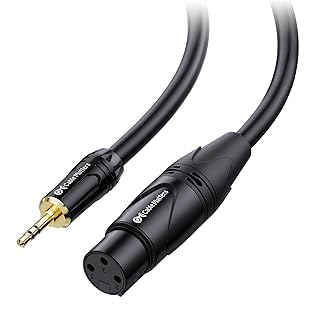
This 6-foot cable has a 3.5mm mini plug and a female XLR connector. It is designed to connect a professional microphone to a camera, DSLR, or computer sound card with a 3.5mm microphone input. The manufacturer describes the connection as unbalanced and notes that the 3.5mm plug has a stepped-down design for recessed camera microphone ports.
Best for: Buyers who need extra cable length and an unbalanced connection to a camera or computer mic input. It is a practical choice when the receiving device has a standard mini-jack microphone input and the microphone setup suits this cable’s wiring.
- Oxygen-free copper conductors and braided copper shielding are specified.
- The listing describes dual-mono output across the phone-jack input.
- The cable is 6 feet long.
Limitation: This is not a universal adapter. Confirm the camera or computer input and microphone requirements; the listing specifically describes it as unbalanced.
JOMLEY Unbalanced XLR Female Cable

This 3.3-foot cable connects a male 3.5mm plug to a regular-size female XLR connector. Its listed uses include connecting a microphone to a camera for interviews or to a computer mic input for podcast recording. The 3.5mm plug is described as recessed-port friendly. The product listing specifies a 20 AWG oxygen-free copper core, shielding, and gold-plated connectors.
Best for: Users who want a short, unbalanced cable for a nearby camera or computer. Choose it if its 3.3-foot length suits your recording setup and you need a regular XLR connector rather than mini XLR.
Limitation: The listing states that 48V condenser microphones require phantom power. This cable should not be treated as a phantom-power source, and the XLR connector is regular size, not mini XLR.
JOMLEY Balanced XLR Female Adapter

This 1-foot adapter has a female XLR connector and a 3.5mm mini-jack plug. The listing describes balanced wiring intended to connect a microphone or other XLR device to a 3.5mm input on equipment such as a DSLR, camcorder, voice recorder, smartphone, laptop, or computer. It also specifies a 20 AWG oxygen-free copper core with shielding and a zinc-alloy XLR housing.
Best for: Buyers looking for a compact adapter with balanced XLR wiring. It may suit a short connection from an XLR source to a compatible mini-jack input, provided the wiring and input behavior match the recording equipment.
Limitation: A cable described as balanced does not make an unbalanced 3.5mm input balanced. Check the device’s input design and the cable pinout before relying on it for noise reduction or a particular channel arrangement.
Tisino Balanced XLR Female to 3.5mm Cable

This 1-foot cable connects a male-XLR microphone to a device with a mini-jack port. Tisino states that the cable carries a balanced mono signal into an unbalanced stereo input; the tip and ring connect to XLR pins 2 and 3. The listing says it is not an unbalanced mono cable or a stereo cable. Its construction includes 20 AWG oxygen-free copper and shielding.
Best for: Buyers who need a short cable and understand the difference between a balanced mono signal and stereo audio. Its explicit wiring description helps shoppers compare it with cables that simply say “balanced.”
Limitation: The manufacturer says dynamic microphones can connect directly, while 48V condenser microphones need a 48V phantom-power connection. The cable itself should not be assumed to provide phantom power.
Tisino XLR Female to 1/4-Inch Cable

This Tisino cable is included as a connector-check comparison, not as a female XLR to mini-jack choice. It connects female XLR to a balanced 1/4-inch TRS plug and is described for balanced audio equipment, including active speakers and stage or studio signal paths. Listed construction details include a 20 AWG oxygen-free copper core, gold-plated connections, an aluminum-alloy housing, and multiple shielding layers.
Best for: Buyers whose equipment has a balanced 1/4-inch TRS input. Its XLR-to-quarter-inch connector type can be useful in a studio or speaker connection where that larger jack is required.
Limitation: It does not terminate in a 3.5mm mini jack. Do not choose it for a camera, laptop, or recorder that requires a mini-jack connection unless you have separately confirmed an appropriate conversion solution.
Buying Guide: How to Choose an XLR Female to Mini Jack Cable
Is your device’s input really a 3.5mm mini jack?
Check the input on the camera, recorder, computer, or other receiving device before ordering. A 3.5mm mini jack is smaller than a 1/4-inch jack, and the two plugs are not interchangeable. Also check whether the port is a microphone input, a headphone output, or a combined headset jack. A cable can fit physically but still be unsuitable for the port’s intended signal.
Confirm that the XLR connector is regular size. The four mini-jack cables above use a regular female XLR connector, according to their listings. They are not mini-XLR cables. This distinction matters because the connector sizes and equipment applications differ.
Should you choose balanced or unbalanced wiring?
Do not select a cable based only on the word “balanced.” The Cable Matters and JOMLEY 3.3-foot products are described as unbalanced. The other JOMLEY adapter and Tisino mini-jack cable are described as balanced, but their wiring and signal descriptions are not identical. In particular, Tisino specifies balanced mono into an unbalanced stereo input.
For the right choice, compare the cable’s stated wiring with both devices’ connection requirements. A balanced XLR output and an unbalanced camera input may need a specific wiring arrangement. The cable’s label alone does not change the input circuitry or guarantee a noise-free connection.
Will the cable power a condenser microphone?
A passive cable does not automatically supply phantom power. The JOMLEY unbalanced listing and Tisino balanced listing both warn that 48V condenser microphones need phantom power. Verify whether the microphone requires phantom power and whether an appropriate powered device or separate power source is part of your setup.
Dynamic microphones and powered microphones can have different connection needs. Read the microphone and recording-device instructions, then match those requirements to the cable’s stated wiring. If the setup involves phantom power, do not assume it will pass correctly through a cable just because the connectors fit.
How much cable length do you need?
Choose a length that reaches comfortably without leaving unnecessary excess. The Cable Matters option is 6 feet, the unbalanced JOMLEY cable is 3.3 feet, and the two balanced mini-jack adapters are 1 foot. A shorter lead may suit a compact camera rig, while additional length can help when a microphone and recorder are farther apart.
Longer cable is not automatically better for every portable setup. Consider how the cable will be routed and whether connectors will be under strain. Keep the plug and port type, signal wiring, and microphone power requirements as the primary selection criteria.
What should you check before ordering?
- Confirm the receiving device has a 3.5mm microphone input, not a 1/4-inch input or headphone-only port.
- Confirm the cable’s XLR connector is regular size and matches the microphone’s XLR plug.
- Compare balanced or unbalanced wiring with the requirements of both devices.
- Check whether a condenser microphone needs 48V phantom power and how that power will be supplied.
- Choose an appropriate length for the distance between the microphone and recording device.
Frequently Asked Questions
What does female XLR to mini jack mean?
It describes a cable with a female XLR connector on one end and a 3.5mm mini-jack plug on the other. Confirm that the XLR connector is regular size and that the mini-jack end matches the device’s input.
Can I connect an XLR microphone directly to a camera?
You can use a suitable XLR-female-to-3.5mm cable when the camera has a compatible 3.5mm microphone input and the cable wiring matches the microphone and camera. Some microphones also require separate power.
Does a 3.5mm-to-XLR cable provide phantom power?
Do not assume it does. The listed cables are connection cables, and the product descriptions do not identify them as phantom-power supplies. Check the microphone’s power requirements and the equipment providing power.
Is a balanced cable the same as a stereo cable?
No. Balanced audio is a signal-wiring method, while stereo carries separate left and right audio channels. The Tisino listing specifically says its cable carries balanced mono into an unbalanced stereo input and is not a stereo cable.
Can I use an XLR-to-1/4-inch cable for a mini-jack input?
Not as a direct connection. A 1/4-inch plug is larger than a 3.5mm mini jack. Choose a cable with the connector your device requires and verify the signal wiring before connecting equipment.