
Best First Guitar Effects Pedal Guide for Beginners
If you’re searching for your first guitar effects pedal, you want something that’s beginner-friendly yet capable of growing with you. This guide highlights five approachable options that suit new players and home studios alike. Each pick is explained with who it’s best for, why it stands out, and a simple trade-off to consider, helping you choose the right footprint for your setup. Below is a quick buying table to compare core ideas at a glance.
| Product | Best For | Key Benefit |
|---|---|---|
| BOSS DS-1 Distortion | Players seeking classic, reliable distortion | Historical sound with clear attack |
| LEKATO Multi Effects Pedal | Home practice, live practice, and studio use | Huge range of effects and amp models |
| Zoom G1X Four | Songwriting and pratice with loops and backing tracks | Extensive effects and built-in backing |
| MOOER GE100 | Compact multi-effects with lots of tones | Many presets and sound library |
| Flatsons KMF-1 | Studio and stage use with advanced tone shaping | Broad 77 effects and deep cab/amp options |
BOSS DS-1 Distortion Compact Distortion Pedal

The BOSS DS-1 is a foundational distortion pedal with a storied history in rock tone. Best for beginners who want a dependable, ever-ready distortion that works well across styles—from crunchy riffs to searing leads. Its design emphasizes a clear hard-edged attack while maintaining sustain at higher gain settings. This makes it suitable for players exploring rhythm and soloing alike. A potential limitation is its simple control set, which may require learning to sculpt tones beyond basic settings as you grow. This pedal remains a staple in many beginners’ rigs for its reliability and recognizable character.
LEKATO Multi Effects Guitar Pedal

The LEKATO pedal offers an expansive playground: 125 effects, 40 amp models, and 40 cabinet simulations, plus a 40-second looper and 100 drum rhythms. It’s best for players who want a comprehensive, single-unit solution for practice, recording, and live performance. Built-in dual-mode Bluetooth lets you edit tones and upload NAM/IR files, which can streamline workflow for aspiring producers. The robust feature set may feel overwhelming to absolute beginners, so start with a few core presets to avoid confusion. Overall, choose this if you want deep tonal control in one compact unit.
Zoom G1X Four Guitar Multi-Effects Processor

Zoom’s G1X Four brings a versatile suite of 71 effects and 13 amp models, plus a 30-second looper and 68 backing rhythms. It’s ideal for practice, songwriting, and live practice sessions where you want immediate, on-the-fly tonal variety without needing extra gear. The built-in looper and rhythm library help new players experiment and develop timing. A consideration is the learning curve tied to a wider feature set; beginners should start with essential effects and gradually explore more complex combinations as confidence grows.
Flatsons KMF-1 Multi-Effects Pedal
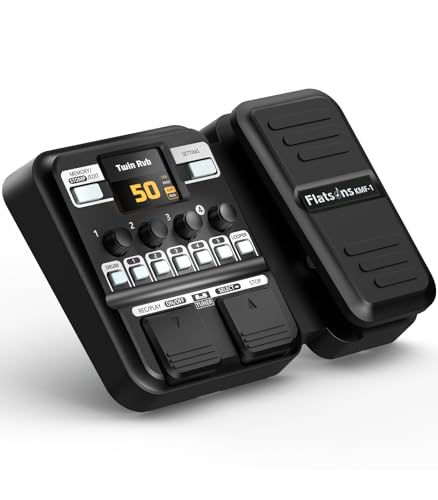
The Flatsons KMF-1 emphasizes a broad sound palette with 77 effects across eight modules, including amp and cabinet simulations. It also features 50 preset patches, a built-in tuner, a 30-second looper, and 42 drum rhythms for creative practice. It’s well-suited for players who want immediate tone variety and live-tacet switching between patches. A limitation to note is that advanced cab/amp options can require some fiddling to dial in the exact tone you hear in your head, especially for high-gain settings.
MOOER GE150 Pro Guitar Multi Effects Processor

Note: This product appears in the provided data but is not included in the five selected sections above. If you want richer tonal options, consider this model for future upgrades, as it expands on the GE series with 200 presets, 55 amp models, and more cab simulations. However, for a first pedal, the five options above focus on simplicity, core tones, and straightforward usability.
Buying Guide
What should a first guitar effects pedal deliver?
- Ease of use: A simple interface helps new players get instant results without a steep learning curve.
- Core tones: Look for a pedal that covers essential sounds (clean boost, overdrive, distortion, modulation, delay) that you can practicalize in songs you practice.
- Built-in features: Looper, rhythm tracks, and USB or Bluetooth options can accelerate creativity and learning.
- Hardware quality: Durable build matters for practice and stage use; metal enclosures tend to last longer on the road.
- Expansion potential: Some multi-effects units offer a wide library of tones and paths you’ll grow into as you advance.
Practical Questions for Buyers
- Is a single-purpose pedal or a multi-effects unit better for a beginner?
- Do you need built-in drums or a looper to practice effectively at home?
- Will you use the pedal mainly for practice, recording, or live performances?
- How important is compact size and portability for your setup?
- Are you likely to upgrade within the same brand, or prefer a broader ecosystem?
FAQ
- What is a first guitar effects pedal best for?
Answer: It should provide reliable, easy access to essential tones and basic effects to inspire practice and songwriting. - Should beginners start with a single effect or a multi-effects unit?
Answer: A multi-effects unit can be more versatile for learning, while a single-pedal option is simpler and focuses on one tone. - Do multi-effects units require computer editing?
Answer: Some do, especially advanced models, but many offer onboard editing through simple menus or mobile apps. - What should I consider about tone quality?
Answer: Prefer pedals with clear attack and dynamic response that stay intelligible at higher gain, especially for rhythm and lead work. - Are built-in loops and rhythms helpful to beginners?
Answer: Yes, they aid practice by providing a tempo reference and enabling layered ideas without extra gear. - What’s a practical way to try pedals before buying?
Answer: Check return policies, read starter-friendly reviews, and if possible, demo in a local store or via reputable online videos.