
The best speakers for a German car depend on the factory opening, mounting depth, wiring, and the sound you want—not the vehicle’s country of origin. These five options include common 6.5-inch replacements, a 6×9-inch upgrade, and smaller speakers for compact openings. The Pioneer TS-F1634R is best for a straightforward 6.5-inch coaxial replacement, while the Kenwood KFC-1666S emphasizes included grilles and specified woofer and tweeter materials. Check your vehicle’s fitment before choosing: speaker size alone does not confirm compatibility.
| Product | Best For | Size | Key Detail |
|---|---|---|---|
| Pioneer TS-F1634R | Common 6.5-inch opening | 6.5 inches | Two-way, 25W nominal |
| Kenwood KFC-1666S | Specified woofer and tweeter construction | 6.5 inches | Grilles included |
| BOSS CH6530 | Buyers checking mounting dimensions | 6.5 inches | 5.5-inch mounting hole |
| NVX XSP692 | Vehicles with 6×9-inch openings | 6×9 inches | 300W RMS per listed description |
| Pioneer TS-F1035R | Compact 4-inch speaker openings | 4 inches | Two-way, 20W nominal |
Pioneer TS-F1634R 6.5-Inch Coaxial Speakers

Best for: Drivers whose German car has a verified 6.5-inch speaker opening and who want a simple two-way coaxial design. A coaxial speaker combines a woofer and tweeter in one assembly, which can make it a practical replacement format when the vehicle’s original speaker layout supports it.
The listed specifications are 200 watts maximum, 25 watts nominal, 4-ohm impedance, and 88dB sensitivity. For choosing an amplifier or head unit, the nominal power figure is more useful than the maximum figure. Compare that rating with the output of the audio system you plan to use.
Why it was selected: Its 6.5-inch size is a common replacement category, and the listing provides both nominal power and sensitivity for comparison. Limitation: The provided information does not give mounting depth or confirm fitment in any specific German car. Measure the opening and check the vehicle’s speaker requirements before purchase.
Kenwood KFC-1666S 6.5-Inch Two-Way Speakers

Best for: Buyers looking for a 6.5-inch two-way speaker with stated woofer and tweeter materials. Kenwood lists a polypropylene woofer with a treated cloth surround and a 1-inch PEI balanced dome tweeter. The product description associates these components with bass response and detailed high frequencies.
The listing also says grilles are included. That can be useful when the installation calls for protective speaker covers, but it does not establish that the grilles will match a particular factory trim panel. Confirm the dimensions and installation arrangement for the vehicle.
Why it was selected: It offers a direct comparison with other 6.5-inch choices while providing more detail about speaker construction and included grilles. Limitation: The supplied product information does not state nominal power handling, impedance, or mounting depth. Check those details and verify fit before pairing it with an existing audio system.
BOSS Audio CH6530 6.5-Inch Three-Way Speakers

Best for: Buyers who want specified mounting measurements to compare with their car’s speaker opening. The listing gives dimensions of 6.6 by 6.6 by 2.4 inches, a 2.1-inch mounting depth, a 5.5-inch mounting hole, and 4-ohm impedance. It identifies the model as a three-way speaker and lists 300 watts per pair.
Those measurements make this option easier to screen for physical fit than products whose supplied details omit mounting dimensions. Still, a matching nominal speaker size does not guarantee a match with the factory bracket, connector, or trim.
Why it was selected: It provides several practical fitment figures and a 4-ohm impedance specification, both useful when comparing replacement candidates. Limitation: The provided data does not separate continuous and peak power handling. Do not treat the 300-watt-per-pair figure as a confirmed RMS rating; check the full specifications before selecting an amplifier.
NVX XSP692 6×9-Inch Two-Way Speakers
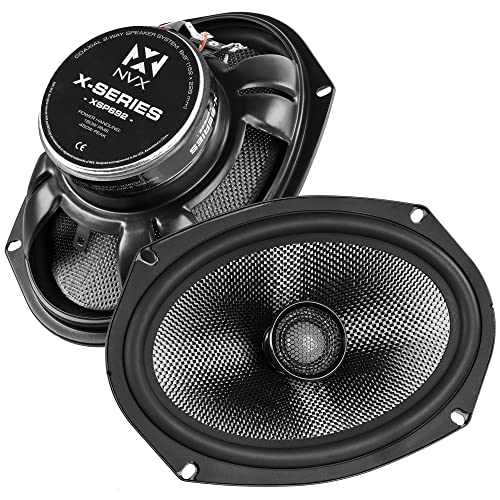
Best for: Drivers whose verified factory or aftermarket opening accepts 6×9-inch speakers. This is a different size class from the 6.5-inch models above, so it is not a direct substitute unless the vehicle has a suitable opening or adapter arrangement.
NVX lists 900 watts peak and 300 watts RMS, carbon fiber cones, rubber surrounds, and 1-inch silk dome German-made tweeters. The stated RMS figure is the more useful power-handling point when comparing with an amplifier. The listing describes the tweeters as German-made; that specification does not mean the complete speaker is designed specifically for German cars.
Why it was selected: It gives buyers with 6×9-inch locations a higher-RMS option and lists materials and tweeter details for comparison. Limitation: Its size may not suit a vehicle designed for 6.5-inch or smaller speakers. Confirm opening dimensions, mounting depth, and power requirements before choosing it.
Pioneer TS-F1035R 4-Inch Coaxial Speakers

Best for: Owners who have confirmed that their vehicle uses 4-inch speaker openings. These two-way coaxial speakers integrate a woofer and tweeter, making them a compact alternative to the larger 6.5-inch models in this guide.
Pioneer lists 150 watts maximum, 20 watts nominal, 4-ohm impedance, and 86dB sensitivity. The nominal power rating and impedance can help buyers compare the speaker with the car’s audio source. Its sensitivity rating is lower than the listed 88dB rating of the TS-F1634R, but that comparison alone does not determine overall sound quality.
Why it was selected: German cars do not all use the same speaker size, and this model gives compact-opening buyers a clearly specified option. Limitation: The 4-inch size is not interchangeable with a 6.5-inch opening. The supplied details do not state mounting depth, so verify both fit and clearance.
Buying Guide: How To Choose Speakers For A German Car
Which speaker size fits your car?
Start with the exact speaker position you plan to upgrade: front door, rear door, dashboard, or rear deck. A single car can use different sizes in different locations. Consult the owner’s manual, a vehicle-specific fitment reference, or the existing speaker’s measurements. Check the opening diameter, mounting depth, screw locations, and clearance behind the panel.
Do not assume that a 6.5-inch speaker fits every German car—or that every position in one vehicle uses the same size. A 4-inch or 6×9-inch model is appropriate only when the opening and mounting arrangement support it. An adapter may be needed in some installations, but confirm that separately for the specific vehicle.
Should you choose a two-way or three-way speaker?
Two-way coaxial speakers combine a woofer and tweeter in one unit. They are a straightforward format to consider when replacing a factory coaxial speaker. Three-way models add another driver or frequency range, but the product label alone does not show how a speaker will sound in a particular door or cabin.
For a vehicle with separate factory tweeters, compare the original system layout before buying coaxial replacements. Replacing one part of a component system with a coaxial speaker may not preserve the original arrangement. Check the car’s wiring and speaker configuration rather than relying on speaker size alone.
How should you compare power ratings?
Use RMS or nominal power handling for a more meaningful comparison with an amplifier or head unit. Peak and maximum figures describe short-duration or maximum conditions and are not directly comparable to continuous power ratings. In this group, the Pioneer listings provide nominal ratings, and NVX lists 300 watts RMS. The BOSS listing gives 300 watts per pair without identifying it as RMS in the supplied information.
Also check the audio source’s output and the speaker impedance. The Pioneer TS-F1634R, TS-F1035R, and BOSS CH6530 list 4-ohm impedance. The supplied feature details for the Kenwood do not state impedance, so verify it before matching that speaker with an amplifier.
What do sensitivity and speaker materials tell you?
Sensitivity is one comparison point for how efficiently a speaker converts input power into sound under the measurement conditions used. The Pioneer TS-F1634R lists 88dB, while the TS-F1035R lists 86dB. These figures can help narrow a choice, but do not establish which speaker will sound better in a particular car.
Materials can help identify construction differences. Kenwood specifies a polypropylene woofer and PEI dome tweeter; NVX lists carbon fiber cones, rubber surrounds, and silk dome tweeters. The product descriptions do not provide identical test conditions, so compare stated specifications without assuming material names alone guarantee a specific sound.
What should you verify before ordering?
- Vehicle and location: Confirm the exact speaker position and factory configuration.
- Dimensions: Check opening size, mounting depth, screw pattern, and clearance.
- Electrical match: Compare impedance and RMS or nominal power with the audio source or amplifier.
- Installation details: Check whether the vehicle needs adapters, wiring changes, or separate grilles.
- System layout: Determine whether the factory system uses coaxial speakers, separate tweeters, or an external amplifier.
For a conservative first comparison, choose a speaker that matches the verified size and electrical requirements before weighing extra features. A well-matched 6.5-inch model is not automatically a better choice than a 4-inch or 6×9-inch model if it does not fit the intended location.
Frequently Asked Questions
Are these speakers specifically made for German cars?
The supplied product details do not identify these models as vehicle-specific German-car speakers. They are general car speakers in several sizes. Confirm fitment for the exact make, model, year, and speaker location before buying.
Can I replace a 6.5-inch factory speaker with a 6×9-inch model?
Not as a direct size-for-size replacement. The 6×9-inch NVX model needs a compatible opening or an appropriate installation solution. Check mounting dimensions and available space before selecting it.
Does a higher maximum wattage mean a louder speaker?
Not by itself. Maximum and peak figures are not the same as RMS or nominal power, and loudness also depends on sensitivity, amplifier output, installation, and other system factors.
Which listed speaker includes grilles?
The Kenwood KFC-1666S listing says grilles are included. Check the grille dimensions and the vehicle’s trim arrangement to confirm they suit the installation.
What does 4-ohm impedance mean when choosing car speakers?
Impedance is an electrical specification that should be compared with the supported load of the head unit or amplifier. The listed Pioneer models and BOSS model specify 4 ohms; verify requirements for the audio equipment and any speaker whose supplied details omit impedance.
Can I install these speakers without an amplifier?
The product information does not establish whether a particular vehicle’s factory audio system will drive every model appropriately. Compare the speaker’s nominal or RMS rating and impedance with the system’s output, and verify the fitment and wiring requirements.