
Best Guitar Amp Bluetooth Transmitter Options for Clear Wireless Playing
Looking for a reliable guitar amp Bluetooth transmitter to free your playing from cables? This guide highlights five top options, explaining who they are best for, plus clear reasons to choose each. The selections cover different frequency bands (2.4GHz and 5.8GHz), latency levels, battery life, and compatibility with electric guitars and basses. Ideal buyers include home practice players, small-venue performers, and stage musicians seeking low-latency, high-fidelity wireless signals.
Summary of chosen products:
- JOYO JW-06: Best for compact practice spaces and small gigs, 5.8GHz with low latency.
- LEKATO WS-60: Best for stereo sound and longer practice sessions, versatile 2.4GHz option with multi-plug support.
- INGPARTNER A9: Best for quick setup and multi-instrument use, reliable 2.4GHz with low latency.
- A12 WENTELMUSIC: Best for home studios and rehearsals, straightforward plug-and-play 2.4GHz.
- JOYO JW-02S: Best for flexible tapping into 5.8GHz with solid battery life.
JOYO JW-06 5.8GHz Wireless System

Best for small live setups and home studios requiring minimal latency. The JW-06 uses 5.8GHz digital transmission delivering 48K/24-bit audio with latency under 6ms. It supports 18 hours of total battery life with an 18-hour runtime via a portable charging case. The system broadcasts 65–100 feet in open spaces, but performance may drop with walls or interference. This makes it ideal for practice rooms and small gigs where cable-free freedom matters but stage-wide interference is limited.
Who this is best for: players who value ultra-low-latency wireless signal and high-resolution audio in compact venues. Best for electric guitar and bass players who travel light and need reliable operation for rehearsals or worship services. Caution: performance can vary in cluttered environments; consider testing in your space before critical performances.
Key considerations:
– Latency under 6ms ensures responsive feel for live playing.
– Battery life supports long practice sessions with a charging case.
– Channel switching can help avoid nearby interference.
LEKATO 5.8GHz Wireless System
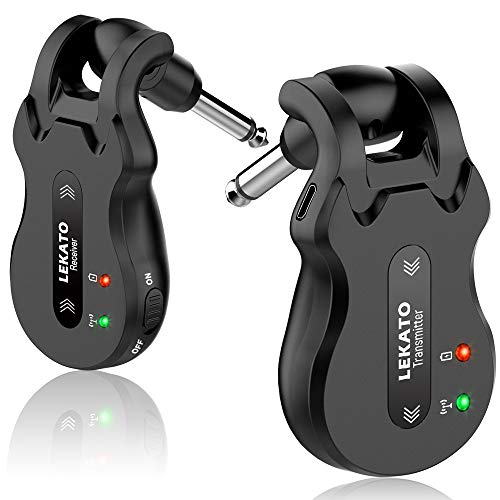
Best for stage use and precise audio capture with minimal interference. This model emphasizes a robust 5.8GHz signal for strong anti-interference performance, making it suitable for live performances and studio practice. It features 24-bit/48kHz audio and latency under 6ms, with a rechargeable battery offering up to around five hours of operation per charge. The 220° rotatable plug helps accommodate awkward jack orientations, helping fit most electric guitars and basses.
Who this is best for: players needing dependable performance in environments with potential wireless noise (e.g., venues with many devices). It’s a solid pick for performers who frequently switch guitars or play on crowded stages. Limitation: the system’s range is excellent in open space but performance can degrade behind walls or dense gear setups.
Key considerations:
– High anti-interference design helps in busy wireless landscapes.
– Rotatable plug provides flexible compatibility with various guitar body shapes.
– Battery life is solid for practice and short gigs; plan charging accordingly.
A9 Wireless Guitar System (2.4GHz)

Best for plug-and-play simplicity and multi-device versatility. The A9 uses a 2.4GHz band with less than 4 ms latency, delivering up to 100 feet open-area range. It emphasizes quick pairing and straightforward operation, making it advantageous for rehearsals, worship services, and home studios. Dual USB charging helps minimize downtime during busy practice schedules.
Who this is for: players seeking a simple, reliable setup that works well with multiple instruments and rapid setup. Choose this if you value an uncomplicated workflow and can operate in venues with moderate wireless congestion. Caution: performance may vary on large stages with heavy Wi-Fi interference; testing in your space is recommended.
Key considerations:
– One-button pairing simplifies setup for quick transitions.
– Suitable for multi-instrument configurations without complex syncing.
– Open-area range is strong but real-world results depend on environment.
A12 Wireless System 2.4GHz

Best for home studios and rehearsal spaces needing easy, dependable wireless guitar transmission. The A12 offers clear and stable 2.4GHz performance with low noise and low latency, supporting up to 30 meters (approximately 100 feet) in open areas. It features dual-head USB charging to power both transmitter and receiver simultaneously, simplifying charging and downtime between sessions.
Who this is for: players who prioritize straightforward operation and dependable daily use, particularly in home studios or small rehearsal rooms. Limitation: best results are in less congested spaces; heavy Wi-Fi or Bluetooth activity may impact performance.
Key considerations:
– Dual USB charging reduces downtime between uses.
– Simple plug-and-play pairing facilitates quick setup.
– Practical range is ideal for practice rooms and small venues.
JOYO JW-02S 5.8GHz System

Best for flexible stage and practice layouts with good battery life. The JW-02S uses 5.8GHz digital transmission to minimize interference from Wi-Fi and Bluetooth, delivering a clean, stable tone that preserves the instrument’s character. It provides 18 hours of total runtime with a six-hour per-charge expectation and features a rotatable plug to fit most jack configurations. It’s a strong option for electric guitar and bass players seeking dependable wireless sound for practice or small performances.
Who this is for: players who want a stable 5.8GHz system with extended battery life and flexible guitar compatibility. Caution: while suitable for small venues, it may not be ideal for large stages where heavy interference is present; test beforehand.
Buying Guide
What frequency should I choose?
5.8GHz systems typically offer stronger resistance to common wireless interference than 2.4GHz in busy environments, making them better for small gigs and rehearsal spaces with many devices. 2.4GHz systems are more widely compatible and can be sufficient for home practice and smaller rooms.
How important is latency?
Latency under 6 ms is generally imperceptible to most players, ensuring natural feel during playing. If you perform fast riffs or precise timing, prioritize models with low latency.
What about range and environment?
Open-area ranges around 65–100 feet are common. Real-world range drops with walls and gear present. Test in your space to confirm reliable signal across your typical playing area.
Battery life and charging options?
Longer battery life supports extended practice and gigs. Look for devices with a charging case or dual USB charging to minimize downtime between sessions.
Plug-in compatibility and setup
Rotatable plugs, multi-plug compatibility, and one-button pairing simplify setup, especially on crowded stages or with multiple guitars. Ensure the system supports both mono and stereo connections if you use stereo outputs or two amplifiers.
Which system should I choose?
– For ultra-low latency and compact setups: prefer 5.8GHz options like JW-06 or JW-02S.
– For studio-like practice with easy charging: consider A12 or A9 for quick plug-and-play and open-area reliability.
– For stereo capability and robust range in varied spaces: LEKATO WS-60 stands out with multiple plug types and strong audio quality.
Quick comparison table
| Product | Frequency | Latency | Battery Life | Best For |
|---|---|---|---|---|
| JOYO JW-06 | 5.8GHz | <6 ms | 18 hours (with case) | Small gigs, practice rooms |
| LEKATO WS-60 | 2.4GHz | <6 ms | 5+ hours | Studio, stage, stereo needs |
| INGPARTNER A9 | 2.4GHz | <4 ms | 4 hours | Quick setup, multi-instrument use |
| A12 WENTELMUSIC | 2.4GHz | <4 ms | Up to 6 hours | Home studios, rehearsals |
| JOYO JW-02S | 5.8GHz | <6 ms | 6 hours | Flexible stage layouts |
FAQ
Do these systems work with both electric and acoustic guitars?
Yes, many are designed to work with electric guitars and basses; some include adapters for acoustic-electric models. Check plug compatibility for your instrument.
Is there any noticeable audio delay?
Most listed models specify latency under 6 ms, which is generally not noticeable during normal playing. Real-world latency can vary with environment.
Can I pair multiple wireless systems at once?
Some models support multiple channels or devices simultaneously, but performance can vary. If you plan multi-instrument use, choose a system advertised for multi-channel operation.
What should I test before a live performance?
Test range across your practice area, ensure no dropouts between your guitar and amp, and confirm battery readiness for the duration of your set.