Best Guitar Amp Isolation Box Solutions for Clean Gear Tone
Direct answers for buyers seeking guitar amp isolation solutions. If you want to reduce ground-loop hum, shield your amp from nearby noise, or move your DI responsibilities off-stage, these products help isolate guitar amp sound and preserve signal integrity. The top picks below are best for home studios, small venues, and portable rigs. Each option targets hum reduction, impedance matching, or sound isolation to improve clarity in recordings and live mixes.
Summary table of selected products:
| Product | Best For | Key Benefit | URL |
|---|---|---|---|
| Pyle Compact Mini Hum Eliminator Box | Small setups needing passive noise filtering | Ground loop hum elimination without power | Amazon |
| Pyle Premium Direct Injection Audio Box | Direct boxes for live or studio apps | Buzz and hum cancellation with impedance transformation | Amazon |
| PYLE-PRO Premium DI Box | Balanced DI for guitars/bass to PA | Clean audio with impedance matching | Amazon |
| JCANOL PD200 Passive DI Box | Studio & live DI with ground lift | Balanced XLR output from unbalanced sources | Amazon |
| Bolanle Passive 1-Channel DI Box | Ground loop reduction & re-amping | Hum eliminator with attenuation options | Amazon |
Pyle Compact Mini Hum Eliminator Box — 2 Channel Passive Ground Loop Isolator

The Pyle Hum Eliminator is a passive two-channel device designed to remove 60Hz AC hum caused by ground loops. It helps prevent hum from entering signal lines by breaking the ground loop safely. Best for small rigs or home studios where a simple, power-free hum filter is preferred. Limitations include relying on the presence of a ground loop and fixed two-channel configuration.
Who it’s best for: Solo performers, small practice spaces, or studios needing a compact, travel-ready hum filter without wiring changes.
Pyle Premium Direct Injection Audio Box

This passive DI box provides a ¼ inch device connector and detachable AC power cord for live sound and recording. It is designed to connect instruments (guitars, keyboards) to main PA or recording mixers and offers buzz and hum cancellation with impedance transformation. Best for on-stage or studio use where clean conversion from unbalanced to balanced signals is needed.
Who it’s best for: Musicians and engineers needing a straightforward DI solution to preserve signal integrity in live or studio contexts.
PYLE-PRO Premium Direct Injection Audio Box
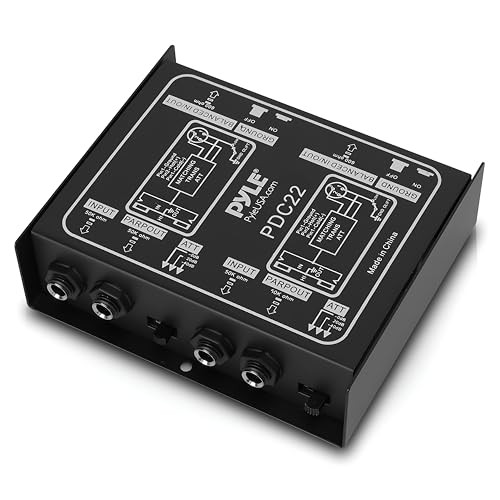
This DI box emphasizes clean audio with buzz and hum cancellation, connecting instruments to a PA or recording mixer. It uses a ¼” device connector and detaches a power cord for flexible live use. Best for performers who need reliable impedance transformation and quiet signal paths with minimal setup.
Who it’s best for: Live performers and studio engineers seeking a durable, cost-effective DI solution for guitars, keyboards, or other instruments.
JCANOL PD200 Stereo Passive DI Box

The JCANOL PD200 is a compact passive DI box with a ground lift option and an input attenuator. It converts unbalanced instrument signals to balanced XLR outputs suitable for studio or live use. Best for small to mid-size setups where impedance matching and clean, balanced outputs matter most.
Who it’s best for: Engineers and musicians needing a compact DI with ground-lift features to minimize hum on stage or in the studio.
Bolanle Passive 1-Channel DI Box

The Bolanle passive DI box offers high-fidelity signal conversion for guitar, bass, and synths without requiring a power supply. It includes a built-in hum eliminator and a dual-mode signal attenuation option. Best for musicians who want a straightforward, power-free DI with practical attenuation for stage control.
Who it’s best for: Players and engineers seeking a simple, reliable DI with effective hum reduction in live or studio workflows.
Buying Guide
What to consider when choosing a guitar amp isolation or DI solution:
- Purpose: Are you eliminating hum, matching impedance, or isolating a loud amp from a recording chain?
- Power needs: Passive DI boxes do not require power, while some isolation devices may rely on external supplies.
- Number of channels: Do you need one-channel or two-channel solutions to fit your rig?
- Signal path: Look for impedance transformation and balanced XLR outputs for clean long runs.
- Portability: If you travel or perform unplugged gigs, a compact design helps.
- Compatibility: Ensure connectors match your instrument (guitar, bass, keyboards) and destination (PA, audio interface, mixer).
What is an isolation device versus a direct box?
Isolation devices like amp shields or housing panels physically separate the amp from other sound sources, reducing bleed. Direct boxes (DI boxes) convert instrument signals to balanced lines, improving noise rejection and enabling safer long cable runs.
How do ground loops affect guitar tone?
Ground loops create AC hum and buzz that can be picked up by signal cables. Ground loop isolators or DI boxes with grounding options break or lift unwanted connections, potentially improving clarity in the final mix.
Best practices for using these tools
Use DI boxes for direct-to-PA or recording paths, especially when long cable runs are necessary. Pair passive DI with proper grounding and avoid stacking devices that introduce extra noise. For live amp isolation in small spaces, combine an angled shield panel with a DI box to minimize bleed and maintain stage volume control.
Product quick-compare
- Best for passive, no-power hum filtering: Pyle Compact Mini Hum Eliminator Box.
- Better for flexible DI needs with impedance transformation: Pyle Premium DI Box and PYLE-PRO Premium DI Box.
- A compact, studio-friendly option with ground-lift: JCANOL PD200.
- Budget-friendly single-channel DI with hum reduction: Bolanle DI Box.
FAQ
- Q: Do I need a DI box if I only play through an amp?
- A: If you route your instrument to a PA or recording interface, a DI box helps preserve tone and reduce noise on longer cables.
- Q: Can a ground loop eliminator fix all hum?
- A: It can reduce or eliminate hum caused by ground loops, but other interference sources may require additional measures.
- Q: Are passive DI boxes sufficient for all instruments?
- A: For most guitars and basses, passive DI boxes work well; active DI boxes may be needed for low-output sources or high channel counts.
- Q: What should I look for in a DI box for live use?
- A: Look for impedance matching, robust connectors, a ground lift option, and a compact, reliable housing.