
For Drop C tuning, heavier electric guitar strings generally help keep the lower notes controlled and the feel consistent. The Jim Dunlop 11–56 set is the closest match to a dedicated Drop C set, while D’Addario NYXL 12–60 is a heavier option for players who want more tension. Ernie Ball Beefy Slinky 11–54 and Jim Dunlop Heavy Core 11–50 offer alternative gauges, but the Zager set is designed for acoustic guitar and is not a direct choice for electric Drop C.
| Product | Best suited for | Listed gauge or type |
|---|---|---|
| Jim Dunlop Nickel Wound Drop C | A direct Drop C set with a 56-gauge low string | 11–56 |
| D’Addario NYXL | Players who want a heavier set and tuning-stability features | 12–60 |
| Ernie Ball Beefy Slinky | Players comparing an 11–54 set | 11–54 |
| Jim Dunlop Heavy Core | Players seeking strings described for lowered tunings | 11–50 |
| Zager Easy Play Acoustic | Acoustic players prioritizing a softer feel | Gauge not provided |
Jim Dunlop Nickel Wound Drop C Strings

Best for: Electric guitar players looking for a set explicitly presented for Drop C, with an 11–56 gauge range. The low string’s listed 56 gauge makes this the most direct match among the supplied products for players who want a dedicated Drop C option.
Jim Dunlop describes the set as designed for a modern playing experience. Its listed features include consistent volume, with notes intended to ring out with equal power and clarity, and comfortable tension intended to support playability. Those features may appeal to players who want a substantial low string without moving to the heaviest gauge in this comparison.
Why it was selected: The product name specifically identifies Drop C, and its 11–56 range provides a clear reference point for comparing string thickness. It is a practical starting option for a player who wants to try heavier strings for a lowered tuning.
Limitation: A string set alone cannot guarantee ideal tension or intonation on every guitar. The product information does not provide instrument-specific setup guidance, so a setup adjustment may be needed after changing gauges or tuning.
D’Addario NYXL 12–60 Strings

Best for: Electric players who want a heavier 12–60 set and value the product’s stated strength and tuning-stability features. Compared with the 11–56 Dunlop set, this is the heavier listed option and may suit players who prefer more substantial strings under the fingers.
D’Addario identifies NYXL as a premium, uncoated electric string with a nickel-plated steel wrap wire and NY Steel core wire. The product description says the strings provide enhanced midrange and a frequency response in the 1–3.5 kHz range intended to add presence and crunch. It also states that the strings stay in tune 131% better than standard strings and are up to 40% stronger. These are manufacturer claims, not a guarantee of results on every guitar.
Why it was selected: The 12–60 gauge offers a clear heavier alternative for Drop C players comparing tension and low-string thickness. Its listed design features also make it relevant to players seeking durability and tuning stability.
Limitation: The heavier gauge may feel less flexible than lighter options. Players moving from a lighter set should consider whether they are comfortable with the change and whether their guitar needs a setup adjustment.
Ernie Ball Beefy Slinky 11–54 Strings

Best for: Players comparing an 11–54 nickel-wound electric set with the heavier 11–56 and 12–60 options. The product name identifies the gauge and construction, making it useful for shoppers who already know they want an 11-gauge high string and a 54-gauge low string.
This set is listed as nickel wound and intended for electric guitar. The 11–54 range places it between the 11–50 Jim Dunlop Heavy Core and 11–56 Jim Dunlop Drop C set by the overall gauge endpoints given in the product names. Those numbers help with a first-pass comparison, although the complete string-by-string gauges are not included in the supplied product information.
Why it was selected: The set gives Drop C players another familiar gauge reference instead of limiting the comparison to strings explicitly marketed for lowered tunings. It may be a better option for someone seeking a middle ground between 11–50 and 11–56.
Limitation: The provided listing information does not state Drop C-specific design features or performance claims. Choose it based on its listed gauge and electric-guitar type, not on an assumption that it is a dedicated Drop C set.
Jim Dunlop Heavy Core 11–50 Strings
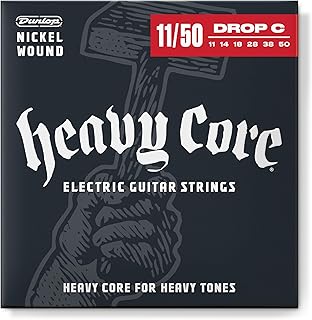
Best for: Electric players interested in a set described as designed for dropped and lowered tunings, but who prefer the lighter 11–50 range listed in the product name. The manufacturer’s stated focus on dropped tunings makes it relevant to Drop C, even though the listed low-string gauge is lighter than the 11–56 and 12–60 alternatives here.
Jim Dunlop lists quick attack and a defined low end among the set’s features. Those descriptions may interest players who want a responsive feel and clarity from lower notes. Because Drop C lowers the sixth string below standard tuning, comparing the low-string gauge and the player’s preferred tension is especially important.
Why it was selected: It is one of the few products in this group explicitly described for dropped and lowered tunings. It offers a lower-gauge comparison for players who do not want to jump straight to a 56- or 60-gauge low string.
Limitation: Its 11–50 range is lighter than the other listed electric options with 54-, 56-, or 60-gauge endpoints. Players seeking a firmer low string in Drop C may prefer to compare those heavier sets as well.
Zager Easy Play Acoustic Guitar Strings

Best for: Acoustic guitar players who prioritize a softer feel and reduced finger pressure, rather than electric players seeking a specified Drop C gauge. The product description says the strings use a soft-metal core and ultra-smooth coating to reduce the pressure needed to fret notes. It also identifies players with finger soreness, arthritis, or hand fatigue as potential users.
Zager lists compatibility with several acoustic guitar brands in the product name and describes the strings as anti-rust with a warm, rich tone. Its comfort-focused features make it a different kind of option from the four electric sets above. The supplied information does not state a gauge, so it cannot be compared directly with the 11–50 through 12–60 electric sets.
Why it was selected: It is included as a clear distinction for shoppers who may be tuning an acoustic guitar rather than an electric. It is not the best match for a typical electric Drop C string search, but its stated comfort features may matter to acoustic players.
Limitation: This is identified as an acoustic guitar string set, and no gauge is provided in the supplied details. Do not treat it as a direct substitute for a specified-gauge electric Drop C set.
Buying Guide: How To Choose Strings For Drop C
What gauge is a good starting point for Drop C?
There is no single gauge that suits every guitar and player. The options here range from 11–50 to 12–60, with 11–56 and 11–54 sets between them. A heavier low string can feel firmer when tuned down, while a lighter set may feel easier to bend. Use those ranges as comparison points, not as a universal prescription.
Scale length, playing style, preferred tension, and the guitar’s setup all affect how a set feels. The product information provided here does not include full string-by-string gauges for every set, so check the package or current product details before ordering if individual string sizes matter to you.
Should I choose a set labeled for Drop C or lowered tunings?
A set specifically labeled for Drop C, such as the Jim Dunlop 11–56 option, is a straightforward place to start. The Jim Dunlop Heavy Core set is described for dropped and lowered tunings. These descriptions make the sets especially relevant, but they do not confirm that either will feel ideal on every guitar.
Other sets can still be compared by gauge. The Ernie Ball 11–54 and D’Addario 12–60 listings provide useful alternatives, but their supplied details do not identify them as Drop C-specific products. Consider the listed gauge and the manufacturer’s stated features rather than assuming that every heavier set is optimized for this tuning.
How should I compare the low string?
In Drop C, the sixth string is tuned lower than it is in standard tuning. Players often focus on that string because they want the low notes to feel controlled and sound clear. Compare the low-string gauge, but remember that the overall gauge range does not tell the whole story: two sets with similar endpoints may have different gauges for the strings in between.
If you are unsure, changing one variable at a time can help. Start with a set close to your current preference, tune the guitar, and assess the feel. If the strings feel too loose or too stiff, consider another gauge at the next string change.
Will a gauge change require a guitar setup?
It may. A change in string gauge or tuning can affect the way a guitar feels and plays. The supplied product details do not specify setup requirements for individual instruments, so there is no universal adjustment that can be recommended for these sets. If the guitar develops tuning, intonation, or playability issues after a change, consult a qualified technician or use the instrument maker’s setup guidance.
Do electric and acoustic strings work interchangeably?
No. These products are not all the same type. Four options are listed as electric guitar strings, while the Zager set is identified as acoustic. Choose strings made for the kind of guitar you play, and confirm the gauge and construction before purchase. The Zager set’s comfort features do not make it a direct electric Drop C alternative.
Which option is better for a lighter or heavier feel?
Among the listed electric sets, the 11–50 Jim Dunlop Heavy Core has the lowest gauge endpoint, while the 12–60 D’Addario NYXL has the highest. The Ernie Ball 11–54 and Jim Dunlop 11–56 sets sit between those endpoints. These numbers offer a useful broad comparison, but actual feel also depends on the guitar and the complete gauge distribution.
Frequently Asked Questions
Can I use regular electric guitar strings for Drop C?
Yes, but a set selected for standard tuning may feel looser when tuned down. Compare gauges and choose based on the tension and flexibility you prefer. A set labeled for Drop C or lowered tunings can be a convenient starting point.
Are heavier strings always better for Drop C?
No. Heavier strings can provide a firmer feel, but they may also feel less flexible. The best choice depends on the guitar, the player’s preferences, and whether the instrument is properly set up for the selected gauge and tuning.
Which product here is specifically identified for Drop C?
The Jim Dunlop Nickel Wound Electric Guitar Strings 11–56 product is named for Drop C. The Jim Dunlop Heavy Core 11–50 set is described as designed for dropped and lowered tunings, but its name does not specify Drop C.
Is the Zager set suitable for electric Drop C?
The supplied listing identifies Zager Easy Play as an acoustic guitar string set. It also does not provide a gauge, so it is not a direct choice for an electric guitar player comparing Drop C string gauges.
Do I need to change all six strings when changing to Drop C?
These products are sold as sets, but the supplied details do not provide instructions for tuning changes. Follow the guitar maker’s guidance and use a complete set appropriate for your instrument and preferred feel. A setup check may be useful when changing string gauge or tuning.