
A headphone amplifier is the better choice when several people need to listen to one source with separate volume controls. For a compact four-listener setup, consider the Mackie HM-4; for bass boost and 3.5 mm headphone support, the LZSIG four-channel model is a better fit. The LZSIG six-channel model serves larger groups, while the FIFINE N6 and Pyle PHA40 offer straightforward four-output monitoring options.
| Product | Best For | Outputs | Notable Feature |
|---|---|---|---|
| Mackie HM-4 | Compact four-person sessions | 4 | Individual level controls |
| LZSIG 4-Channel | Mixed headphone plug sizes | 4 | Bass boost and 3.5 mm support |
| FIFINE N6 | Studio and stage monitoring | 4 | Metal construction |
| Pyle PHA40 | Basic four-listener distribution | 4 | Independent output controls |
| LZSIG 6-Channel | Groups with up to six listeners | 6 | Supports 1/8-inch and 1/4-inch plugs |
Mackie HM-4 Headphone Amplifier

The Mackie HM-4 is a compact headphone amplifier for sharing one audio source with as many as four listeners. Its four independent outputs each have a level control, so listeners can adjust their own volume rather than relying on one shared setting.
Best for: Small recording sessions, shared listening, or other situations where four people need individual volume adjustment. It accepts a source with a 1/4-inch or 1/8-inch output, providing flexibility for different source connections.
Why it was selected: The listed features directly address the central need behind a headphone splitter and amplifier: distributing audio to multiple headphones while keeping level control separate for each listener.
Limitation: It has four outputs, so it is not the right choice if more than four people need to listen at once. Check the connection type on the source and headphones before choosing any required cables or adapters.
LZSIG Four-Channel Amp With Bass Boost
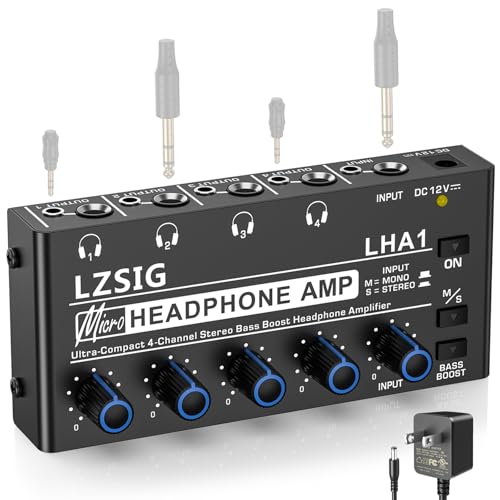
This LZSIG model provides four independently controlled headphone outputs and supports headphones with 3.5 mm or 6.35 mm plugs. The product information specifies support for up to four pairs of 32–100-ohm headphones and lists compatibility with audio sources that have 3.5 mm or 6.35 mm outputs.
Best for: Home studios or shared listening setups that use a mix of common headphone plug sizes. Choose this model if bass boost is a useful option: its switch increases the listed 400–600 Hz and 3000–7200 Hz frequency bands.
Why it was selected: It combines four individual volume controls with support for both 1/8-inch and 1/4-inch headphone connections. The listed 12V power supply and home-studio design also make its intended use clear.
Limitation: Bass boost changes the audio character, so it may not suit listeners who want an unaltered monitoring signal. Its capacity is limited to four headphone pairs.
FIFINE N6 Four-Channel Amplifier
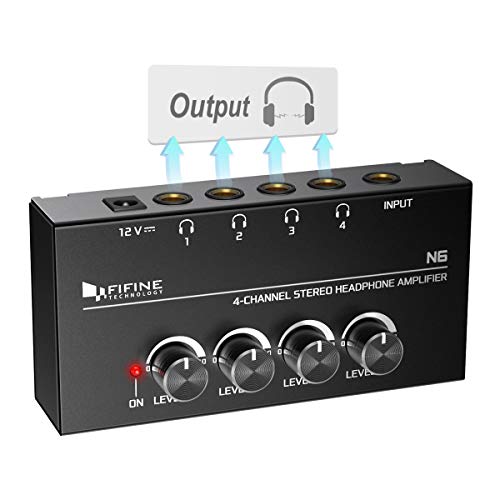
The FIFINE N6 is a four-output stereo headphone amplifier with a separate volume knob for each output. Its metal construction and compact design are intended for studio and stage use, as well as shared listening applications such as monitoring a mix or listening to a TV with earbuds.
Best for: Users who want a compact four-listener unit with 1/4-inch connections. The listed input and four outputs use 1/4-inch TRS jacks for stereo connections.
Why it was selected: Independent level controls suit groups with different preferred listening volumes, while the compact metal body is relevant for portable studio and stage setups.
Limitation: The product listing says the TRS/TS cables are not included. Its connection layout is based on 1/4-inch jacks, so users with 3.5 mm-only equipment should confirm the needed adapter or cable before buying.
Pyle PHA40 Four-Channel Headphone Amp

The Pyle PHA40 distributes one source to as many as four headphone pairs. Each output has an independent rotary volume control, and the listed connections are four 1/4-inch stereo headphone outputs and a 1/4-inch source input.
Best for: A basic shared-monitoring arrangement in which several people need to hear the same mix and control their own output level. It is especially relevant for users whose source and headphones already use 1/4-inch connections.
Why it was selected: Its purpose and controls are straightforward: send a source to four listeners and let each listener set a separate level. That makes it a direct match for a simple four-person splitter-and-amplifier setup.
Limitation: The listed jacks are 1/4-inch, so users with 3.5 mm plugs may need suitable adapters. The supplied product information does not specify a supported headphone impedance range.
LZSIG Six-Channel Headphone Amplifier

This LZSIG amplifier provides six independently controlled stereo headphone outputs, making it the largest-capacity option in this selection. Its product information lists support for up to six pairs of 32–100-ohm headphones and 1/8-inch or 1/4-inch TS and TRS plugs.
Best for: Home studios, group monitoring, or shared listening sessions with five or six people. Choose this model over a four-channel unit when the extra outputs are necessary and individual volume adjustment matters.
Why it was selected: It offers more simultaneous headphone connections than the four-channel alternatives while retaining per-channel controls. The listed bass-boost function and support for multiple plug sizes may also suit varied setups.
Limitation: It is unnecessary for a group of four or fewer if the extra channels will not be used. Bass boost alters the sound, which may be unsuitable for listeners seeking neutral monitoring.
Buying Guide: How To Choose A Headphone Splitter And Amplifier
A passive headphone splitter simply connects multiple headphones to one output. A headphone amplifier distributes the source signal through powered amplification, and models in this roundup add separate volume controls for individual outputs. For several listeners who want different volume levels, an amplifier with per-channel controls is generally the more suitable format.
How many headphone outputs do you need?
Count the people who will listen at the same time, not just the headphones you own. Four-channel models cover small groups and common studio monitoring needs. A six-channel unit is a better match for a larger session. Choosing more outputs than necessary may add unused capacity, while choosing too few can require a second device or a different setup.
Also consider whether everyone will use the amplifier at once. If the number of listeners changes between sessions, select a channel count that covers the largest expected group.
Do listeners need separate volume controls?
Individual level knobs let each listener adjust their own output without changing the level for everyone else. This is useful when people have different preferred volumes or when a recording session needs several musicians to monitor the same source.
Check the product description for independent controls on each output. A splitter that only duplicates a connection may not offer the same listening flexibility as a multi-channel amplifier.
Which plugs and cables should you check?
Identify the source output and headphone plug sizes before selecting a model. The products here include different connection layouts: some accept 1/8-inch and 1/4-inch connections, while others list 1/4-inch input and output jacks. An adapter can sometimes bridge plug-size differences, but confirm the appropriate type for the equipment involved.
Pay particular attention to cable inclusion. The FIFINE listing states that its TRS/TS cables are not included. Do not assume that a cable or adapter is supplied unless the product information says so.
Does headphone impedance matter?
Impedance is one factor to check when matching headphones with an amplifier. The LZSIG four- and six-channel listings specify support for 32–100-ohm headphones. The other product descriptions supplied here do not give a comparable impedance range, so consult the relevant product details if your headphones fall outside a typical consumer range or you need a particular match.
Do not assume that all amplifiers support every headphone equally. The listed specifications are the safest basis for comparing a model with your equipment.
Is bass boost useful for monitoring?
Bass boost can make a sound signature more pronounced, but it changes the signal rather than simply distributing it. The LZSIG models describe a bass-boost switch that increases specified frequency bands. This may appeal to listeners who want that adjustment for casual listening, while users seeking a neutral reference should consider whether they can leave the feature off.
Where will you use the amplifier?
For a fixed home studio, prioritize channel count, plug compatibility, and separate volume controls. For portable or stage setups, compact size and construction may also matter; the FIFINE listing specifically describes a compact metal design. Check the power requirements as part of setup planning, since the listed LZSIG models include a 12V supply.
For a straightforward four-listener system, compare the Mackie, FIFINE, and Pyle options by their connection types and stated features. If you need 3.5 mm support or bass boost, the LZSIG four-channel model offers those listed functions. If you need six outputs, the six-channel LZSIG is the relevant choice here.
Frequently Asked Questions
What is the difference between a headphone splitter and a headphone amplifier?
A splitter duplicates an audio connection for multiple headphones. An amplifier distributes audio through amplification and may provide separate volume controls for each output. The products listed here are multi-channel headphone amplifiers designed for shared listening.
Can four people listen to one source at different volumes?
Yes. The four-channel models listed here have independent output-level controls, allowing each listener to set a separate volume while sharing one source.
Which option supports six headphone pairs?
The LZSIG six-channel headphone amplifier is listed as supporting up to six pairs of 32–100-ohm headphones, with an independent volume control for each channel.
Do these amplifiers work with 3.5 mm headphones?
The two LZSIG models list compatibility with both 3.5 mm and 6.35 mm headphone connections. Models listing only 1/4-inch jacks may require a suitable adapter for 3.5 mm headphones.
Are connection cables included?
Package contents vary by model. The FIFINE N6 listing specifically says its TRS/TS cables are not included. Check each product’s current package information rather than assuming cables are supplied.
Should I choose a four-channel or six-channel amplifier?
Choose a four-channel amplifier if no more than four people need simultaneous listening. Choose a six-channel model when up to six listeners need separate outputs and individual volume controls.