
The best high-end headphone amp depends on your headphones and listening setup. The FiiO JadeAudio GIGAS 1 is best for demanding planar or high-impedance headphones, while the Apos Gremlin suits listeners seeking a tube-hybrid, balanced design. The Douk Audio U3 PRO offers high output and replaceable op-amps; Neoteck is a portable-style choice with bass boost, and LZSIG is designed for sharing audio among several listeners.
| Product | Best For | Standout Feature |
|---|---|---|
| FiiO JadeAudio GIGAS 1 | Demanding headphones | Up to 4,600 mW per channel balanced output |
| Apos Gremlin | Tube-style desktop listening | Class A hybrid and balanced connections |
| Douk Audio U3 PRO | High-impedance headphones | 18–600Ω range and replaceable op-amps |
| Neoteck 3.5mm Headphone Amp | Simple portable listening | Bass switch and 3.5mm connections |
| LZSIG 4-Channel Headphone Amp | Shared monitoring | Independent controls for four listeners |
FiiO JadeAudio GIGAS 1

Best for: Listeners using power-hungry planar magnetic or high-impedance headphones who want a desktop amplifier with both balanced and single-ended outputs.
The GIGAS 1 uses a Class AB discrete amplification circuit with ON Semiconductor transistor pairs. Its listed balanced output reaches up to 4,600 mW per channel at 32 ohms. That output makes it the strongest stated power option in this selection, although actual headphone performance also depends on the headphone’s sensitivity and the source signal.
- 4.4mm balanced and 3.5mm outputs support two common connection types.
- The 3.5mm output supports CTIA microphone pass-through for compatible headsets.
- The manufacturer describes the circuit’s sound as smooth and natural.
Choose this if high output and flexible headphone connections are priorities. Avoid choosing solely by maximum power: sensitive in-ear headphones may need careful volume adjustment. The listing does not specify additional input options, so check the connection requirements of your source before buying.
Apos Gremlin Balanced Tube Amp

Best for: Desktop listeners who want a tube-hybrid design and have compatible balanced audio connections.
The Gremlin combines a tube preamp stage with transistor amplification in a Class A design. Its listed output is 1,250 mW. The product description identifies replaceable 12AU7 and 6922 tubes and balanced XLR inputs, plus balanced 4-pin XLR and 4.4mm outputs. These details make it a distinctive option for listeners who want tube hardware alongside balanced connectivity.
- Hybrid tube-and-transistor construction.
- Balanced inputs and outputs for compatible equipment.
- Replaceable tubes allow tube changes, though the listing does not establish a specific sound outcome for every tube.
Choose this if the tube-hybrid format and balanced connections match your setup. It is a less straightforward pick for someone seeking a compact, plug-and-play amp with only conventional 3.5mm connections. Confirm that your source and headphones use the necessary connections before selecting it.
Douk Audio U3 PRO

Best for: Desktop listeners who need a compact amplifier for a broad stated headphone impedance range and want the option to change op-amps.
The U3 PRO is listed as delivering up to 1,500 mW at 32 ohms and supporting headphones rated from 18 to 600 ohms. Its design uses an OP+BUF architecture, with OP42 and BUF634 components and a pluggable op-amp socket. The built-in voltage-boost circuit operates from a 5V DC input and is described as maintaining an operating voltage of ±14V.
- 3.5mm and 6.35mm headphone jacks accommodate two common plug sizes.
- The replaceable-op-amp socket offers customization for users comfortable with component changes.
- The supplied description characterizes its sound as warm and delicate.
Choose this if you want a desktop amp with substantial stated output and an upgradeable circuit. The replaceable-op-amp feature is not essential for ordinary listening, and modifications should be limited to users who understand the component requirements. Check your headphone connector and source arrangement before purchase.
Neoteck 3.5mm Headphone Amp

Best for: Buyers who want a straightforward 3.5mm amp for compatible phones, computers, or portable audio players, with a switchable bass feature.
This model has a 3.5mm AUX input and output and is listed for headphones rated from 16 to 600 ohms. The product details report a signal-to-noise ratio above 100 dB and a THD+N figure of 0.0005%. It also includes a bass switch for listeners who want to emphasize bass during playback.
- 3.5mm input and output keep connections simple for sources with a matching jack.
- The stated impedance range covers a broad selection of headphones.
- The bass switch provides an optional tonal adjustment.
Choose this if a basic 3.5mm signal path and bass adjustment are more important than balanced outputs or multi-listener controls. The provided details do not state a maximum output-power figure or battery information, so do not assume it can drive every demanding headphone or operate independently of an external source.
LZSIG LHA2 Four-Channel Amp
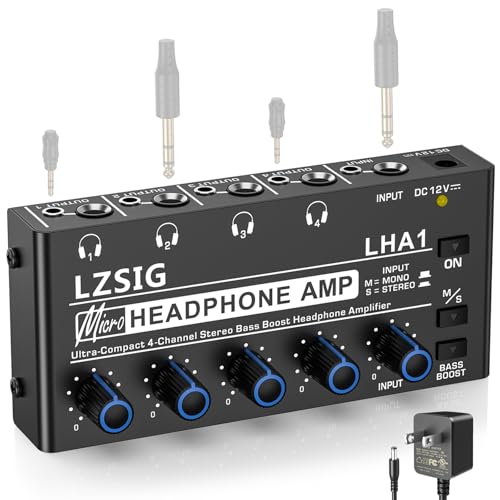
Best for: Home-studio users, small groups, and shared monitoring sessions that need separate headphone volume controls.
The LZSIG LHA2 is a four-channel headphone amplifier with independent level adjustment for each channel. It is specified for up to four pairs of 32–100-ohm headphones and accepts 3.5mm or 6.35mm plugs. Its 12V power arrangement and stated compatibility with devices that provide a 3.5mm or 6.35mm audio output suit studio and shared-listening setups.
- Four independent volume controls help listeners set their own levels.
- A bass-boost switch increases the listed 400–600 Hz and 3,000–7,200 Hz bands.
- The product description cites five ROHM operational amplifiers and low-noise operation.
Choose this over a single-listener hi-fi amp when distributing one source to several headphone users is the main goal. Its stated headphone range is narrower than several personal amps here, and it is designed around shared monitoring rather than balanced headphone outputs or individualized mixes.
Buying Guide: How to Choose a High-End Headphone Amp
What headphones will the amp need to drive?
Start with the headphone’s impedance and sensitivity specifications. Impedance alone does not determine whether a headphone needs a powerful amp, but it helps narrow the field. The Douk U3 PRO lists support from 18 to 600 ohms, while the Neoteck lists 16 to 600 ohms. The FiiO specifies high balanced output, making it a candidate for demanding headphones. Compare the amp’s documented output with your headphone maker’s recommendations where available.
For sensitive in-ear monitors or efficient headphones, maximum power is not automatically an advantage. A powerful amplifier can reach high volume quickly. Look for usable volume control and start at a low level when connecting unfamiliar equipment.
Do you need balanced or single-ended connections?
Check the connectors on both the source and headphones. A 3.5mm or 6.35mm jack is a common single-ended connection. Balanced audio hardware may use 4.4mm or XLR connectors. A balanced output is useful only when the rest of the signal chain supports the matching connection; it does not make an incompatible headphone plug fit without the correct cable or adapter.
The FiiO lists both 4.4mm balanced and 3.5mm outputs. The Apos Gremlin lists balanced XLR inputs and 4-pin XLR and 4.4mm outputs. The Douk provides 3.5mm and 6.35mm headphone jacks. Match the actual source output and headphone cable rather than buying based on connector labels alone.
Is a personal amp or a distribution amp the better fit?
A personal desktop amp focuses on one listener’s headphone setup. Models such as the FiiO, Gremlin, and Douk are more relevant when choosing output power, circuit design, or headphone connections for individual listening. A distribution amplifier is intended to serve multiple listeners. The LZSIG provides four channels with independent volume controls, which is more useful for group monitoring than for a single high-end headphone system.
For a studio or rehearsal space, also consider how many people need to listen at once and whether each person needs a separate mix. The LZSIG listing describes distribution and independent level controls, but not separate audio mixes per channel. Do not assume that individual volume controls mean independent source material.
Should you choose a tube or solid-state design?
Tube and hybrid amplifiers are often selected for their circuit format and the possibility of changing tubes. The Apos Gremlin combines a tube preamp stage and transistor amplification. The Douk U3 PRO is a solid-state design with a replaceable op-amp socket. These construction choices do not guarantee a particular result with every headphone or recording. Consider them alongside power, noise, connectivity, and ease of use.
Which extra features matter in daily use?
Prioritize features that solve a specific need. A bass switch can alter the listening balance, while multiple output channels help groups monitor a source. Replaceable op-amps or tubes may appeal to users who want to modify a system, but they add complexity. If simple operation is the priority, confirm the unit’s input, power requirements, and headphone connector before choosing.
Frequently Asked Questions
What does a headphone amp do?
A headphone amplifier increases the audio signal’s ability to drive headphones. It can provide useful volume and control when a source’s headphone output is insufficient for the connected headphones. It does not automatically improve every system; the source, headphones, and listening level all matter.
Does a high-impedance headphone always need a powerful amp?
No. Impedance is only one part of the requirement. Sensitivity and the desired listening level also affect how much power a headphone needs. Check the headphone specifications and compare them with the amplifier’s documented output.
Is a balanced headphone output always better?
No. Balanced output is useful when the amplifier, cable, and headphones all support the required connection. It is not a universal upgrade, and a single-ended connection can be appropriate for compatible equipment.
Can a four-channel headphone amp create separate mixes?
Not necessarily. Multiple channels and individual volume controls can let several listeners monitor audio at different levels, but separate mixes require suitable routing and input features. Confirm those functions in the product specifications.
How should I choose between the Douk and Neoteck?
Choose the Douk if you want a desktop design with 3.5mm and 6.35mm jacks, stated output up to 1,500 mW at 32 ohms, and a replaceable-op-amp socket. Choose the Neoteck if a simple 3.5mm input and output with a bass switch better matches your setup.