
The best home-office speakerphone depends on how many people need to join calls and whether you prefer a wired USB setup, wireless flexibility, or a traditional phone. The Anker PowerConf S330 is best for straightforward USB calls, while the Anker PowerConf suits users who want a six-microphone array and noise-management features. For larger groups, the NEARITY A20S offers an extended pickup range and daisy chaining. The EMEET M0 Plus is a compact option with four microphones, and the AT&T ML17929 is designed for two-line telephone use.
| Speakerphone | Best suited for | Standout listed feature |
|---|---|---|
| Anker PowerConf S330 | Simple wired computer meetings | USB-C connection and four microphones |
| Anker PowerConf | Small-group calls needing 360-degree pickup | Six microphones and Voice Radar 3.0 |
| NEARITY A20S | Larger rooms and group meetings | 16-foot pickup and daisy chain for up to six units |
| EMEET M0 Plus | Buyers seeking a four-microphone 360-degree model | Four microphones and 360-degree voice pickup |
| AT&T ML17929 | Home offices using two phone lines | Two-line calling and built-in speakerphone |
Anker PowerConf S330 USB Speakerphone

The Anker PowerConf S330 is best for a home-office user who wants a wired computer speakerphone with a simple setup. It connects through USB-C and includes a standard USB adapter, so it can connect through either listed USB format. The wired connection is intended to provide a stable link for meetings.
Its four high-sensitivity microphones provide 360-degree voice coverage, with the listed pickup range reaching 3 meters. Smart Voice Enhancement is designed to reduce background noise while enhancing voices. These features make the S330 a practical choice for individual calls or a small group seated near the device.
- Best for: Plug-and-play USB meetings and nearby participants.
- Why it was selected: It combines four-microphone coverage, voice processing, and a wired connection.
- Limitation: The stated pickup range is 3 meters, so it is a less suitable choice than the NEARITY A20S for a larger room.
Anker PowerConf Six-Microphone Speakerphone
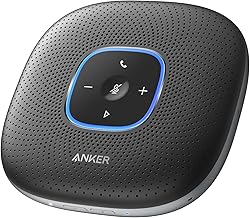
The Anker PowerConf is best for home-office users who want 360-degree voice pickup and automated audio processing. Its six microphones are arranged in a 360-degree array to capture voices from different directions. Voice Radar 3.0 is described as using AI deep learning to reduce noise, cancel echo, and detect multiple speakers.
The speakerphone also automatically balances voice volume to address differences in how loudly or how far away participants speak. That makes it a useful option when several people share a table and may not sit at equal distances from the device. The product is described as a Zoom Certified conference speaker.
- Best for: Small-group meetings where participants sit around the speakerphone.
- Why it was selected: Six microphones, 360-degree coverage, and stated noise and echo processing address common meeting needs.
- Limitation: The supplied details do not state a specific voice-pickup distance, so compare it with the A20S if room coverage is your main concern.
NEARITY A20S Conference Speaker

The NEARITY A20S is best for a home office that sometimes hosts larger meetings or needs to cover a broad table. It has eight omnidirectional MEMS microphones and a stated 16-foot, 360-degree pickup range. Automatic Gain Control is listed as a way to balance voice volumes across that range.
Its AI 2.0 processing is designed to reduce noise, echo, and reverberation. The product also supports daisy chaining up to six units through POE cables, with the supplied details describing use in rooms for meetings of up to 30 people. This expansion option distinguishes it from the single-device models in this selection.
- Best for: Larger home-office meeting spaces or users who may need multiple units.
- Why it was selected: The stated 16-foot pickup range and six-unit daisy-chain capability support broader room coverage.
- Limitation: Its daisy-chain feature is aimed at expanded setups; buyers who only need a simple single-device connection may prefer a more straightforward USB speakerphone.
EMEET M0 Plus Conference Speaker

The EMEET M0 Plus is best for buyers looking for a conference speakerphone identified by a four-microphone, 360-degree voice-pickup design. That microphone arrangement is the key listed detail for comparing it with other models: the Anker PowerConf S330 also has four microphones, while the Anker PowerConf has six and the NEARITY A20S has eight.
The product name identifies it as both a conference speaker and microphone, making it relevant to a home office where the device needs to handle meeting audio. The available product information does not provide further connection, processing, pickup-distance, or expansion details, so check the product listing to confirm those requirements before choosing it.
- Best for: Buyers prioritizing a four-microphone, 360-degree pickup configuration.
- Why it was selected: Its stated microphone layout directly suits multi-directional voice pickup for conference calls.
- Limitation: The supplied details do not specify a pickup range or connection type.
AT&T ML17929 Two-Line Speakerphone

The AT&T ML17929 is best for a home office that uses traditional telephone lines and needs to manage separate work and personal calls. It supports two lines and three-way conferencing. Its built-in speakerphone has adjustable volume, allowing hands-free calling without holding the receiver.
Caller ID and Call Waiting are listed features, along with a display that stores a history of 99 names and numbers. The phone is also described as headset compatible. Unlike the USB conference speakers in this guide, this model is designed around corded telephone use rather than a listed USB computer-meeting connection.
- Best for: Users who need two telephone lines, call screening, and hands-free phone calls.
- Why it was selected: It serves a different but important home-office need: managing conventional phone lines and three-way calls.
- Limitation: Choose another model if your priority is a USB speakerphone for computer-based meetings.
Buying Guide: How To Choose A Home-Office Speakerphone
Do you need a USB meeting device or a telephone speakerphone?
Start by identifying where your calls take place. A USB speakerphone is the relevant category if you want a device for computer-based meetings. The Anker PowerConf S330 is explicitly described as a USB speakerphone with USB-C and a standard USB adapter. The NEARITY A20S also lists a USB connection. For a traditional two-line telephone setup, the AT&T ML17929 is the match in this selection.
Do not assume that a model will connect to a specific computer, operating system, conferencing app, or phone system unless the product information confirms it. Check the connection details and your intended setup before buying. For the EMEET M0 Plus, the information provided here does not state a connection type, so verify that point if it is essential.
How many microphones and what pickup range do you need?
Microphone count can help compare designs, but it does not tell the whole story. The EMEET M0 Plus lists four microphones with 360-degree voice pickup, and the Anker PowerConf S330 lists four microphones with a 3-meter pickup range. The Anker PowerConf has six microphones arranged for 360-degree coverage, while the NEARITY A20S lists eight microphones and a 16-foot pickup range.
Match the stated range to the size of the room and the distance between the device and participants. For a compact desk or a small table, a shorter stated range may be sufficient. For a larger room, the A20S provides the clearest listed range information among these products. Room layout, obstacles, and participant placement can affect how well a device works in practice.
Would noise and echo processing help your calls?
Background sounds and room echo can make speech harder to follow. The PowerConf S330 lists Smart Voice Enhancement for reducing background noise and enhancing voices. The Anker PowerConf lists Voice Radar 3.0 for noise reduction, echo cancellation, and multiple-speaker detection. The NEARITY A20S lists AI 2.0 noise, echo, and reverberation cancellation.
These descriptions identify the processing each product claims to provide; they do not establish identical performance in every room. Consider your usual environment. A quiet office may place more value on ease of connection, while a room with several speakers or noticeable reverberation may make audio-processing features more relevant.
Do you need one speakerphone or an expandable setup?
Most home-office buyers can begin by comparing a single device’s pickup coverage with their usual seating arrangement. The NEARITY A20S is the only model here that lists daisy chaining, with up to six units connected through POE cables. This feature is designed to extend coverage for larger meeting spaces, including setups described for rooms of up to 30 people.
If you do not expect to expand, focus on the microphone layout, connection, and range you need now. A daisy-chain feature can be useful for a changing office, but it may add complexity compared with choosing one speakerphone sized for a desk or small meeting table.
Which features matter for a dedicated phone line?
For office calls made over telephone lines, look beyond microphone count. The AT&T ML17929 lists two-line support, three-way conferencing, Caller ID, Call Waiting, a 99-name-and-number history, adjustable speakerphone volume, and headset compatibility. Those features address call management rather than computer-meeting pickup distance.
Choose a phone-centered model if line handling and screening calls are central to your work. Choose a USB conference speakerphone if computer-based meetings are the priority. If you rely on both types of calling, confirm whether you need two separate devices rather than assuming one product handles both workflows.
What should you check before ordering?
- Connection: Confirm the device’s listed USB, telephone, or other connection matches your equipment.
- Room coverage: Compare the stated pickup range with the distance between the speakerphone and participants.
- Meeting size: Consider whether one device is enough or whether an expandable arrangement is useful.
- Call environment: Look for listed noise, echo, or reverberation processing if your room needs it.
- Missing specifications: Check the product listing for details that are not supplied here, particularly for the EMEET M0 Plus.
- Use case: Separate computer-based conference needs from traditional telephone-line features.
Frequently Asked Questions
What is the best speakerphone for a simple wired home-office setup?
The Anker PowerConf S330 is a strong fit based on its listed plug-and-play USB-C connection, included standard USB adapter, four microphones, and 3-meter pickup range. It is designed for buyers who want a wired computer speakerphone.
Which speakerphone lists the longest pickup range?
The NEARITY A20S lists a 16-foot, 360-degree voice-pickup range. Its eight omnidirectional MEMS microphones and automatic gain control are also specified for balancing voices across that range.
Which model is designed for two telephone lines?
The AT&T ML17929 is the two-line corded speakerphone in this selection. It also lists three-way conferencing, Caller ID, Call Waiting, and a built-in speakerphone.
Is a higher microphone count always better?
No. Microphone count is one comparison point, not a guarantee of better call quality. Consider the listed pickup range, room size, voice processing, connection type, and how participants will sit.
Which products list noise or echo management?
The Anker PowerConf S330 lists Smart Voice Enhancement for background-noise reduction and voice enhancement. The Anker PowerConf lists noise reduction and echo cancellation through Voice Radar 3.0, and the NEARITY A20S lists AI 2.0 noise, echo, and reverberation cancellation.
What should I verify about the EMEET M0 Plus?
The supplied product details identify four microphones and 360-degree voice pickup, but do not specify its connection type or pickup distance. Check the product listing for those details if they affect your setup.