
For home audio, the SVS SoundPath Speaker Level Subwoofer Adapter is the clearest match: it converts speaker-level connections to stereo RCA line output for a powered subwoofer. The other listed converters are primarily designed for car audio, so check their specifications and installation requirements before using them at home. The comparison below distinguishes the home-audio option from alternatives that may suit only compatible setups.
| Product | Best For | Key Point |
|---|---|---|
| SVS SoundPath | Home powered-subwoofer connections | Speaker-level input and stereo RCA output |
| AICARS 2-Pack | Basic speaker-to-RCA conversion | Compact, two converters included |
| Scosche LOC2SL | Car-audio systems needing a remote knob | Two-channel converter with remote control knob |
| Scosche LOC80 | Basic car-audio integration | Two-channel speaker-to-RCA conversion |
| BOSS Audio Systems B65N | Car systems with noise concerns | Ground loop isolator and input sensitivity adjustment |
SVS SoundPath Speaker Level Subwoofer Adapter

Best for: Home listeners connecting a powered subwoofer to a legacy integrated amplifier or other component that has speaker-level outputs but lacks a suitable line-level subwoofer output. This is the strongest fit in the list for a home-audio application.
The SVS adapter converts speaker-level output to stereo RCA line-level output. Its input uses stereo 24K gold-plated five-way binding posts that accept bare wire, spade, or banana connectors. The output uses stereo gold-plated RCA jacks for connection to a powered subwoofer’s line-level inputs.
Why it was selected: The product is specifically described as a home-audio line-out converter and as a solution for adding a subwoofer to legacy integrated amplifiers and components.
Limitation: It provides RCA line-level output, not speaker-level power for a passive subwoofer. Confirm that the subwoofer has compatible line-level inputs and that the amplifier’s speaker connections can be used as intended.
AICARS RCA Line Output Converter, 2-Pack

Best for: Buyers seeking a basic, compact speaker-to-RCA converter and who have confirmed that its connections and electrical specifications suit their system. The listing describes conversion from speaker-level output to a line-level signal for an amplifier or subwoofer.
AICARS says the converter changes speaker outputs into line-level signals below one volt peak and describes the design as compact and plug-and-play. The listing presents the product as a two-pack and mentions use with audio sources that lack RCA outputs.
Why it was selected: It offers the core high-to-low conversion function and provides two units, making it a potentially useful option when more than one conversion is needed.
Limitation: The listing focuses on car audio and does not establish home-audio compatibility, input limits, or detailed connection guidance. Do not assume it is suitable for a home amplifier without checking those details.
Scosche LOC2SL Converter With Remote Knob
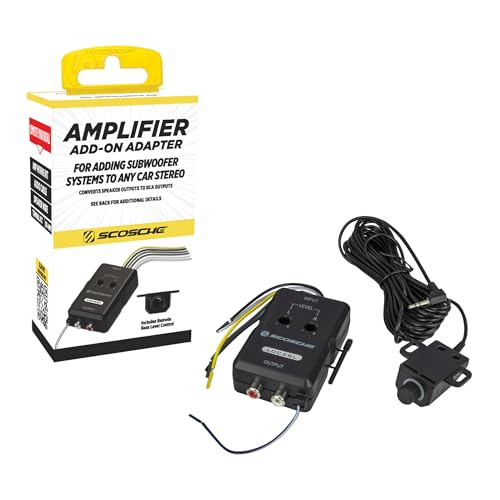
Best for: Car-audio users adding an aftermarket amplifier or subwoofer to a factory stereo and wanting a remote control knob as part of the converter setup.
Scosche describes this as a two-channel high-to-low RCA converter. It accepts speaker-level audio and converts it to RCA line-level output for integration with an aftermarket amplifier. The listed features emphasize compatibility with a range of car-audio systems and installation with a factory stereo.
Why it was selected: The remote control knob distinguishes it from the simpler converters in the list and may suit car-audio installations where a separate control is wanted.
Limitation: This is a car-audio product, not a clearly specified home-audio adapter. The product information does not explain home amplifier input limits or power requirements, so verify suitability before connecting it to home equipment.
Scosche LOC80 Two-Channel Converter

Best for: Car-audio owners who need a straightforward way to connect a factory stereo’s speaker-level signal to an aftermarket amplifier or subwoofer with RCA inputs.
The LOC80 converts speaker-level signals to RCA line-level signals and is described as a two-channel converter. Scosche lists it for integration between a factory car stereo and an aftermarket amplifier, with flexible installation options.
Why it was selected: It is a clearly described, basic high-to-low converter for adding amplification to a system without RCA preamp outputs.
Limitation: Its listed purpose is car audio. The product details do not specify home-audio connections or the input limits needed to determine whether it is appropriate for a particular home receiver or integrated amplifier.
BOSS Audio Systems B65N Converter

Best for: Car-audio users who need high-level-to-RCA conversion and are also addressing alternator-related whine or noise in their system.
The B65N is described as a high-level-to-RCA impedance converter with a ground loop isolator. Its listed features include input sensitivity adjustment and reduction of high-pitched whine associated with a car’s electrical system.
Why it was selected: It combines conversion with noise-related features, which can be relevant when integrating a factory car stereo with RCA-input equipment.
Limitation: The listed noise concern is specific to car electrical systems. The available product details do not establish suitability for home audio or provide connection and input-level specifications for a home setup.
Buying Guide: How To Choose A High-To-Low Converter
What does a high-to-low converter do?
A high-to-low converter, also called a line output converter, takes a speaker-level signal and provides a lower-level output, commonly on RCA connectors. This can help connect speaker outputs to equipment that accepts line-level input, such as a powered subwoofer or an amplifier with RCA inputs. The converter does not provide the same function as an amplifier: it changes the signal level rather than powering a passive speaker or subwoofer.
Is the converter designed for home audio or car audio?
Check the product’s intended use before choosing. The SVS SoundPath listing specifically describes home-audio use with legacy integrated amplifiers and powered subwoofers. The Scosche and BOSS products in this comparison are described for car systems. A car-audio converter should not be treated as a home-audio solution just because it has speaker wires and RCA outputs.
Look for documentation that confirms the converter can accept your amplifier’s speaker output and work with your receiving device. If a listing does not state input limits, required power, or wiring details, contact the manufacturer or choose a product with specifications that match your equipment.
What connections does your subwoofer or amplifier need?
Identify the input on the receiving component. A powered subwoofer may accept RCA line-level input, while a passive subwoofer requires an amplified speaker-level signal. A line output converter provides a signal for a compatible line-level input; it does not drive a passive subwoofer. Also check whether you need one channel or stereo RCA outputs.
Could grounding or noise be a concern?
Noise can come from wiring, grounding, or interference, but the right remedy depends on the system. The BOSS B65N lists a ground loop isolator and sensitivity adjustment for car-audio noise concerns. Do not assume that a car-focused isolator will solve noise in a home system. Check the source of the noise and follow the equipment manufacturers’ connection instructions.
What installation details should you verify?
- Confirm which amplifier terminals provide the speaker-level signal and whether the converter accepts that signal.
- Match the converter’s output connectors to the receiving component’s inputs.
- Check the product’s stated input limits, channel count, and power or wiring requirements.
- Turn equipment off before changing connections and follow the manuals for the amplifier, converter, and subwoofer.
- Do not connect speaker outputs to RCA inputs directly unless the equipment documentation explicitly allows it.
Should you choose a remote knob or a basic converter?
A basic converter may be sufficient when the goal is simply to provide RCA output from speaker-level audio. The Scosche LOC2SL adds a remote control knob, while the LOC80 is a more straightforward two-channel option. These are car-audio products, so the feature difference does not make either one automatically suitable for a home system.
Frequently Asked Questions
Can I use a car line output converter with a home receiver?
Not automatically. Car converters are designed and described for car-audio systems, and their product information may not specify home amplifier input limits or installation requirements. Verify compatibility with the manufacturers before connecting one.
Can a high-to-low converter connect a home amplifier to a powered subwoofer?
Yes, if the converter accepts the amplifier’s speaker-level output and provides a line-level output compatible with the powered subwoofer. The SVS SoundPath adapter is the product in this list specifically described for that home-audio use.
Will a line output converter power a passive subwoofer?
No. A line output converter provides a lower-level signal; it does not supply speaker-driving power. A passive subwoofer needs an appropriate amplifier.
Do all converters eliminate hum or alternator noise?
No. Noise reduction depends on the converter, the system, and the source of the noise. The BOSS B65N lists car electrical noise and a ground loop isolator, but that does not establish that it will fix noise in every setup.
Do I need a two-channel converter?
Choose based on the source signal and the receiving equipment. Two-channel converters provide left- and right-channel connections, while a subwoofer may use a particular input arrangement. Check both equipment manuals and the converter’s specifications before buying.