
A key of F harmonica is a practical choice for playing songs in F or using cross-harp position for music in C. The Fender Blues Deluxe is a straightforward pick for players seeking a versatile F harp, while the East top 008K is aimed at players who want a responsive diatonic instrument. The Lee Oskar and Hohner are simple options for buyers who already know the model or brand they want, and the seven-key East Top set suits players who need several keys.
| Product | Best for | What stands out |
|---|---|---|
| Fender Blues Deluxe in F | Players seeking a versatile single harp | PVC comb and brass reeds |
| East top 008K in F | Players wanting a feature-rich diatonic harp | Phosphor bronze reeds and compact size |
| Lee Oskar Major in F | Buyers seeking a clearly labeled major diatonic | Major diatonic design |
| East Top seven-key set | Players who need several keys | Includes A, B, C, D, E, F, and G |
| Hohner 532BX-F | Buyers seeking a named F blues harp | Diatonic blues harmonica in F |
Fender Blues Deluxe Harmonica In F

The Fender Blues Deluxe is a key-of-F harmonica designed for players at different experience levels. Its listed construction includes a molded PVC comb and brass reeds, which Fender identifies as the source of its classic tone and pitch. This makes it a direct option for someone who has chosen F and wants a single diatonic instrument rather than a multi-key kit.
Best for: Beginners and experienced players who want a general-purpose F harmonica for learning, practice, or playing songs in the key. It was selected because the listing explicitly identifies the key and describes the instrument as suitable for all levels.
Consider: The supplied product details do not specify tuning, dimensions, or included accessories. Check the listing if those details matter to your setup.
East Top 008K Diatonic Harmonica In F

This East top 10-hole, 20-tone diatonic harmonica is listed in F and described for blues, folk, rock, country, and jazz. Its stated components include a precision-made plastic comb and phosphor bronze reeds. The listing also describes a 1.2 mm reed plate and says the instrument is designed for responsive playing and techniques such as bending and overblowing.
Best for: Players who want a single F harp with listed construction details and an emphasis on expressive techniques. Its stated pocket-size dimensions—4.01 by 1.06 by 0.75 inches—may also suit someone who wants a compact instrument to carry.
Consider: The listing’s claims about responsiveness and airtightness are product descriptions, not independent performance measurements. Players should compare the instrument with their own technique and preferences.
Lee Oskar Major Diatonic In F
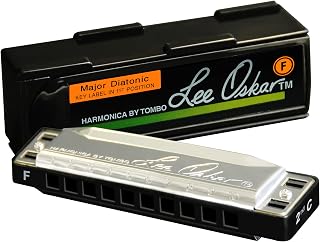
The Lee Oskar listing identifies this instrument as a major diatonic harmonica in F, with an orange label. That concise description makes it easier to distinguish from harmonicas designed around other tunings or keys. A major diatonic F harp is suited to melodies in F and can also be used in other positions depending on the song and playing approach.
Best for: Buyers who specifically want a major diatonic harmonica in F, particularly if they already use or are comparing Lee Oskar instruments. It was selected because the product title and features clearly state both the key and harmonica type.
Consider: The available product details do not list reed material, comb construction, dimensions, or included accessories. Review the listing for specifications you need before choosing it over a more fully described option.
East Top Seven-Key Harmonica Set

This set includes seven 10-hole, 20-tone harmonicas in A, B, C, D, E, F, and G. The listed package also includes a canvas bag with built-in foam and a cleaning cloth. Rather than buying only an F harmonica, this option provides instruments for players who regularly need to change keys between songs or practice material.
Best for: Beginners building a collection, players who perform songs in multiple keys, or buyers who want an F harp alongside six other listed keys. It was selected because the set includes F and directly addresses the need for several keys.
Consider: Choose this set only if the other keys will be useful. The listing describes phosphor bronze reeds and a canvas bag, but does not provide individual details for each harp beyond the shared set description.
Hohner 532BX-F Diatonic Blues Harmonica

The Hohner 532BX-F is listed as a diatonic blues harmonica in the key of F. The product information is brief, but its title makes the intended type and key easy to identify. It can be considered by players who want an F diatonic harp for blues-related playing or who are comparing specific Hohner models.
Best for: Buyers who want a clearly identified Hohner blues harmonica in F. It was selected because both the key and diatonic blues-harp format are stated in the product information.
Consider: The supplied details do not describe materials, dimensions, tuning, or accessories. If those factors affect your decision, confirm the specifications in the product listing before purchasing.
Buying Guide: How To Choose A Key Of F Harmonica
What does “key of F” mean?
The key printed on a harmonica identifies its tuning. A key-of-F harmonica is designed around F as its home key. That makes it a logical choice for playing melodies or arrangements in F, but the instrument can also be used in other musical positions. The right choice depends on the song, the accompanying instruments, and the sound or playing style you want.
Should you choose a single F harp or a set?
Choose a single F harmonica if you mainly play songs that call for F or are adding one specific key to an existing collection. The Fender, East top 008K, Lee Oskar, and Hohner listings all identify a single harmonica in F. A multi-key set is better when you often play songs in different keys; the East Top set includes seven listed keys, including F.
What is the difference between first and second position?
Players commonly use a diatonic harmonica in more than one position. First position, often called straight harp, centers on the harmonica’s labeled key. For an F harp, that means playing in F. Second position, often called cross harp, is commonly used for blues and centers a fifth above the labeled key; an F harp is therefore commonly used for music in C in second position. Specific notes and techniques depend on the song and arrangement.
Which features should you compare?
- Harmonica type: These products are presented as diatonic instruments. Confirm the type you need if you are shopping for a different style of harmonica.
- Reed material: The Fender listing specifies brass reeds, while the East Top products list phosphor bronze reeds. The Lee Oskar and Hohner details provided here do not specify reed material.
- Comb and construction: Fender lists a molded PVC comb; the East top 008K lists a precision-made plastic comb. Compare stated materials rather than assuming construction details not provided.
- Playing techniques: The East top 008K listing specifically mentions bending and overblowing. If those techniques are important, look for clear product information about them.
- Portability and storage: The East top 008K lists compact dimensions. The seven-key set includes a foam-lined canvas bag and cleaning cloth.
- Key coverage: Verify that the instrument is in F, especially when selecting among products in multiple keys. The seven-key kit includes F along with A, B, C, D, E, and G.
Is an F harmonica suitable for beginners?
It can be. The Fender listing says it is designed for all levels, and the East top 008K listing includes beginners among its intended players. A beginner should first check which key their lesson, songbook, or backing track requires. Starting with a different key can make practice material sound unlike the recording or accompaniment.
How should you match the harmonica to a song?
Check the song’s key and the harmonica position required by the arrangement. A song in F may call for an F harmonica in first position, while a blues arrangement in C may use an F harmonica in second position. If you play with a band or backing track, confirm the key with the other musicians rather than relying only on the genre.
Frequently Asked Questions
What key is a key-of-F harmonica tuned to?
It is tuned as a harmonica in F. Its labeled key is the home key for first-position playing, though players can use other positions for different musical contexts.
Can you play blues on a key-of-F harmonica?
Yes. The Hohner 532BX-F is specifically listed as a diatonic blues harmonica in F. An F diatonic harp is also commonly used in second position for blues in C.
What key harmonica is commonly used for blues in C?
An F harmonica is commonly used for blues in C when playing in second position. Confirm the required key and position for the specific song or arrangement.
Is a 10-hole diatonic harmonica good for beginners?
A 10-hole diatonic harmonica is a common format for learning melodies and blues techniques. The East top 008K listing describes its 10-hole, 20-tone model as suitable for beginners as well as experienced players.
Should I buy a seven-key harmonica set?
Choose a seven-key set if you expect to play in several keys and want F included with A, B, C, D, E, and G. If you need only an F harmonica, a single-key model may be the more direct choice.