
High-efficiency speakers can produce more sound from a given amount of amplifier power, but the supplied product details do not list sensitivity measurements for these models. This list is therefore a practical comparison of five speaker types—not a verified ranking by efficiency. The Sony bookshelf pair is best suited to home stereo or theater setups, while the Anker is better for portable listening. The Edifier and OROW models target desktop use, and the MB-M694 pair is designed for car audio.
| Product | Best suited for | Key listed detail |
|---|---|---|
| Sony SS-CS5M2 | Home stereo and theater | Three-way bookshelf pair |
| Anker Soundcore 2 | Portable listening | 24-hour playtime and IPX7 |
| Edifier M60 | Desktop audio | 66W RMS and multiple inputs |
| Audio Midrange MB-M694 | Car or truck audio | 6×9-inch, 4-ohm pair |
| OROW S211 | Budget-minded desktop setups | USB-powered 2.1 system |
Sony SS-CS5M2 Bookshelf Speakers

The Sony SS-CS5M2 is a compact passive bookshelf speaker pair for listeners building a home stereo or theater system. Its listed design uses three drivers, including a 5.12-inch woofer and high-precision tweeters. The product description also identifies Hi-Res Audio and premium componentry as features.
Best for: Buyers who want a dedicated left-and-right speaker pair for home listening and have an amplifier or receiver suitable for passive speakers. It was selected because its bookshelf format and three-way driver arrangement make it the clearest home-audio option in this list.
Efficiency note: No sensitivity figure or recommended amplifier range is included in the supplied details. Those specifications are needed to judge how loudly the speakers play from a given amplifier output.
Limitation: This is not a self-powered speaker system, so plan for suitable amplification and confirm the connection requirements before buying.
Anker Soundcore 2 Portable Speaker

The Anker Soundcore 2 is a portable Bluetooth speaker listed with 24-hour playtime, IPX7 water resistance, 12W stereo sound, BassUp, and wireless stereo pairing. The product description also mentions Bluetooth 6 and use at home, in the shower, outdoors, and while traveling or camping.
Best for: People who prioritize portability and a rechargeable, water-resistant design over a traditional passive speaker setup. It was selected because its stated use cases cover travel and outdoor listening, unlike the home, car, and desktop models here.
Efficiency note: A portable speaker’s stated wattage does not establish acoustic efficiency. The supplied information does not include a sensitivity measurement.
Limitation: Its 12W rating and compact portable format may not suit buyers seeking a conventional high-output home stereo system. Check the product listing for current specifications if Bluetooth version or pairing details are important to your setup.
Edifier M60 Multimedia Speakers

The Edifier M60 is a compact multimedia speaker system specified at 66W RMS. Listed features include Bluetooth 5.3, Hi-Res Audio with LDAC, a 3-inch mid-bass driver, a 1-inch tweeter, and USB-C and AUX inputs. The classic oak finish is also identified in the product name.
Best for: Desktop listeners who want wired input choices as well as Bluetooth. It was selected because the combination of USB-C, AUX, and wireless connectivity gives it a clear computer and multimedia role.
Efficiency note: The 66W RMS figure describes power, not sensitivity. The supplied product details do not state how much sound pressure the speakers produce at a specified distance and input level.
Limitation: This is a compact desktop model, so choose it for near-field listening rather than assuming it will replace larger room-filling speakers. Check the listing for connection and source-device requirements.
Audio Midrange MB-M694 Car Speakers

The Audio Midrange MB-M694 listing describes a pair of 6×9-inch, 4-ohm loudspeakers for car or truck audio. The product name states a 1000W maximum rating and identifies the speakers as high efficiency. That efficiency wording is not accompanied by a sensitivity figure in the supplied details, so it cannot be independently compared with measured sensitivity data for other models in this list.
Best for: Buyers replacing or adding speakers in a car or truck audio system who need a 6×9-inch pair. It was selected because it is the only listed model specifically intended for vehicle audio.
Efficiency note: “1000W Max” is not the same as continuous power handling or sensitivity. Confirm the RMS rating and installation dimensions from the full listing before matching these speakers to an amplifier or vehicle.
Limitation: The product details do not specify a sensitivity number, RMS rating, or fitment information for particular vehicles. Do not assume the 6×9 format guarantees a direct fit in every car or truck.
OROW S211 USB-Powered 2.1 Speakers
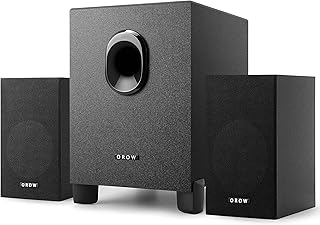
The OROW S211 is a USB-powered 2.1 multimedia speaker system with a subwoofer and 16W listed output. Its product name identifies strong bass, 3.5mm audio inputs, a wooden finish, and use with a PC, PS4, or TV.
Best for: Desktop or media users who want a compact 2.1 arrangement and a straightforward 3.5mm audio connection. It was selected because the included subwoofer distinguishes it from the other desktop-focused option.
Efficiency note: The 16W figure does not establish speaker sensitivity or how much output is produced per watt. The supplied details do not include a sensitivity rating.
Limitation: USB power and a 3.5mm audio input mean buyers should check the power and audio connection needs of their specific source device. Its listed output is lower than the Edifier’s stated 66W RMS, though wattage alone does not predict perceived loudness.
Buying Guide: How To Choose High-Efficiency Speakers
What does speaker efficiency mean?
Speaker efficiency describes how effectively a speaker converts electrical input into acoustic output. In consumer specifications, buyers usually compare sensitivity, commonly expressed as decibels at a stated distance with a specified input. A higher sensitivity figure generally means a speaker can play louder than a lower-sensitivity model when both receive the same power, assuming the measurements use comparable methods.
Do not treat maximum wattage as a measure of efficiency. A large maximum-power number does not show how loud a speaker plays at one watt, nor does it tell you how much continuous power it can handle. Look for sensitivity, impedance, and an appropriate power-handling specification together.
Which specifications should you compare?
- Sensitivity: Compare figures only when their measurement conditions are similar. A sensitivity number is central when efficiency is the priority.
- Impedance: Check that the speaker’s impedance is suitable for the connected amplifier or receiver. The MB-M694 listing states 4 ohms; the other supplied descriptions do not provide impedance.
- Power handling: Look for a clearly stated RMS or continuous rating, not just a peak or maximum figure. The MB-M694 name gives a maximum rating but not an RMS figure.
- Amplifier requirements: Passive speakers need an external amplifier or receiver. Self-powered and portable models contain amplification, so compare their inputs and intended uses instead.
- Speaker format: Choose bookshelf speakers for a home stereo, car speakers for vehicle installation, and multimedia speakers for a desk or computer setup.
Should you choose passive or powered speakers?
Passive speakers such as the Sony bookshelf pair can be matched with a separate amplifier or receiver. This approach gives buyers control over amplification, but it requires checking the amp’s supported impedance and power. Powered multimedia speakers, such as the Edifier and OROW, include amplification as part of the system. They can simplify a desktop setup, but their inputs and placement are more specific to their intended use.
The Anker Soundcore 2 is a portable Bluetooth product rather than a conventional passive speaker. It is the more relevant choice for travel and outdoor convenience. It should not be compared directly with a passive home speaker using only wattage figures.
How should you match speakers to the room or vehicle?
Start with where the speakers will be used. For a living room, consider the Sony pair and make sure you have compatible amplification. For a desktop, compare the Edifier’s USB-C, AUX, and Bluetooth options with the OROW’s 3.5mm input and included subwoofer. For a car or truck, check speaker size, mounting depth, wiring, and vehicle fitment before choosing the MB-M694 pair.
For outdoor or shower-area use, the Anker listing states IPX7 water resistance. Follow the manufacturer’s use instructions and do not assume that a water-resistance rating makes a speaker appropriate for every wet environment.
What should you verify before buying?
- Confirm the full model name and current specifications on the product listing.
- Look for a sensitivity figure if high efficiency is a strict requirement.
- Verify whether the product is a pair, a single speaker, or a multi-part system.
- Check the exact connectors and power arrangement for your audio source.
- For car speakers, verify dimensions and installation requirements for your vehicle.
- For passive speakers, confirm amplifier compatibility before connecting equipment.
Because the supplied details omit sensitivity for all five products, none can be confirmed as the most efficient speaker from this list. Buyers who need a strict efficiency comparison should gather comparable sensitivity specifications before deciding.
Frequently Asked Questions
Which speaker on this list is confirmed to be the most efficient?
None can be confirmed as the most efficient because the supplied product details do not provide comparable sensitivity measurements. The MB-M694 name uses the phrase “high efficiency,” but no sensitivity figure is included to verify or compare that claim.
Does a higher wattage rating mean a speaker is more efficient?
No. Wattage describes power handling or output-related specifications, depending on how the rating is defined. Speaker sensitivity is the more useful specification for comparing how much sound a speaker produces from a given input.
Which option is best for a home stereo?
The Sony SS-CS5M2 is the clearest home stereo choice in this list because it is a three-way bookshelf speaker pair. It requires suitable external amplification, and its sensitivity is not stated in the supplied details.
Which option is best for a computer desk?
The Edifier M60 is suited to desktop use and lists Bluetooth, USB-C, and AUX inputs. The OROW S211 is another desktop option, with a 2.1 speaker-and-subwoofer arrangement and a 3.5mm input.
Can the car speakers fit any vehicle with 6×9-inch openings?
Not necessarily. The MB-M694 listing gives a 6×9-inch size, but the supplied details do not confirm fitment for particular vehicles. Check mounting depth, opening dimensions, and installation requirements before purchasing.
Is a portable Bluetooth speaker a good substitute for a home stereo?
It can serve casual listening needs, but the Anker Soundcore 2 is designed as a portable speaker with Bluetooth and stated 24-hour playtime. Buyers seeking a traditional home stereo should compare passive bookshelf speakers and suitable amplification instead.