
The right live sound power amplifier depends on your passive speakers, required output, and preferred setup. The Rockville D12 is best for buyers seeking high stated RMS output and monitoring features; the Peavey IPR2 2000 is described as a lightweight option for mobile DJs and bands; and the Crown XLi800 is a straightforward two-channel choice. The Pyle PTA1000BT adds Bluetooth and USB playback, while the Rockville RPA5 offers a built-in crossover and several input and output types.
| Amplifier | Best suited to | Standout listed details |
|---|---|---|
| Rockville RPA5 | Flexible rack-based setups | Built-in crossover; stereo and bridged modes |
| Pyle PTA1000BT | Buyers who want playback features | Bluetooth, USB-A MP3 player, bridge mode |
| Crown XLi800 | Buyers seeking a two-channel amp | 600-watt bridged output at 8 ohms |
| Peavey IPR2 2000 | Mobile DJs, bands, and venues | Lightweight design; two-channel stereo setup |
| Rockville D12 | Higher-output passive speaker systems | 1400W RMS at 4 ohms; LCD monitoring |
Rockville RPA5 2-Channel Power Amplifier

The Rockville RPA5 is a rack-mount amplifier listed with 1000 watts peak and 400 watts RMS. It supports stereo and bridged modes and includes a built-in crossover, making it a candidate for systems that need more than one operating configuration.
Its listed connections include XLR, 1/4-inch, and RCA inputs, plus Speakon and banana outputs. This range is useful when a setup includes different source or speaker connection types. The 2U rack-mount format also suits buyers planning to install the amplifier in a rack.
- Best for: DJs and live-sound users who want multiple input choices, a built-in crossover, and stereo or bridged operation.
- Why it was selected: Its feature list combines rack mounting, crossover functionality, and several connection options in one two-channel model.
- Consideration: The listing distinguishes 1000W peak from 400W RMS. Compare the RMS rating and operating mode with the speaker’s requirements rather than choosing by peak power alone.
Pyle PTA1000BT Bluetooth Rack-Mount Amplifier
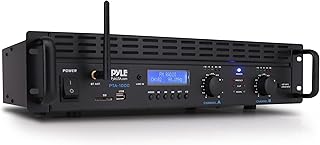
The Pyle PTA1000BT is a two-channel rack-mount amplifier whose listing highlights Bluetooth, a USB-A input with an MP3 player, and bridge mode. It also lists TRS and XLR inputs, Speakon outputs, a cooling fan, and LED level meters. The product name describes it as bridgeable with 2000W output, but buyers should check the full specifications for the rating at their intended load and mode.
Bluetooth and USB playback make this model different from a basic power amp. Those features may suit a system where direct playback is useful, while TRS and XLR inputs offer wired connection options.
- Best for: DJs or event operators who want a rack-mount amp with built-in wireless and USB playback options.
- Why it was selected: It combines amplification features with playback inputs, level meters, and bridge mode.
- Consideration: Built-in playback may not be needed in a setup that already uses a mixer or dedicated media player. Confirm the output rating for your speaker impedance before purchase.
Crown XLi800 Two-Channel Power Amplifier

The Crown XLi800 is listed as a two-channel power amplifier with 600 watts bridged at 8 ohms. Its product title positions it for professional DJ, PA, and stage use. The bridged rating is a specific operating condition, so it should not be treated as the output available in every configuration.
This model is a practical option to compare when a buyer wants a two-channel amplifier from Crown and has a system plan that may use bridged operation. Check the complete manufacturer specifications for channel-by-channel power ratings, supported speaker impedances, and connection details before matching it with a PA system.
- Best for: Buyers comparing two-channel amps for DJ, PA, or stage systems who have verified that the listed 8-ohm bridged configuration suits their setup.
- Why it was selected: It is explicitly identified as a two-channel professional amplifier and supplies a stated bridged rating.
- Consideration: The supplied product information does not provide further input, output, or per-channel ratings. Confirm those details against your system requirements.
Peavey IPR2 2000 Lightweight Power Amp

The Peavey IPR2 2000 is described as a lightweight power amp for driving passive speakers. Its listing specifically names DJs, bands, and venues as potential users and identifies a two-channel design for stereo setups. Those details make it relevant to mobile sound systems where carrying equipment matters, as well as fixed installations that need two-channel amplification.
The supplied product information does not state output ratings at particular impedances or list connector types. Buyers should verify those specifications before selecting speakers or planning a stereo or bridged configuration.
- Best for: Mobile DJs and bands who prioritize a lightweight amplifier for passive speakers, or venues looking for a two-channel stereo design.
- Why it was selected: Its listing directly addresses live performers and emphasizes portability and passive-speaker use.
- Consideration: The available product description does not include power figures or connection details. Confirm both before comparing it with amplifiers that publish those specifics.
Rockville D12 Class D Power Amplifier

The Rockville D12 is a two-channel Class D rack-mount amplifier listed at 1400W RMS at 4 ohms and 700W RMS at 8 ohms. It supports stereo, parallel, and bridge modes and is described as stable at 4- and 8-ohm loads. Listed features include a crossover, limiter, LCD, XLR and 1/4-inch inputs, and SpeakON and binding-post outputs.
The LCD displays volume in dB per channel and operating temperature, according to the product information. This monitoring can help operators keep an eye on those displayed values during use.
- Best for: Buyers seeking higher stated RMS output, multiple operating modes, and an LCD for monitoring channel volume and temperature.
- Why it was selected: Its listed RMS ratings, crossover, limiter, and connection options make it the most feature-detailed high-output choice in this selection.
- Consideration: The 5000W peak figure is not the same as its listed RMS ratings. Match the speaker load and operating mode to the applicable RMS specification.
Buying Guide: How To Choose A Live Sound Power Amplifier
How much amplifier power do your speakers need?
Start with the passive speaker’s recommended power range and impedance, then compare those figures with the amplifier’s specifications for the intended operating mode. Do not use peak wattage as a substitute for continuous or RMS output. For example, the Rockville D12 listing provides separate RMS ratings at 4 and 8 ohms, while the RPA5 listing distinguishes peak output from RMS output.
Amplifier power is only one part of a suitable match. Check the manufacturer’s guidance for both speaker and amplifier, including any minimum supported load. If a rating is not supplied in the product details, consult the complete specifications rather than estimating.
Should you choose stereo, parallel, or bridged operation?
Stereo operation sends separate left and right signals through two channels, which suits many two-channel PA arrangements. Bridge mode combines amplifier channels for a different output configuration, but its power rating and supported speaker load can differ from stereo operation. Parallel mode, when available, is another configuration and should not be assumed to have the same effect as bridging.
Choose a mode only after checking the amplifier instructions and speaker requirements. A bridged rating such as the Crown XLi800’s listed 600 watts at 8 ohms applies to that stated configuration; it does not describe every way to use the amp.
Which connections and extra features matter?
Check the signal inputs on your mixer or playback device and the speaker outputs required by your cables. The RPA5 lists XLR, 1/4-inch, and RCA inputs. The D12 lists XLR and 1/4-inch inputs, plus SpeakON and binding-post outputs. Confirm that the specific cables and connectors in your system match the amplifier.
Additional features should solve a real setup need. A built-in crossover may matter if you need that function in the amplifier. Bluetooth and USB playback distinguish the Pyle PTA1000BT, while the Rockville D12 lists a limiter and LCD monitoring. Avoid paying attention to feature counts without checking how each item fits your signal chain.
What matters for mobile use and rack installation?
For a mobile rig, consider the amplifier’s listed weight or portability information, rack format, and the rest of the equipment you need to transport. The Peavey IPR2 2000 is described as lightweight, while the RPA5, Pyle PTA1000BT, and D12 are identified as rack-mount models. Verify dimensions and rack requirements in the full product specifications if space is limited.
For a fixed venue, plan for the amplifier’s placement, accessible controls, cabling, and the cooling requirements stated by its manufacturer. The Pyle listing specifically mentions a cooling fan; do not assume other models use the same cooling arrangement unless their documentation confirms it.
How should you compare wattage claims?
Compare like with like: RMS with RMS, the same impedance, and the same operating mode. A peak figure can be useful as a product descriptor, but it does not tell you the continuous output available for a particular speaker load. Also check whether a quoted number applies to one channel, both channels, or bridged operation.
When a listing does not give enough detail for a fair comparison, treat that as an information gap. The available details for the Peavey IPR2 2000, for example, identify its intended use and two-channel design but do not provide specific impedance-based output figures here.
Frequently Asked Questions
What does a live sound power amplifier do?
A power amplifier drives passive speakers by increasing the level of an audio signal from a mixer or other source. It is different from a powered speaker, which has amplification built into the speaker cabinet.
Can I use any power amplifier with passive PA speakers?
No. The amplifier’s output, operating mode, and supported speaker impedance must suit the speakers. Check the specifications for both products before connecting them.
Is peak wattage the same as RMS wattage?
No. Peak and RMS figures describe different power ratings. Use the appropriate continuous or RMS rating for the speaker load and amplifier mode when comparing products.
What is the benefit of bridged mode?
Bridged mode combines amplifier channels into a different output configuration and can provide a higher stated output under specified conditions. Confirm the required speaker impedance and the amp’s bridged rating before using it.
Do I need Bluetooth on a live sound amplifier?
Bluetooth can be useful when wireless playback is part of your setup. It may be unnecessary if a mixer or dedicated playback device already handles audio sources. The Pyle PTA1000BT is the product in this selection whose listing specifically includes Bluetooth.
Which amplifier is best for a mobile DJ?
The Peavey IPR2 2000 is described as lightweight and intended for DJs, bands, and venues. A mobile DJ should also compare the amplifier’s verified power ratings, connections, rack needs, and compatibility with the passive speakers in the system.