
The best loop pedal for vocals depends on how you’ll route your microphone and how much control you need. The BOSS RC-1 is a straightforward choice for simple looping, while the Donner Triple Looper suits performers who want three saved loops and a screen. The LEKATO triple-loop model adds synchronous recording, and the LEKATO 9-loop pedal offers longer total recording time. These products are described primarily as guitar pedals, so check the input and microphone setup you need before buying.
| Product | Best suited for | Key listed feature |
|---|---|---|
| BOSS RC-1 | Simple loop practice and performance | 24-segment LED indicator; 12 minutes of record time |
| Donner Triple Looper | Managing song sections | Three loop slots; 90 minutes total recording time |
| LEKATO Triple Looper | Performers who want sync recording | Three loops; synchronous recording mode |
| LEKATO 9-Loop Pedal | Saving more loop ideas | Nine loops; 40 minutes total recording time |
| Sondery Triple Looper | Saving and transferring loop tracks | Three tracks; USB WAV import and export |
BOSS RC-1 Loop Station

The BOSS RC-1 is best for singers who want a basic looper for building a vocal phrase, practicing harmonies, or layering short parts without navigating a large feature set. Its listed functions include record, playback, overdub, undo, and redo. A 24-segment LED indicator displays loop status, and the pedal provides up to 12 minutes of recording time.
The product is described as a stereo looping pedal with stompbox operation and a level control. Those features make it a simple option for a player who wants foot-operated control and a visible loop indicator. It was selected as the most direct, uncomplicated choice in this group.
Vocal setup note: The listed description identifies guitar, bass, keyboards, and other instruments, but does not specify a microphone preamp or XLR microphone input. Confirm how your microphone will connect before choosing it. Its 12-minute recording capacity may also be less suitable than longer-memory options for extended sets or many saved ideas.
Donner Triple Looper With Screen

The Donner Triple Looper is best for vocal performers who want separate loop slots for parts such as a verse, chorus, and backing layer. It has three independent loops, each able to store up to 30 minutes, with 90 minutes of total recording time. A built-in screen displays loop status, recording progress, and timing.
Its one-footswitch operation is listed for recording, playback, overdubbing, stopping, and clearing. That can suit a singer who wants hands-free control while performing, without a more complicated control layout. It was selected for the combination of visible status information and substantial stated recording capacity.
Vocal setup note: The listing describes the unit as a guitar pedal for electric guitar and bass, not as a dedicated microphone looper. Check the signal path and microphone connection requirements before purchase. Choose another option if you need a product listing that explicitly confirms direct microphone input.
LEKATO Triple Looper With Sync
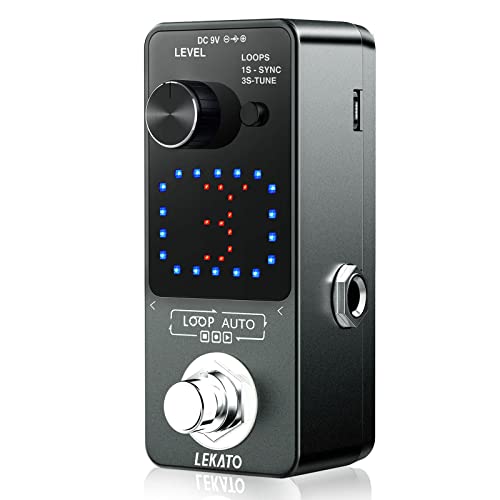
The LEKATO triple looper is best for performers who want three loop slots and the option to enter recording during playback. Its synchronous recording mode is described as letting the user enter the recording state at any time during playback, which can help when adding a vocal part after a loop has started. It offers three loops, up to six minutes per loop, and 18 minutes total memory.
The listing also specifies 48 kHz/24-bit uncompressed audio, an analog-dry-through design, a built-in tuner, and a visual time indicator. It was selected for its sync feature and combination of loop status feedback with three available loop slots.
Power and vocal setup cautions: The listing says the power supply is not included and specifies a 9V center-negative supply. It describes the pedal for electric guitar and bass, so verify the microphone connection and signal-level requirements for your setup. Its 18-minute total capacity is lower than the 40- and 90-minute alternatives here.
LEKATO 9-Loop Pedal With Tuner

The LEKATO 9-loop pedal is best for singers who want to retain several loop ideas rather than work with only one or three saved slots. It provides nine loops and 40 minutes of total recording time, with a maximum single-loop recording duration of 10 minutes. A visual time indicator helps show loop timing while recording or playing.
Its listed audio specifications are 48 kHz/24-bit sampling and uncompressed audio, with an analog-dry-through design. The built-in high-sensitivity tuner is another listed feature, though its usefulness depends on the instrument or signal chain being tuned. This model was selected for its larger number of loop slots and longer total memory than the simpler options.
Vocal setup note: The product name and description focus on guitar and bass. They do not confirm a direct microphone input or a built-in microphone preamp. It may not be the right choice if you need a self-contained vocal pedal, and its stated limit of 10 minutes per loop should be considered when planning long sections.
Sondery Triple Looper With USB

The Sondery Triple Looper is best for performers who want three saved tracks and the ability to transfer WAV files to or from a computer. Each of its three tracks can store up to 30 minutes. A top toggle switch selects a track, while one footswitch handles recording, playback, overdubbing, stopping, and clearing. Color LEDs indicate the loop mode.
USB import and export are useful listed features for moving loop files between the pedal and a PC without a separate drive. This model was selected for that file-transfer function, which distinguishes it from the other three-slot options in this list.
Vocal setup note: The description does not identify a dedicated microphone input, preamp, or vocal-specific effects. Confirm your microphone routing needs before buying. The product also has three tracks rather than the nine loop slots offered by the LEKATO 9-loop model, so it may be less suited to users who want more saved locations.
Buying Guide: How to Choose a Loop Pedal for Vocals
Will the pedal accept a microphone directly?
Start by checking the input type and signal requirements. The products listed here are marketed mainly as guitar or instrument pedals. Their supplied descriptions do not confirm an XLR microphone input or built-in microphone preamp. A vocal microphone may need a suitable preamp or mixer before its signal reaches an instrument pedal, depending on the pedal’s connections and levels.
Before purchasing, confirm the connector, whether the input accepts your microphone’s signal, and how the output will connect to your mixer, audio interface, or speaker system. Do not assume that an instrument pedal will work as a direct-to-microphone device just because it can loop audio.
How many loops and how much recording time do you need?
Loop count and recording duration solve different problems. More loop slots can make it easier to save distinct musical ideas or song sections, while longer total memory gives you more room for extended phrases. The BOSS RC-1 lists 12 minutes of recording time; the LEKATO sync model lists 18 minutes total across three loops; the LEKATO 9-loop pedal lists 40 minutes; and both the Donner and Sondery models list up to 90 minutes total.
Check per-loop limits as well as total capacity. For example, the Donner and Sondery models specify up to 30 minutes per loop, while the LEKATO 9-loop model specifies up to 10 minutes per loop. Match those limits to your longest planned vocal section.
Do you need saved song sections or quick overdubbing?
For building arrangements with separate sections, consider a pedal with multiple slots. The Donner and Sondery models each list three tracks or loops, and the LEKATO models offer three or nine, depending on the version. The BOSS RC-1 emphasizes core loop actions, including overdub, undo, and redo, which may be enough when you mainly want to layer phrases in a straightforward practice setup.
Check how each model switches between loops and controls recording. A single footswitch can keep operation simple, but it is important to understand how the pedal starts, stops, clears, and selects loops before using it in a live vocal performance.
Which visual indicators help during a performance?
A visual display can help you track a loop without looking away for long. The BOSS RC-1 lists a 24-segment LED indicator. The Donner model has a screen that displays loop status, recording progress, and timing. The LEKATO 9-loop and sync models list visual time indicators. The Sondery uses color LEDs to indicate loop mode.
Choose the type of indicator that makes sense for your setting. A screen with timing information may be useful on a dim stage or during repeated section changes, while a simple LED display may be sufficient for basic looping and practice.
Do audio specifications and file transfer matter?
If you plan to move recordings between a pedal and a computer, the Sondery model specifically lists USB import and export of WAV files. The LEKATO models list 48 kHz/24-bit uncompressed audio and analog-dry-through design. The BOSS and Donner product details supplied here focus more on loop control and memory than those audio specifications.
Use only listed specifications when comparing products, and check the complete manufacturer information for details not included in a short product description. Audio terms do not establish that a pedal has microphone-level input or is designed specifically for vocals.
What should you verify before connecting a vocal rig?
- Confirm the microphone connector and whether the pedal supports the signal level it produces.
- Determine whether you need a mixer, microphone preamp, or other equipment between the microphone and pedal.
- Check how the pedal output will connect to your PA, powered speaker, mixer, or recording interface.
- Verify power requirements. The LEKATO sync model’s listing specifies a 9V center-negative supply and says the supply is not included.
- Practice footswitch timing and loop clearing before using the pedal during a performance.
Frequently Asked Questions
Can I plug a vocal microphone directly into these loop pedals?
The supplied product details do not confirm direct XLR microphone input or a built-in microphone preamp for these models. Check the manufacturer’s input specifications and plan for suitable microphone-level equipment if required.
Which listed pedal has the most total recording time?
The Donner Triple Looper and Sondery Triple Looper each list 90 minutes of total recording time. The Donner specifies three loops of up to 30 minutes each, and the Sondery lists three tracks of up to 30 minutes each.
Which option has the most loop slots?
The LEKATO 9-loop pedal has the most listed slots, with nine loops and 40 minutes of total recording time.
Which pedal includes synchronous recording?
The LEKATO triple looper with sync lists a synchronous recording mode that lets the user enter recording during playback. The listing specifies three loops and 18 minutes of total memory.
Which model supports USB loop-file transfer?
The Sondery Triple Looper lists USB import and export for WAV files between the pedal and a PC.
What is a good choice for simple vocal-loop practice?
The BOSS RC-1 is a straightforward option for basic recording, playback, overdubbing, undo, and redo. Confirm its connection requirements for your microphone setup, because its listing describes it as an instrument looper rather than a dedicated vocal pedal.