
The best mic and recording equipment depends on whether you want a simple USB setup, a complete podcast bundle, or controls for recording across several devices. The FIFINE T669 is best for a desktop studio with an adjustable boom arm, while the ALSO GO bundle suits beginners who want a mixer and accessories together. ZealSound is a flexible pick for USB and mobile recording; MAONO offers straightforward computer recording, and Dejasound adds monitoring and mute controls.
| Product | Best For | Standout Feature |
|---|---|---|
| FIFINE T669 | Desktop podcasting and voice-over | Boom arm and dual-layer pop filter |
| ALSO GO F998 Bundle | Beginners seeking a complete kit | Mixer with effects and recording modes |
| ZealSound K66 | Multi-device creators | USB-C and Lightning adapters included |
| MAONO A04 | Simple computer-based recording | Plug-and-play USB connection |
| Dejasound DJM5 | Creators who want onboard controls | Echo, volume, mute, and headphone monitoring |
FIFINE T669 USB Microphone Kit
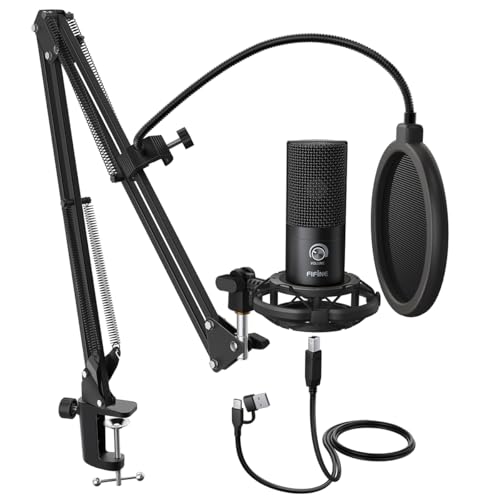
The FIFINE T669 is a USB condenser microphone kit for podcasting, voice-over, and computer-based recording. It connects directly to a PC or laptop without additional hardware or drivers, and its cardioid capsule is designed to capture sound from the front while reducing ambient noise.
Best for: Desktop creators who want a microphone with a boom arm and pop filtering included. The arm adjusts up and down and extends forward and backward, making it easier to position the mic for speaking or voice-over. The included dual-layer pop filter helps reduce plosive bursts from speech.
Why it stands out: This kit combines a USB mic, an adjustable suspension arm, a pop filter, and an 8.2-foot USB cable. It is a more complete desktop arrangement than a standalone microphone, and its setup is designed to be straightforward.
Limitation: The listed features state that it is incompatible with Xbox. Choose another option if Xbox use is essential.
ALSO GO F998 Podcast Equipment Bundle

The ALSO GO bundle pairs a BM800 microphone with an F998 audio interface mixer and several recording accessories. The package lists microphone boom arms, a 3.5mm earphone, shock mounts, pop filters, foam caps, XLR and USB cables, and 3.5mm audio cables.
Best for: New podcasters who want a kit with a mixer and multiple accessories rather than choosing each component separately. The F998 offers 16 background effects, seven podcast and recording modes, four voice-changer modes, and nine adjustable knobs.
Why it stands out: The mixer provides more hands-on sound options than a basic USB microphone. Cardioid pickup, noise-reduction features, a dual-layer pop filter, and a windproof foam cap are listed as tools for focused voice recording.
Limitation: This kit has more controls and components to set up than a simple plug-and-play USB mic. It may be more equipment than necessary for someone who only needs clear speech for calls or basic voice recordings.
ZealSound K66 USB Podcast Microphone

The ZealSound K66 is a condenser USB microphone with gain, volume adjustment, a mute button, headphone monitoring, and echo controls. Its cardioid pickup pattern focuses on sound from the front. The listed frequency response is 40Hz–18kHz, with a 46kHz sampling rate.
Best for: Creators who record on more than one device. The product listing names Windows PCs, Macs, laptops, tablets, PS4, and PS5, and says the included USB-C and Lightning adapters support compatible phones and tablets. It is also presented for podcasting, streaming, online classes, and meetings.
Why it stands out: A selectable noise-reduction mode is intended to reduce sounds such as keyboard clicks, computer fans, air-conditioning hum, and background chatter. The mute button indicates the active mode, while the default mode is described as maintaining a natural vocal tone.
Limitation: The noise-reduction mode is described as helping reduce unwanted sounds, not eliminating them. It does not replace choosing a quieter recording space.
MAONO A04 USB Microphone

The MAONO A04 is a USB condenser microphone designed for computer-based podcasting, live streaming, video calls, speech, and voice-over. Its listed specifications include a 192kHz/24-bit sampling rate and a 16mm electret condenser transducer.
Best for: Buyers who want a direct USB connection for recording on a laptop or computer without adding an external sound card or driver software. Its described frequency response is intended for studio, speech, and voice-over applications.
Why it stands out: The simple connection makes it a practical alternative to a bundle with a separate mixer. The product also lists a magnet ring on the USB cable as an anti-interference feature, and recommends a 2- to 6-inch recording range.
Limitation: The listing says the microphone is not compatible with Xbox. It also does not describe the kind of bundled mixer or extensive onboard controls found in some complete podcast kits.
Dejasound DJM5 Recording Microphone

The Dejasound DJM5 is a USB condenser microphone for podcasting, vocal recording, streaming, and home-studio use. Its listed specifications include a cardioid polar pattern, a 16mm diaphragm, a 192kHz/24-bit sampling rate, and a 30Hz–16kHz frequency response.
Best for: Users who want basic recording controls on the microphone. The DJM5 includes echo control, volume adjustment, a mute button, and a 3.5mm headphone-monitoring jack. Its USB output is described as supporting plug-and-play connection to a PC, laptop, or smartphone.
Why it stands out: The combination of monitoring and onboard adjustments can make it easier to manage a recording without relying entirely on software controls. It is a more control-focused option than the MAONO A04, based on the listed features.
Limitation: The product details do not specify which smartphone connections or adapters are included. Check the connection requirements for your device before choosing it for mobile recording.
Buying Guide: How To Choose Mic And Recording Equipment
Do you need a simple USB microphone or a complete bundle?
A USB microphone is a practical choice for voice recording when you want fewer components and a direct computer connection. The FIFINE T669 and MAONO A04 are examples of this simpler approach. A bundle with an audio interface mixer, such as the ALSO GO F998 kit, makes more sense if you want multiple controls and accessories in one package.
Before choosing a bundle, consider whether you will use its included cables, filters, stands, and sound effects. Extra components can be useful for a more involved setup, but they also require more space and setup time.
Which features matter for clear speech?
A cardioid pickup pattern is designed to focus on sound from the front of the microphone. It can help prioritize a speaker’s voice, but it does not make a room silent. Background noise, microphone placement, and speaking distance still affect the recording.
A pop filter or foam cap can help manage plosive sounds and airflow. For the FIFINE T669, the product listing specifically describes a dual-layer filter. For the ALSO GO bundle, it lists a dual-layer filter and windproof foam cap.
Should you choose onboard controls or software controls?
Onboard controls are useful when you want to mute, adjust volume, monitor audio, or change an effect without navigating recording software. The ZealSound K66 lists gain, volume, mute, monitoring, and echo features. The Dejasound DJM5 lists volume, mute, echo, and headphone monitoring.
If you prefer a simpler setup, a basic USB microphone may be enough. If you plan to change settings during a podcast or livestream, compare the controls and effects available on each device before buying.
What should you check for device compatibility?
Confirm the connection type and supported devices for your intended setup. The ZealSound listing names computers, tablets, consoles, and mobile devices, and includes USB-C and Lightning adapters. The FIFINE T669 and MAONO A04 listings specify that they are not compatible with Xbox. Do not assume that a USB connector alone guarantees compatibility with every phone, console, or recording app.
Do you need an isolation shield or a microphone stand?
A stand helps position a microphone at a consistent distance, while an isolation shield is intended to reduce sound reflections and some ambient interference around the recording area. These are separate accessories rather than substitutes for microphone selection. Consider the available desk or floor space and whether you record seated or standing before adding either to a setup.
Frequently Asked Questions
What is the easiest recording microphone to set up?
A USB microphone described as plug-and-play is a straightforward choice. The FIFINE T669, MAONO A04, and Dejasound DJM5 listings describe direct USB connections without additional hardware or drivers.
Which option is best for a beginner podcast setup?
The ALSO GO F998 bundle is best suited to a beginner who wants a microphone, mixer, and several accessories together. A simple USB microphone may be a better fit if you do not need mixer effects or extra components.
Which microphone includes mobile adapters?
The ZealSound K66 listing says USB-C and Lightning adapters are included for compatible mobile devices. Check that the connector and device requirements match your phone or tablet.
Does a cardioid microphone block all background noise?
No. Cardioid pickup is designed to focus on sound from the front and reduce some unwanted sound, but it does not eliminate room noise. A quiet space and suitable microphone placement remain important.
Can I use the FIFINE T669 or MAONO A04 with Xbox?
The supplied product details say that the FIFINE T669 and MAONO A04 are not compatible with Xbox. Choose equipment whose listing explicitly supports your intended console if console recording is required.