
The best way to connect a microphone to an RCA input is usually to use a microphone preamplifier or mixer with an RCA output. A passive adapter may change the connector but usually does not provide the gain or signal conversion a microphone needs. Of these options, the ATNEDCVH preamplifier is the closest match for a direct microphone-to-RCA setup; the XLR cables below are options only when the connected equipment’s signal level, wiring, and connectors are suitable.
| Product | Best suited for | Key limitation |
|---|---|---|
| ATNEDCVH Stereo Audio Preamplifier | Mic-level input with RCA output | Requires DC 5V power |
| HUALEU 1FT XLR-to-RCA Y Cable | Unbalanced XLR/RCA connections | Does not provide microphone preamp gain |
| SiYear XLR-to-Dual-RCA Cable | Longer XLR-to-RCA connection | Not a substitute for a preamp |
| HUALEU 3FT XLR-to-Dual-RCA Cable | Short XLR-to-RCA patch connection | Signal level and wiring must match |
| Cable Matters Dual XLR-to-RCA Cable | RCA line output to XLR inputs | Its stated connection direction is the reverse use case |
ATNEDCVH Stereo Audio Preamplifier

Best for: Buyers who need a device between a microphone and equipment with RCA inputs. Unlike a simple cable, this product lists microphone among its input sources and RCA left/right among its outputs. It also specifies 20 dB of gain, which is relevant when a low-level source needs amplification before reaching downstream audio equipment.
The unit has XLR balanced, RCA, and 3.5mm inputs and outputs, a volume adjustment knob, and DC 5V power. The listed NE5532 dual op-amp and noise-reduction circuit are product features, not a guarantee of noise-free performance in every setup. Check the microphone’s connector and signal requirements before connecting it.
Why it was selected: It is the clearest match in this list for the actual microphone-to-RCA task because it combines a stated microphone input with RCA outputs. Caution: It requires DC 5V power, and the product description does not identify specific microphone types or phantom-power support. Do not assume it powers a condenser microphone.
HUALEU 1FT XLR-to-RCA Y Cable

Best for: A setup that already has compatible signal levels and needs an XLR male connector on one end and two RCA female connections on the other. The product describes the cable as bidirectional and says its unbalanced wiring connects XLR pin 2 to the RCA center pin, with pins 1 and 3 connected to the RCA ring.
Why it was selected: Its XLR-to-dual-RCA connector arrangement is potentially useful when adapting an XLR connection to a pair of RCA connections. The manufacturer’s bidirectional claim may help with flexible routing, but it does not mean the cable amplifies a microphone signal or converts it to line level.
Caution: A passive cable is not a microphone preamp. A microphone connected directly to an RCA line input may produce a very quiet signal, and wiring or connector fit alone does not resolve that level mismatch. Confirm the equipment’s input and output requirements before use.
SiYear XLR Male To Dual RCA Cable
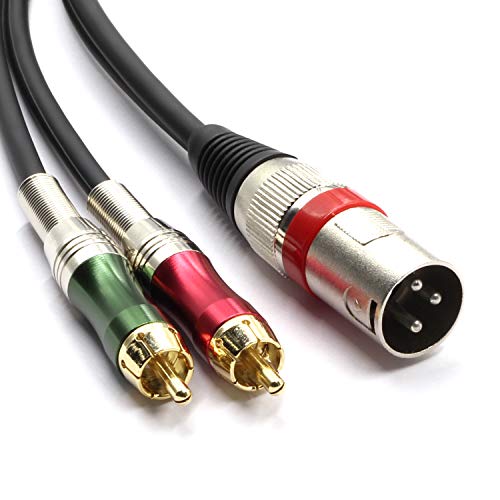
Best for: Buyers who need a 1.5-meter cable with one three-pin XLR male connector and two RCA plugs. Listed uses include connections involving a mixing console, microphone, tape recorder, and amplifier line output. The cable’s stated high-density and aluminum-foil shielding is intended to help prevent electromagnetic and radio-frequency interference.
Why it was selected: It offers a longer XLR-to-dual-RCA cable option than a short adapter, which can suit a setup where the devices are not side by side. Its described application includes audio equipment commonly found around microphones and amplifiers.
Caution: The product details do not state that it supplies gain or otherwise conditions a microphone-level signal for an RCA input. Treat it as a connector cable, not a replacement for a preamp. Check whether the signal source and destination are designed for the cable’s unbalanced connection.
HUALEU 3FT XLR-To-Dual-RCA Cable

Best for: Buyers seeking a three-foot cable with one XLR male and two RCA male plugs. Its listed construction includes 24AWG oxygen-free copper wire, shielding, and gold-plated XLR and RCA connectors. The description presents the cable as an adapter between RCA-output devices and XLR-input equipment, while also claiming bidirectional use.
Why it was selected: The cable’s connector layout is relevant to adapting between XLR and a pair of RCA connections, and its three-foot length can provide more placement flexibility than a short patch cable. The stated materials may matter to buyers comparing cable construction.
Caution: Its described primary example runs from RCA outputs to XLR inputs, not from a microphone into an RCA input. Even if the physical connection can be reversed, that does not make the cable a preamplifier or guarantee suitable signal levels. Verify both connector gender and the equipment’s wiring requirements.
Cable Matters Dual XLR-To-RCA Cable

Best for: Buyers adapting a stereo RCA line output from a DAC, preamplifier, receiver, or similar source to compatible XLR male inputs. The six-foot cable has two female XLR connectors and two RCA male plugs, carrying separate left and right unbalanced analog signals.
Why it was selected: It provides a clearly described stereo RCA-to-XLR connection and specific wiring information: XLR pin 2 connects to the RCA center pin, while pins 1 and 3 connect to the RCA shield. This detail helps buyers compare connection requirements before purchasing.
Caution: This product is described for RCA line outputs feeding XLR inputs, so it is not the most direct choice for a microphone feeding an RCA input. The manufacturer explicitly notes that the cable adapts connectors but does not convert an unbalanced signal into a balanced one. It also does not add microphone gain.
Buying Guide: How To Connect A Microphone To An RCA Input
Do you need a cable or a preamp?
Start by identifying the signal level, not just the connector. A microphone commonly supplies a lower-level signal than an RCA line input expects. A passive adapter changes the physical connection; it does not necessarily increase level. If a mic-level signal is too quiet, choose a microphone preamp or mixer that accepts the microphone and provides an RCA output or a compatible output that can be adapted appropriately.
For the products listed here, the ATNEDCVH preamplifier is the closest match because its description lists both microphone input and RCA output, plus 20 dB of gain. The XLR-to-RCA cables may be useful for suitable equipment connections, but their descriptions do not establish that they provide microphone amplification.
What connectors are on the microphone and RCA equipment?
Check the microphone’s connector, the destination’s RCA input, and the connector genders on each cable. An XLR microphone typically has a three-pin XLR connection, while a consumer RCA input generally uses separate left and right sockets. A cable with one XLR end and two RCA ends does not automatically split a mono microphone signal into usable stereo audio. The product’s wiring and your equipment’s channel arrangement matter.
Also distinguish RCA input from RCA output. Some cables in this list are described primarily for connecting RCA source outputs to XLR inputs. That is the opposite direction from a microphone-to-RCA-input setup. A claimed bidirectional cable can be physically reversible, but it cannot correct an unsuitable signal level or guarantee compatibility with every device.
Will a passive cable provide enough volume?
Usually, a passive cable should not be treated as a gain device. If the microphone is connected directly to a line-level RCA input, the result may be too quiet or otherwise unsuitable. A preamp raises the signal before it reaches the receiving equipment. Check whether the receiving device has a dedicated microphone input; if it does, that may be a better connection point than its RCA line input.
Does the microphone need phantom power?
Some condenser microphones require phantom power, while other microphones do not. The product information supplied for the ATNEDCVH preamplifier does not specify phantom-power support. Do not assume that an XLR connector or a microphone input means phantom power is available. Check the microphone’s documentation and the preamp or mixer specifications before connecting a microphone that requires it.
How should you compare cable length and shielding?
Choose a cable long enough to reach without putting strain on connectors, but avoid excess length when it is not needed. The listed options include a one-foot HUALEU cable, a three-foot HUALEU cable, a 1.5-meter SiYear cable, and a six-foot Cable Matters cable. Some descriptions mention shielding or construction materials. Those details can help compare products, but they do not substitute for checking signal direction, connector type, wiring, and level.
What should you verify before ordering?
- Confirm whether the device has an RCA input or an RCA output.
- Identify whether the microphone output is XLR, 1/4-inch, or another connector.
- Check whether the receiving input expects microphone-level or line-level audio.
- Choose a preamp or mixer if the microphone needs amplification before reaching an RCA line input.
- Verify cable connector gender, channel count, wiring, and any phantom-power requirements.
Frequently Asked Questions
Can I plug an XLR microphone directly into an RCA input?
Only if the connectors and signal requirements are suitable, but a passive cable does not add gain. A microphone may be too quiet for an RCA line input. A preamp or mixer is generally the more appropriate solution when the destination lacks a microphone input.
Does an XLR-to-RCA cable convert microphone level to line level?
No. A passive cable adapts connectors and wiring; it does not provide preamplification. Use a microphone preamp or mixer when the signal needs additional gain.
Which listed product is the closest match for microphone to RCA?
The ATNEDCVH Stereo Audio Preamplifier is the closest match because its product information lists microphone input, RCA output, and 20 dB of gain. Its description does not confirm phantom-power support, so check microphone requirements separately.
Can I use a cable labeled RCA to XLR in reverse?
Some listed cables claim bidirectional use, but reversing a cable does not change its signal level or guarantee that its wiring suits the connected devices. Check the exact connector genders, pin wiring, and equipment instructions before relying on reverse use.
Will a microphone connected to RCA play in stereo?
Not necessarily. A single microphone normally supplies a mono signal. A cable with two RCA plugs does not by itself create a true stereo microphone signal. The destination and any preamp or mixer determine how the mono signal is routed.