Best MIDI Controllers for Guitarists: Keyboard, Foot Pedal, and Bluetooth Options
Looking to control MIDI-enabled gear from a guitar setup? This guide highlights the best MIDI foot controllers and compact MIDI keyboards that integrate with guitar rigs, amps, and multi-effects. These picks are ideal for players who want seamless control over loops, effects, and parameter changes without breaking their playing flow. The top options below suit different needs: compact Bluetooth foot controllers for stage use, feature-rich MIDI pedals for live rigs, and keyboard-style controllers for studio tweaking. The following table summarizes the five hand-picked products and who they’re best for.
| Product | Best For |
|---|---|
| HOTONE MIDI Foot Controller Pedal Ampero Control | Guitarists needing compact Bluetooth control and multiple banks |
| Behringer FCB1010 Ultra-Flexible MIDI Foot Controller | Players who want extensive banked presets and dual expression pedals |
| M-VAVE Chocolate Plus Wireless MIDI Guitar Pedal Turner | Guitarists seeking wireless BT control for loops and DAW |
| PAINTAUDIO MIDI Captain Foot Controller | Pro setups needing many programmable switches and deep customization |
| Akai MPK Mini MK3 | Studio and practice rigs needing a portable keyboard controller |
HOTONE MIDI Foot Controller Pedal Ampero Control

This compact, four-footswitch Bluetooth MIDI controller is designed for players who need fast, on-the-fly control. It supports standard MIDI, USB MIDI, and Bluetooth MIDI Input/Output/Thru, making it easy to integrate with guitar rigs, amps, and floor processors. The dedicated mobile app lets you adjust settings on the fly, and you can send or transfer up to 16 MIDI messages per footswitch (32 for A/B groups). With 100 banks of presets and flexible trigger actions, this device is best for players performing live who require quick, reliable access to multiple effects and loops. A limitation to note: the unit relies on Bluetooth connectivity for wireless operation, which can introduce latency if used with certain gear setups. Choose this if you value portability and Bluetooth convenience for live performances.
- Best for: Stage players needing quick, wireless control with many preset banks.
- Key strengths: Bluetooth MIDI, mobile app control, multiple message sends per switch, large preset banks.
- Potential limitation: Bluetooth latency can affect timing in very tight setups.
Behringer FCB1010 Ultra-Flexible MIDI Foot Controller

Behringer’s FCB1010 offers extensive customization for players who need robust, programmable control across large gigs or studio sessions. It features 10 banks with 10 user-editable presets each and two expression pedals with freely assignable MIDI channel, controller number, and range. Each preset can transmit five MIDI program changes and two MIDI controller commands simultaneously. This makes it a strong choice for guitarists who need deep routing options and hands-free control of multiple effects, synths, or DAW parameters. A caveat: its size and weight are greater than compact footcontrollers, so it’s better suited for pedalboards with room or studio desks. Choose this if you want maximum flexibility and extensive pedal control.
- Best for: Players who require many presets, multiple pedals, and deep MIDI routing.
- Key strengths: 10 banks x 10 presets, two expression pedals, multiple commands per preset.
- Potential limitation: Bulky footprint and heavier build than compact options.
M-VAVE Chocolate Plus Wireless MIDI Guitar Pedal Turner

This wireless Bluetooth MIDI foot controller is built for guitarists who want freedom from cables. It features four foot switches and a rechargeable battery, plus an intelligent app for control over page turns, DAW integration, and loop/pedal switching. The device supports BLE/MIDI control across multiple platforms, including Windows, macOS, iOS, and Android. It’s ideal for stage performers who need reliable wireless control of loops, tuner, and effects without a tether. A limitation is that wireless reliability can vary with environment and Bluetooth interference. Choose this if you want hands-free, wireless control and easy app-based management.
- Best for: Guitarists needing wireless control and app-driven customization.
- Key strengths: Bluetooth MIDI, cross-platform app, portable 4-button layout.
- Potential limitation: Wireless performance may vary by environment.
PAINTAUDIO MIDI Captain Foot Controller

The PAINTAUDIO MIDI Captain is a feature-rich foot controller designed for complex live rigs and studio setups. It supports 10 foot switches and a time engine that automates key actions across a bank of presets. Each switch can be fully customized, with USB Deep Setup Mode allowing updates and expanded functionality. This controller is best for advanced users who want intricate control over a broad range of effects, synths, and MIDI-enabled gear. A potential limitation is the learning curve required to master its many functions. Choose this if you need deep customization and ongoing flexibility for large rigs.
- Best for: Pro setups needing extensive customization and automation.
- Key strengths: Time Engine, 10 fully customizable switches, USB update support.
- Potential limitation: Complex to configure and learn for beginners.
Akai MPK Mini MK3 25-Key USB MIDI Controller
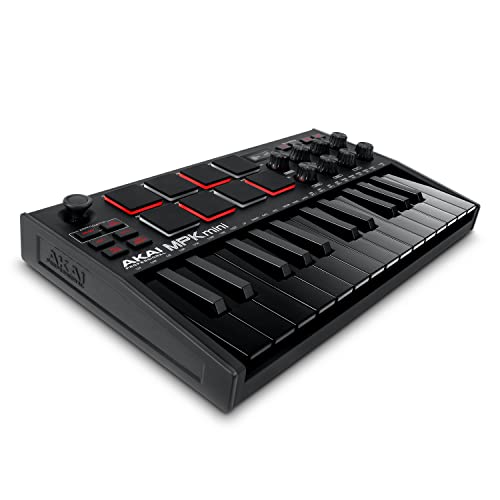
The Akai MPK Mini MK3 is a compact USB MIDI keyboard controller with 25 velocity-sensitive keys, eight backlit drum pads, and eight assignable knobs. It also includes a four-way thumbstick for pitch and modulation control, plus an arpeggiator with adjustable resolution, range, and modes. While designed primarily for studio production and on-the-go music creation, its portability makes it a solid choice for guitarists who want a small payload to control virtual instruments, loopers, and DAWs in rehearsal spaces or on the road. It lacks integrated expression pedals or footswitches, so consider pairing it with a separate pedal for hands-free control if needed.
- Best for: Guitarists who want a portable keyboard-style controller for DAWs and synths.
- Key strengths: 25 keys, eight pads, NKS integration compatibility with NI software.
- Potential limitation: No built-in foot switches or expression pedals.
Buying Guide: Key Considerations for Guitar MIDI Controllers
When choosing a MIDI controller to use with a guitar setup, consider the following questions and guidelines:
- What is your primary use case? Live performance, studio production, or both? Choose a device with the right balance of portability and control features for your setting.
- Bluetooth vs. USB? Do you need wireless operation on stage, or is a wired connection more reliable for your rig?
- How many banks and presets do you need? More banks allow deeper preset management for multiple songs or tones.
- Do you require expression pedals or full footswitch control? Some devices provide dedicated pedals; others rely on separate gear.
- Is size and weight a factor? Compact controllers are easier on a pedalboard but may offer fewer controls.
- Software compatibility and setup. Look for devices with easy app control or strong DAW integration for quick changes during gigs.
Comparison at a Glance
- Best for compact stage use: HOTONE Ampero Control—Bluetooth, 4-footswitch, many banks.
- Best for maximum routing flexibility: Behringer FCB1010—10 banks, dual pedals, extensive command options.
- Best for wireless convenience: M-VAVE Chocolate Plus Wireless—Bluetooth, 4 switches, cross-platform app.
- Best for deep on-stage customization: PAINTAUDIO Captain—Time Engine, USB Deep Setup, 10 switches.
- Best for portable studio integration: Akai MPK Mini MK3—25 keys, pads, and NKS-ready for virtual instruments.
FAQs
- Can a guitar player use a keyboard-style MIDI controller? Yes, many guitarists use compact keyboards to trigger synths, DAWs, or software effects when plugged into a host device.
- Do wireless MIDI controllers introduce latency? Some Bluetooth devices may experience minimal latency depending on the gear and environment; wired connections are typically more consistent for timing-critical tasks.
- What should I look for in an expression-capable MIDI pedal? Look for dedicated expression pedal inputs, assignable MIDI messages, and reliable calibration options.
- Are there any compatibility considerations with DAWs? Most modern MIDI controllers support common DAWs; check for native support or included software like NI integration or special editors.
- Is a large bank count useful for live gigs? Yes, more banks simplify song-by-song mapping, allowing you to switch tones and effects quickly between numbers.
- Should I choose a compact controller or a full-size setup? If you perform live with limited space, choose compact options; for layered rigs in studio or stage, consider larger controllers with more switches and pedals.