
The best MIDI keyboard for live performance depends on how you trigger sounds: the Akai MPK Mini IV is best for compact pad-and-knob control, while the M-Audio Oxygen 49 MKV offers full-size keys for playing parts. The Keystation 49 MK3 is a straightforward 49-key option, and the MPK Mini MK3 and Donner N-25 suit portable setups. These controllers send MIDI data; the listed product details do not identify built-in sound engines or speakers, so check your performance rig’s software and connections before choosing.
| Keyboard | Best for | Key format | Notable control |
|---|---|---|---|
| Akai MPK Mini IV | Compact live triggering | 25 mini keys | Eight pads and eight knobs |
| M-Audio Oxygen 49 MKV | Playing parts across a wider range | 49 full-size keys | Velocity-sensitive keys |
| M-Audio Keystation 49 MK3 | A basic 49-key controller choice | 49 keys | Details are limited in the supplied listing |
| Akai MPK Mini MK3 | Portable playing with pitch and modulation control | 25 mini keys | Four-way thumbstick and arpeggiator |
| Donner N-25 | Beginners and compact practice or performance rigs | 25 mini keys | Programmable banks and tap tempo |
Akai Professional MPK Mini IV

Best for: Performers who need compact keys alongside hands-on control for beats, samples, and software instruments. Its 25 mini velocity-sensitive keys support piano-style parts and synth leads, while eight velocity- and pressure-sensitive MPC pads are designed for finger drumming and sample triggering.
The MPK Mini IV also has eight assignable 360-degree knobs, a full-color screen, and a push/turn encoder. Those controls can make it a better fit than a keyboard-only controller when a performer wants to adjust settings or navigate presets without reaching for the computer. The product is USB-powered, which is useful when planning a compact setup.
Consideration: The 25-key mini format offers less playing range than a 49-key model. Choose this if pads and controls matter more than a full-size keyboard span; avoid it if you need more physical keys for two-handed parts.
M-Audio Oxygen 49 MKV

Best for: Players who prioritize a wider playing range and full-size piano-style keys. The Oxygen 49 MKV has 49 velocity-sensitive full-size keys, a practical distinction for live parts that require more range than a 25-key mini controller provides.
The listed Native Kontrol Standard integration is intended to let users control Native Instruments presets and sound libraries from the Oxygen series. The listing also describes a choice of one of three curated Komplete 15 Select bundles: Beats, Band, or Electronic. These software-related features may suit performers who build their set around compatible virtual instruments and libraries.
Consideration: The supplied feature information does not specify pad count, dimensions, or connection details. Confirm that the controller’s controls and connection method suit your particular stage setup before buying. Choose it for its 49 full-size keys rather than assuming it has a particular pad layout.
M-Audio Keystation 49 MK3

Best for: Shoppers considering a 49-key MIDI controller who want to compare a Keystation model with the feature-rich Oxygen 49 MKV. The product name identifies it as a USB MIDI controller with 49 keys, making its key count and USB MIDI category clear from the supplied listing.
A 49-key layout may be a better starting point than a 25-key mini keyboard for performers who want more room to play notes. The listing data provided here does not describe its key action, knobs, pads, software, or other performance controls, so those details should not be assumed from the model name alone.
Consideration: Product details are limited in the supplied information. Check the current listing for the exact controls, included items, and connection requirements before deciding whether it meets your stage needs.
Akai Professional MPK Mini MK3

Best for: Performers seeking a compact 25-key controller with dedicated pitch and modulation gestures. Its velocity-sensitive mini keys are suited to portable playing, and a four-way thumbstick provides dynamic pitch and modulation control.
The built-in arpeggiator has adjustable resolution, range, and modes, offering another way to shape note patterns during production or performance. The listing also identifies Native Kontrol Standard integration with Native Instruments. That may be relevant to performers who want to work with compatible presets and sound libraries.
Consideration: The mini keyboard format limits the physical playing range compared with 49-key controllers. Choose this if portability and the thumbstick are priorities; choose a larger keyboard if your set depends on a wider span of keys.
Donner Mini MIDI Keyboard N-25
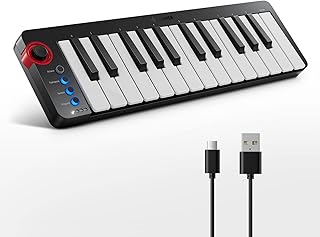
Best for: Beginners and performers who want a small controller with basic tools accessible from the keyboard. The N-25 has 25 mini velocity-sensitive keys and four user-programmable banks. Its listed functions include an arpeggiator, sustain, octave control, and tap tempo.
The supplied details say it connects with Mac or PC through USB-MIDI without extra drivers and can connect to smartphone music apps using an OTG adapter. The listing also mentions 40 teaching courses. These details make it a candidate for someone combining music learning with a compact software-based setup.
Consideration: Its 25-key mini layout is less suitable for parts that need a broad keyboard range. Phone connection requires an OTG adapter according to the listing, so account for that accessory when planning a mobile setup.
Buying Guide: Choosing A Live MIDI Keyboard
How many keys do you need onstage?
Key count affects how much of a part you can play without changing octaves or moving your hands. A 25-key controller is compact and can work well for short synth lines, riffs, and note input. A 49-key controller gives you more room for melodies, chords, and two-handed parts. The Keystation 49 MK3 and Oxygen 49 MKV are the options here with 49 keys; the MPK Mini IV, MPK Mini MK3, and Donner N-25 have 25.
Key size matters too. The Oxygen 49 MKV is specifically described as having full-size piano-style keys. The three 25-key models are described as having mini keys. Consider your playing technique and available stage space together rather than choosing by key count alone.
Do you need pads, knobs, or performance gestures?
For launching samples or finger drumming, the MPK Mini IV stands out in this group because it lists eight velocity- and pressure-sensitive MPC pads. Its eight assignable knobs and screen add direct control options. The MPK Mini MK3 instead highlights a four-way thumbstick for pitch and modulation, plus an adjustable arpeggiator.
The Donner N-25 emphasizes programmable banks and core functions such as sustain, octave, and tap tempo. The Oxygen 49 MKV’s supplied details focus on keys and Native Kontrol Standard integration. The Keystation listing information provided here is not detailed enough to compare its control layout. If a particular pad or knob arrangement is essential, verify it in the current product listing.
Will it work with your live software setup?
A MIDI controller sends performance or control information to compatible equipment or software; the supplied feature descriptions do not establish that any of these keyboards produce sound on their own. Before buying, identify the instrument or performance software you plan to use and confirm how it receives MIDI. Also check the needed cable, adapter, and power arrangements for your computer, mobile device, or other gear.
The Donner listing explicitly describes USB-MIDI connections with Mac and PC and smartphone music-app connection through an OTG adapter. The MPK Mini IV is described as USB-powered. For the other controllers, the information provided here does not fully establish stage-specific connection or power requirements. Verify those points against the manufacturer’s current specifications.
What should you prioritize for portability?
A compact 25-key controller can take up less space than a 49-key layout, but the product details supplied do not give dimensions or weights for a direct size comparison. If you carry your own gear, check those measurements and consider how the keyboard will fit with your stand, laptop, cables, and other instruments.
For a compact controller with multiple control types, compare the MPK Mini IV’s pads and knobs with the MPK Mini MK3’s thumbstick and arpeggiator. For a simpler beginner-oriented feature set, the Donner N-25 lists programmable banks and teaching courses. Match the feature set to what you will actually operate during a set.
Which details should you verify before a performance?
- Connections: Confirm the controller can connect to the computer or device running your instruments and that you have the required cable or adapter.
- Control mapping: Check whether keys, pads, knobs, and other controls can be assigned as needed in your software.
- Power: Verify how the keyboard receives power and whether your planned setup provides it.
- Software: Confirm that any included or supported software is appropriate for your instruments and operating system.
- Stage layout: Compare key count and key size with the parts you play and the space available.
These checks are especially important when feature data is limited. A controller’s model name or MIDI designation does not, by itself, confirm particular pad controls, software behavior, or a specific connection workflow.
Frequently Asked Questions
Can a MIDI keyboard make sound by itself?
The listed products are described as MIDI controllers, and the supplied details do not say that they have built-in sound engines or speakers. Plan to use a compatible sound source, such as software or other MIDI equipment, and confirm how your chosen setup connects.
Is a 25-key or 49-key MIDI keyboard better for live performance?
A 25-key model is a better fit when compact size and simple riffs, leads, or triggering matter most. A 49-key model provides more playing range for melodies and parts that need more notes at once. The right choice depends on your repertoire and stage space.
Which keyboard in this selection has performance pads?
The Akai Professional MPK Mini IV listing specifies eight velocity- and pressure-sensitive MPC pads with RGB feedback. The other supplied product details do not specify an equivalent pad configuration.
Which option is designed with beginners in mind?
The Donner N-25 listing describes a beginner-friendly layout, four programmable banks, core keyboard functions, and 40 teaching courses. Those listed features make it a relevant option for new users who also want a compact controller.
Can I connect a MIDI keyboard to a phone or tablet?
The Donner N-25 listing says it can connect to smartphone music apps with an OTG adapter. For other models, the information provided here does not confirm mobile-device compatibility. Check the keyboard, device, app, and adapter requirements before purchasing.
What is the main difference between the MPK Mini IV and MPK Mini MK3?
The MPK Mini IV listing emphasizes eight pads, eight assignable knobs, a color screen, and an encoder. The MPK Mini MK3 listing highlights a four-way pitch-and-modulation thumbstick, an adjustable arpeggiator, and Native Kontrol Standard integration. Both have 25 velocity-sensitive mini keys.