
The best monitor speakers for a keyboard depend on where and how you play. The PreSonus Eris 3.5 is best for compact desktop practice, while the Yamaha HS4 and HS5 are nearfield studio monitors for detailed listening. The Coolmusic DM20 is designed for instrument practice with Bluetooth and USB playback, and the ALTO TX410 is better suited to louder rehearsals and performance spaces.
| Product | Best suited for | Key listed feature |
|---|---|---|
| PreSonus Eris 3.5 | Compact home practice | 50 watts; 3.5-inch woofers |
| Yamaha HS4 | Nearfield keyboard monitoring | Pair; 4.5-inch woofer |
| Yamaha HS5 | Detailed studio listening | 70-watt bi-amp system |
| ALTO TX410 | Rehearsals and performance spaces | 350-watt powered PA speaker |
| Coolmusic DM20 | Practice with backing tracks | Instrument input, Bluetooth, and USB |
PreSonus Eris 3.5

Best for: Keyboard players who want a compact stereo pair for home practice, desktop listening, or a small music-production setup. The Eris 3.5 is sold as a pair and has 50 watts of built-in amplification, so it does not require a separate power amplifier.
Its 3.5-inch woven-composite woofers and 1-inch silk-dome tweeters are specified for a frequency range of 80 Hz to 20 kHz. That gives buyers a clear description of its low- and high-frequency coverage when comparing it with larger monitors. The manufacturer describes the sound as balanced, with bass and highs suited to music and general listening.
Why it was selected: This is a straightforward choice for players who value a smaller footprint and stereo monitoring over filling a large room. It is also listed for uses beyond music production, including gaming, movies, and streaming.
Limitation: The listed frequency range starts at 80 Hz, and the 3.5-inch woofer is smaller than the drivers in the Yamaha HS4 and HS5. Choose another option if you specifically need larger drivers or strong sound coverage in a performance space.
Yamaha HS4 Powered Studio Monitors
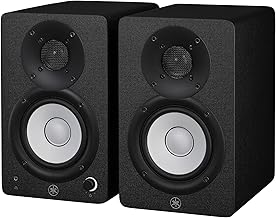
Best for: Keyboardists looking for a pair of two-way powered monitors for close-range listening. The listed package includes a pair, and each speaker design uses a 4.5-inch cone woofer with a 1-inch dome tweeter.
The HS4 has a stated frequency response of 60 Hz to 22 kHz at -10 dB. That specification gives buyers a useful comparison point against the smaller PreSonus Eris 3.5, whose listed range begins at 80 Hz. The HS4 is a middle-size option among the products here: it has a larger woofer than the Eris 3.5 and a smaller woofer than the HS5.
Why it was selected: A pair of powered, two-way monitors can suit a home keyboard setup where stereo sound and nearfield monitoring are priorities. The driver sizes and frequency specification make the HS4 a clear option for buyers comparing compact monitors.
Limitation: The supplied product details do not state amplifier power or connection types. Check that the inputs match your keyboard or audio setup before choosing this model.
Yamaha HS5 Powered Studio Monitor

Best for: Keyboard players who want a larger nearfield monitor with a 5-inch woofer and a stated bi-amplified power system. The listed configuration includes a 45-watt low-frequency amplifier and a 25-watt high-frequency amplifier, for 70 watts of total amplification.
The HS5 is a two-way, bass-reflex monitor with a 1-inch dome tweeter. Its stated frequency response is 54 Hz to 30 kHz. Compared with the HS4, it has a larger woofer and a wider stated frequency range; compared with the Eris 3.5, it is the larger-driver studio-monitor option in this selection.
Why it was selected: It suits players who want a studio-monitor format for hearing keyboard parts in detail at a listening position near the speakers. Its driver and amplifier specifications make it easy to compare with smaller monitors.
Limitation: The supplied listing describes one monitor, not a pair. Buyers wanting stereo should confirm how many units are included and check that the speaker connections suit their keyboard setup.
ALTO TX410 Powered PA Speaker

Best for: Keyboard players who need a speaker for a larger practice room, rehearsal, or performance venue rather than quiet desktop monitoring. The TX410 is a 10-inch powered PA speaker with 350 watts of bi-amplified power.
Its listed design emphasizes projection and clarity in settings with crowd or background noise. The speaker is described as suitable for pole mounting or floor-monitor use and has straightforward onboard controls. Those features make it a different type of choice from the Yamaha and PreSonus nearfield studio monitors.
Why it was selected: It addresses a different buyer need: making a keyboard audible across a room or in a live setting. Choose this if sound coverage and a PA-style format matter more than a compact desk arrangement.
Limitation: A PA speaker is not the same product category as a close-range studio monitor. The provided features do not specify the exact input connections, so check compatibility with your keyboard before purchasing.
Coolmusic DM20 Keyboard Monitor

Best for: Keyboardists who want an instrument-focused practice speaker with backing-track playback. The DM20 is a 20-watt personal monitor amplifier with a standard 1/4-inch instrument input, Bluetooth, and a USB slot for playing files from a flash drive.
Its listed speaker components are a 6.5-inch woofer and a 2.5-inch tweeter. Separate low- and high-tone controls let users adjust those parts of the sound, while a master volume dial controls overall level. The product is also described for electronic drums and digital pianos, as well as keyboards.
Why it was selected: The combination of a direct instrument input and built-in playback features makes it a practical practice-oriented choice. It can play backing tracks from a phone or tablet over Bluetooth, or from a USB flash drive.
Limitation: The listed 20-watt output is lower than the ALTO TX410’s stated 350 watts. Choose a PA speaker instead if your main priority is higher-output sound for a larger venue.
Buying Guide: How To Choose Keyboard Monitor Speakers
Do you need studio monitors, a practice amp, or a PA speaker?
Start with the room and listening distance. Studio monitors such as the PreSonus Eris 3.5 and Yamaha HS4 or HS5 are intended for nearfield listening. They can suit a home setup where the player listens from close to the speakers. A keyboard practice amplifier, such as the Coolmusic DM20, adds instrument-focused controls and playback options. A PA speaker such as the ALTO TX410 is aimed at louder, larger spaces.
How important are speaker size and frequency specifications?
Driver size and frequency range help compare products, but neither specification alone guarantees that a speaker will suit every room or keyboard. In this selection, the woofer sizes range from 3.5 inches on the Eris 3.5 to 10 inches on the TX410. The Yamaha HS5 has a listed 54 Hz to 30 kHz response, while the HS4 lists 60 Hz to 22 kHz at -10 dB. Compare the figures as product specifications, not as a substitute for considering placement and use.
Should you choose a pair or a single speaker?
A pair can reproduce stereo keyboard parts, provided the keyboard or audio setup supports stereo output and the speakers can be connected appropriately. The Eris 3.5 and HS4 are explicitly listed as pairs. The HS5 product details describe a monitor but do not state that the package includes two units. Confirm package quantity before planning a stereo setup.
Which connections and playback features matter?
Check the keyboard’s output connectors against the speaker’s inputs before buying. The DM20 listing specifically names a 1/4-inch instrument input, Bluetooth, and USB playback. The supplied descriptions for the other products do not give a full input list, so verify the exact model’s connection options. Bluetooth and USB playback can be useful for practice tracks, but they do not replace checking the direct keyboard connection.
What should you consider for rehearsals and live use?
For a room with other musicians or an audience, sound coverage may matter more than nearfield detail. The TX410 is the clearest PA-oriented option here: its listing specifies 350 watts, a 10-inch speaker, pole mounting, and floor-monitor use. For bedroom or desktop practice, a smaller studio monitor or personal amplifier may fit better. Match the speaker category to the space instead of choosing only by wattage.
Frequently Asked Questions
Can I use studio monitors with a keyboard?
Yes, studio monitors can be used with a keyboard if the keyboard’s output and the monitor’s input are compatible. Check the connection types and package contents, especially if you want a stereo pair.
Which option is best for a small home practice setup?
The PreSonus Eris 3.5 is a compact powered stereo pair with 50 watts of built-in amplification. The Coolmusic DM20 is another practice-focused choice if you want a 1/4-inch instrument input and built-in Bluetooth and USB playback.
Which product is better for a larger rehearsal space?
The ALTO TX410 is the PA-style option in this selection. It has a 10-inch speaker and 350 watts of listed bi-amplified power, and its features include pole mounting and floor-monitor use.
Is the Yamaha HS5 sold as a pair?
The supplied HS5 product details describe a powered studio monitor but do not confirm that the package includes a pair. Check the current listing’s package quantity before buying for stereo keyboard monitoring.
Can the Coolmusic DM20 play backing tracks?
Yes. Its listed features include Bluetooth playback from phones or tablets and USB playback from a flash drive. The USB slot is described as disconnecting Bluetooth while reading local music files.