
If you are looking for a new cassette deck or player, the right choice depends on whether you want to record, duplicate tapes, or simply listen. The TEAC W-1200 is best for flexible home playback and recording, while the Pyle dual decks are better suited to basic dubbing and RCA-connected setups. The FiiO CP13 is a portable cassette player, not a recording deck. Product details vary, so check the listed features and confirm the connections and functions you need before buying.
| Product | Best suited for | Key listed feature |
|---|---|---|
| TEAC W-1200 | Home playback, recording, and tape handling | Two independent decks; pitch control; USB listed in name |
| FiiO CP13 | Portable cassette listening | Headphone output and USB-C charging |
| Pyle Dual Cassette Deck | Basic tape dubbing and RCA connections | Normal and high-speed dubbing |
| Pyle Digital Dual Cassette Deck | Dual-deck playback and dubbing | CrO2 selector and three-digit counter |
| Onkyo TARW244 | Shoppers considering a double cassette deck | Listed as a double cassette deck |
TEAC W-1200 Dual Cassette Deck
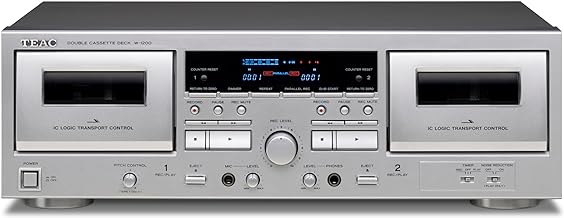
The TEAC W-1200 is the most feature-rich home deck in this selection for people who want two cassette mechanisms and recording functions. Its independent one-way decks let you prepare a cassette in one bay while the other is playing or recording. That can make tape changes and handling more convenient during longer listening or recording sessions.
Both mechanisms play Normal Type I, Chrome Type II, and Metal Type IV tapes. The listed recording support is narrower: Normal and Chrome tapes. The deck also includes a built-in noise-reduction system intended to reduce playback hiss and support tapes recorded with Dolby B noise reduction.
- Best for: Home users who want two independent mechanisms, tape recording, and playback controls.
- Why it stands out: TAPE1 has ±12% pitch control and A-B Repeat, while both decks include Return-to-Zero counter functions.
- Consider: Recording is listed for Normal and Chrome tapes, not Metal tapes. The deck is a home component rather than a portable player.
Pitch adjustment can help when an older tape plays at the wrong speed or key. A-B Repeat and adjustable speed may also be useful for reviewing or transcribing recorded speech. The product name lists USB, karaoke microphone input, and a remote, but the provided feature details do not explain their exact specifications; confirm the functions you require before purchase.
FiiO CP13 Portable Cassette Player

The FiiO CP13 is a portable cassette player for listeners who want to play tapes rather than record or duplicate them. It has physical play, stop, rewind, and fast-forward buttons, a volume dial, a 3.5 mm headphone input, and a USB-C charging port. Its listed controls and headphone connection distinguish it from the full-size dual cassette decks in this guide.
FiiO describes the CP13 as using an all-analogue circuit and a JRC5532 op-amp. The casing is made from aluminium alloy, with a large analogue volume knob. These are design and component details from the product description; they do not establish how the player will sound with every cassette or headphone.
- Best for: People who want a dedicated portable device for cassette listening.
- Why it was selected: It offers straightforward transport buttons, a headphone input, and USB-C charging in a compact player format.
- Consider: The supplied details do not list recording, dubbing, speakers, or a line output. Choose another product if you need a recording deck or a component with RCA outputs.
The CP13 should be compared with portable cassette players, not treated as a direct substitute for a dual-deck home recorder. Check whether the included or separately required accessories meet your listening setup needs; the provided product information does not specify what accessories are included.
Pyle Home Dual Cassette Deck

The Pyle Home Dual Cassette Deck is best for buyers who prioritize tape-to-tape dubbing and conventional RCA connections. It offers normal-speed and high-speed dubbing, so users can choose between regular-speed copying and a faster transfer option. The provided details do not state how the sound quality differs between those speeds.
The deck includes RCA line inputs and outputs, a three-digit tape counter, a CrO2 tape selector, an auto tape selector, and an auto-stop function. Its product description also lists recording-level control and removable rack-mounting hardware. A digital link interface is described for connection to a PT600A amplifier, which is not included.
- Best for: Users who want a dual cassette component for dubbing and RCA-connected audio equipment.
- Why it was selected: It combines two dubbing speeds with basic tape monitoring and line connections.
- Consider: The PT600A amplifier is not included. Verify that your existing equipment has compatible connections before choosing this model.
The listing identifies the unit as a 110V/220V device, but the available information does not explain how voltage selection works. Buyers should check the product instructions and their local power requirements rather than assume a particular setup. This model is a more direct choice for copying tapes than the portable FiiO player.
Pyle Digital Dual Cassette Deck

This Pyle model is another option for buyers seeking a dual cassette deck with dubbing and RCA line connections. Its listed features closely resemble those of the other Pyle deck: normal- and high-speed dubbing, a three-digit counter, CrO2 tape selection, auto tape selection, and auto stop. It also lists a digital link interface for connection to a PT600A amplifier.
The description calls this product a digital dual cassette deck, but the supplied feature list does not specify a digital audio output or computer-transfer function. Its listed connections are RCA line inputs and outputs, and the digital link is described for the PT600A amplifier. Do not assume it digitizes tapes to a computer based on the word “digital” in the product name.
- Best for: Buyers who want a dual-deck dubbing unit with tape counter and RCA connections.
- Why it was selected: It offers the same practical dubbing and monitoring categories as the other Pyle model in this product list.
- Consider: The amplifier is not included, and the provided details do not describe direct computer conversion.
Compare this model with the other Pyle deck by checking the current listing for exact model details and included hardware. Their supplied feature descriptions are very similar, so the information here does not establish a meaningful performance advantage for one over the other.
Onkyo TARW244 Double Cassette Deck

The Onkyo TARW244 is listed as a double cassette deck, making it a possible candidate for shoppers comparing two-bay home components. However, no features beyond the product name were supplied for this listing. That means the available information does not confirm its recording functions, tape types, connections, dubbing speeds, controls, or included accessories.
- Best for: Shoppers specifically researching an Onkyo double cassette deck who can verify the full listing details.
- Why it was selected: It is explicitly identified as a double cassette deck, so it is relevant to buyers looking for a home component rather than a portable player.
- Consider: The available product data is too limited for a feature-by-feature comparison. Confirm the exact condition, capabilities, and connections before purchase.
Compared with the TEAC and Pyle products described above, the Onkyo listing provides much less information here. Do not assume it has the same recording, dubbing, or connection options simply because it is a double deck.
Buying Guide: How To Choose A Cassette Deck
Do you need a cassette deck or a cassette player?
A cassette player is intended primarily for listening. A cassette deck is generally the more relevant category when you need home connections, recording, or tape-to-tape dubbing. In this selection, the FiiO CP13 is described as a portable player with headphone output and transport controls. The TEAC and Pyle products are described as decks with two mechanisms or dubbing features.
Start by listing the tasks you expect the device to perform. If you only want to play tapes through headphones, a portable player may meet the purpose. If you need to record audio onto cassettes, copy tapes, or connect to other audio equipment, inspect the deck’s recording and input/output details instead.
Do you want to record or duplicate tapes?
Recording and dubbing are different needs. The TEAC W-1200 feature list identifies recording support for Normal and Chrome tapes. The Pyle decks list normal- and high-speed cassette dubbing, along with RCA inputs and outputs. The supplied FiiO and Onkyo descriptions do not confirm recording capabilities.
For tape copying, check whether the unit supports the source and destination arrangement you need, and whether the listed dubbing speed is acceptable. High-speed dubbing can save time, but the provided product details do not quantify transfer time or describe the resulting audio quality. For recording, check the supported tape types and available input connections.
Which tape types should you check?
Tape-type support can affect which cassettes a deck can play or record. TEAC lists playback for Type I, Type II, and Type IV tapes, while recording is listed for Type I and Type II. The Pyle descriptions mention a CrO2 selector and auto tape selection, but do not provide the same full type-by-type playback and recording breakdown.
If your collection includes different formulations, check both playback and recording support. A statement that a deck plays a tape type does not automatically mean it can record onto that type. For older tapes, also consider whether the unit has controls that address playback speed or noise reduction.
Which connections fit your audio setup?
RCA line inputs and outputs are listed for both Pyle decks. The TEAC product name includes USB, but the supplied feature details do not explain the USB function. The FiiO CP13 lists a 3.5 mm headphone input and USB-C charging. These connections serve different purposes, so match them to your receiver, amplifier, headphones, or computer workflow rather than relying on the product category alone.
Check the exact ports and their intended uses in the current product information. A charging port is not necessarily an audio output, and a product name mentioning USB does not by itself confirm a specific computer-transfer process. The Pyle digital link is described as connecting to a PT600A amplifier, which is not included.
Are pitch control and noise reduction important?
Pitch control changes playback speed. On the TEAC W-1200, TAPE1 has an adjustment range of ±12%, which may help when a tape’s playback speed or key needs correction. The product also combines pitch adjustment with A-B Repeat for reviewing sections of speech. The other supplied product descriptions do not list comparable pitch controls.
The TEAC also lists a built-in noise-reduction system for reducing tape hiss and playing tapes recorded using Dolby B noise reduction. If you have older recorded tapes, compare noise-reduction support with your collection. Do not assume that every cassette deck can reproduce a particular recording’s noise-reduction treatment.
Do you need a portable design or two independent bays?
Choose based on where and how you will use the device. The FiiO is described as a portable player with a volume dial, headphone input, and USB-C charging. The TEAC’s two independent mechanisms are intended for home use and allow activity on one deck while the other is being handled. Pyle’s dual-deck models emphasize dubbing.
A portable player is not a replacement for a recording component, and a full-size dual deck may be unnecessary for headphone-only listening. Compare the product’s stated purpose with your available space and the tasks you actually perform.
What should you verify before buying?
Confirm the precise model, included accessories, power requirements, and connections in the current listing. This is especially important when a listing provides limited details, as with the Onkyo TARW244. For Pyle, note that the PT600A amplifier is not included. For TEAC, verify the exact USB and microphone functions if those features are central to your choice.
Also distinguish supported features from assumptions. A dual cassette deck is not automatically a tape digitizer, a player is not automatically a recorder, and playback support does not guarantee recording support. Use the listed specifications to compare products on the same criteria.
Frequently Asked Questions
Which product in this selection supports the most tape types?
The TEAC W-1200 lists playback support for Normal Type I, Chrome Type II, and Metal Type IV tapes. Its listed recording support covers Normal and Chrome tapes.
Which product is best for portable cassette listening?
The FiiO CP13 is the portable listening option in this selection. Its listed features include transport buttons, a 3.5 mm headphone input, a volume dial, and USB-C charging.
Which decks list high-speed dubbing?
Both Pyle dual cassette decks list normal- and high-speed cassette dubbing. The supplied descriptions do not specify the audio-quality difference between the two speeds.
Can the Pyle decks connect to a PT600A amplifier?
Both Pyle descriptions list a digital link interface for connecting to a PT600A amplifier. The amplifier is not included, and both products also list RCA line inputs and outputs.
Does the Onkyo TARW244 record or dub tapes?
The available information identifies the Onkyo TARW244 as a double cassette deck but does not confirm recording, dubbing, tape support, or connections. Check the complete product listing before deciding.
Does the word “digital” mean the Pyle deck transfers tapes to a computer?
Not based on the supplied details. The Pyle listing describes RCA line connections and a digital link for a PT600A amplifier, but it does not specify direct computer transfer or tape digitization.