
The best nu metal distortion pedal depends on whether you prioritize detailed EQ, tight high gain, or multiple distortion characters. The BOSS MT-2 Metal Zone is best for extensive tone shaping, while the JOYO JF-17 suits players who want a sweepable midrange and boost control. The STRICH WARCRY offers two distinct modes, and the BOSS ML-2 focuses on aggressive, sharp-edged distortion. The AFOT pedal provides six controls for shaping a broader range of metal, rock, and punk sounds.
| Pedal | Best For | Standout Feature |
|---|---|---|
| BOSS MT-2 Metal Zone | Broad tone shaping | Dual-stage gain and advanced EQ |
| JOYO JF-17 Extreme Metal | Adjustable metal rhythm and lead tones | Sweepable mid-frequency control |
| STRICH WARCRY | Switching between two metal characters | Classic and Extreme modes |
| BOSS ML-2 Metal Core | Direct, forceful metal distortion | Sharp-edged attack |
| AFOT Heavy Metal Distortion | Hands-on EQ adjustment | Three-band EQ and six rotary controls |
BOSS MT-2 Metal Zone

The BOSS MT-2 Metal Zone is best for guitarists who want to shape a nu metal tone in detail rather than rely on a single fixed distortion character. Its high-gain circuit uses two gain stages, and the pedal’s tone-shaping capabilities are designed to cover both mid-scooped rhythm sounds and more prominent tones that cut through a mix.
This range can be useful when moving between dense rhythm parts and sustained lead lines. The listed features describe thick, tight distortion with smooth sustain, making the MT-2 a flexible choice for players who want to adjust their sound around their guitar, amplifier, and band mix.
- Best for: Players who want broad EQ options and high-gain sustain.
- Why it stands out: Its dual-stage gain circuit and advanced tone shaping offer more adjustment possibilities than a pedal with only basic tone controls.
- Consider: The number of tone-shaping possibilities may take time to dial in; choose a simpler control layout if you want fewer adjustments.
JOYO JF-17 Extreme Metal
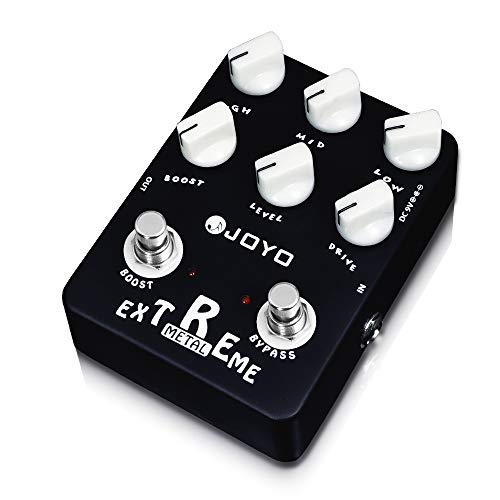
The JOYO JF-17 is best for players who want to adjust the midrange precisely for heavy rhythm guitar and lead parts. It combines high-gain distortion with a three-band EQ and a sweepable mid-frequency control. Six controls—Low, Mid, High, Boost, Level, and Drive—provide separate adjustments for tone, output, and distortion.
For nu metal, the mid-frequency sweep is the key comparison point: it lets players move the center of the midrange adjustment instead of relying on a fixed mid control. The product features also describe tight low end for palm-muted riffs and a boost control for adding saturation and volume to solos.
- Best for: Guitarists who want to fine-tune mids for rhythm and lead tones.
- Why it stands out: Sweepable mids and a separate boost control offer more targeted adjustments than a basic gain-and-tone pedal.
- Consider: Its six controls provide many settings to manage; a simpler pedal may suit players who prefer quick, minimal setup.
STRICH WARCRY Metal Distortion

The STRICH WARCRY is best for players who want two distinct distortion modes in a compact pedal. Its Classic and Extreme settings are intended to cover different metal characters, from melodic tones associated with 1980s metal to a heavier industrial-style grind. A wide gain range and separate Volume, Gain, and Tone knobs provide additional adjustment.
This pedal is a practical option for players who want to compare two core distortion modes without depending only on EQ changes. Its zinc-alloy construction and compact design are listed features for portability and durability. The straightforward three-knob layout also keeps the main adjustments easy to identify.
- Best for: Players looking for selectable distortion characters and simple controls.
- Why it stands out: The Classic and Extreme modes provide a clear contrast within one compact pedal.
- Consider: A 9V DC adapter is required and is not included. Check that the adapter has a negative-inside, positive-outside configuration before powering the pedal.
BOSS ML-2 Metal Core
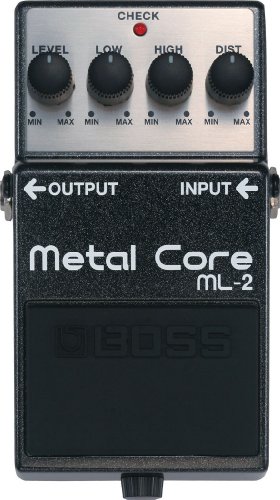
The BOSS ML-2 Metal Core is best for guitarists seeking an intentionally heavy distortion sound with a sharp attack. Its listed features emphasize ultra-heavy distortion for metal riffs, with Low and High settings for adjusting the sound. The metal construction is described as road-tough, which may appeal to players who want a solid pedal enclosure.
Compared with pedals that offer extensive EQ or several modes, the ML-2 has a more focused feature set. That makes it worth considering when the main requirement is forceful distortion for riffs rather than a wide palette of tonal adjustments. Its low and high controls allow some shaping, but the supplied features do not describe a sweepable mid control or multiple distortion modes.
- Best for: Players who prioritize heavy distortion and a sharp-edged riff attack.
- Why it stands out: Its stated purpose is focused on ultra-heavy metal tones, with Low and High settings for adjustment.
- Consider: Choose another option if you need detailed midrange control or multiple selectable distortion characters.
AFOT Heavy Metal Distortion

The AFOT Heavy Metal Distortion is best for players who want separate bass, mid, and treble controls alongside gain and boost. Its six rotary controls are Treble, Mid, Bass, Boost, Volume, and Distortion. The product description presents it as a pedal for metal, rock, and punk, with a range that extends from heavier blues and hard rock to high-gain metal.
For a nu metal setup, the three-band EQ provides a direct way to adjust the frequency balance, while the boost and distortion controls handle additional output and drive shaping. Its stated emphasis on clarity at higher gain may interest players who want definition alongside saturation, although the best setting will depend on the rest of the guitar rig.
- Best for: Players who prefer separate bass, mid, treble, boost, volume, and distortion adjustments.
- Why it stands out: Its three-band EQ offers direct control over more frequency ranges than a single tone knob.
- Consider: The detailed control set may require more adjustment than a pedal with a simpler layout.
Buying Guide: How to Choose a Nu Metal Distortion Pedal
A nu metal distortion pedal should fit the sound you want and the controls you expect to use. Heavy gain alone does not determine the right choice. EQ range, midrange control, boost functions, and the number of distortion modes can all affect how easily a pedal fits into a guitar rig.
Do you need detailed EQ or simple controls?
Choose a pedal with several EQ controls if you want to make deliberate changes to bass, midrange, and treble. The BOSS MT-2 offers advanced tone shaping, while the JOYO JF-17 and AFOT pedal specify three-band EQ controls. For fewer adjustments, the STRICH WARCRY offers Volume, Gain, and Tone knobs alongside its two modes.
How important is midrange control?
Midrange affects how a guitar tone sits between bass-heavy rhythm parts and other instruments. The JOYO JF-17 is the most specific option in this group for adjusting where the midrange control operates because it includes a sweepable mid-frequency control. The MT-2 offers broader tone shaping, while the ML-2 lists Low and High settings rather than a dedicated mid control.
Do you want one core sound or several characters?
If you prefer switching between distinct distortion styles, compare pedals with multiple modes. The STRICH WARCRY has Classic and Extreme modes, while the EX Inferno in the product list offers Raw, Brutal, and Inferno modes. A focused pedal such as the BOSS ML-2 is a better fit when the priority is its described heavy, sharp-edged distortion rather than mode selection.
Will you use a boost for leads?
A boost control can help you adjust output or saturation for a lead part. The JOYO JF-17 and AFOT pedal both list boost controls. Before choosing, check whether you want boost as a dedicated adjustment or prefer to manage volume and gain through the pedal’s other controls.
What should you check before powering the pedal?
Confirm the power requirements for the exact pedal before connecting an adapter. The STRICH WARCRY listing specifies a 9V DC adapter with negative inside and positive outside, and states that the adapter is not included. Do not assume that every pedal uses the same adapter configuration based on appearance or brand.
Frequently Asked Questions
What makes a distortion pedal suitable for nu metal?
A suitable pedal can provide the gain and tone controls needed for your preferred heavy rhythm and lead sounds. Adjustable EQ, midrange shaping, and boost options can help you fit the guitar tone to your amplifier and mix.
Which pedal here has the most detailed midrange control?
The JOYO JF-17 is the clearest choice for midrange adjustment because it lists a sweepable mid-frequency control in addition to Low, Mid, and High controls.
Which option has the simplest mode selection?
The STRICH WARCRY offers two listed distortion modes: Classic and Extreme. Its three main knobs control Volume, Gain, and Tone.
Is the BOSS ML-2 a good choice for detailed EQ shaping?
The ML-2 may suit players seeking heavy distortion and a sharp attack, but its listed features specify Low and High settings rather than extensive EQ or sweepable mids. Consider the MT-2 or JOYO JF-17 if detailed tone shaping is a priority.
Does the STRICH WARCRY include a power adapter?
No. Its product details state that a 9V DC adapter is required but not included. The specified polarity is negative inside and positive outside.
Should I choose more gain or more EQ control?
Choose based on what your current rig needs. More gain can provide additional saturation, while EQ control helps shape the pedal’s frequency balance. If you are unsure, compare the listed controls and consider whether you need bass, midrange, treble, or boost adjustments.