Best Optical Audio Cable Extender for Home Theater and More
Instantly extend your Toslink connections with reliable optical audio cable extenders. This guide highlights top options for different setups, from compact to long-range solutions. Best for: small media spaces, mid-sized living rooms, and larger home theaters. The top picks cover direct extension cables, couplers, and dual-cable adapters to ensure clear, lossless digital audio across equipment like TVs, soundbars, gaming consoles, and receivers.
| Product | Best For | Why It Stands Out |
|---|---|---|
| VANAUX 3.3ft Optical Extension Cable | Close-range setups | Compact design with solid signal integrity for short runs. |
| VANAUX 10ft Optical Extension Cable | Mid-range layouts | Longer reach without sacrificing PCM/LPCM support. |
| Accessonico Fiber Optic Cable Extender (2 Pack) | Large rooms and multi-cable expansion | Two-pack extender to connect separate runs. |
| Togconn Optical Fiber Extender Coupler (2 Pack) | Connecting two optical cables | Easy two-cable extension with reliable S/PDIF compatibility. |
| SOUNDFAM Optical Extension Cable 6 Foot | Balanced single-run extension | Durable, with minimal signal loss and EMI resistance. |
VANAUX Optical Extension Cable 3.3ft

Best for compact spaces such as behind a wall-mounted TV or a streaming device. This extension cable adds reach where standard cords fall short, enabling placement of devices away from the TV wall. It supports uncompressed PCM audio and common surround formats like Dolby Digital and DTS. Best for: small entertainment setups, single-room configurations, players or consoles close to the TV but with a short existing cable.
Caution: Ensure the connected devices have standard Toslink ports and that the distance remains within the cable’s specified length to avoid potential signal degradation.
VANAUX Optical Extension Cable 10ft
Best for mid-range living rooms or media setups where the receiver or soundbar sits a bit farther from the TV. The 10-foot extension maintains audio fidelity while extending the reach of your Toslink connection. Supports standard Toslink audio, including 5.1 to 7.1 surround formats via LPCM and Dolby/DTS variants. Best for: home theaters with wall-mounted TVs and distance-limited media players.
Limitation: The longer the run, the more you should verify connector quality and minimize cable bends to avoid potential interference.
Accessonico Fiber Optic Extender 2 Pack

Best for larger rooms where multiple runs are needed. This 2-pack extender helps connect two Toslink cables, enabling longer reach or more flexible routing. The product is designed to extend your existing optical cable without introducing noticeable signal loss. Best for: multi-room setups or zones with centralized A/V receivers. Caution: Check compatibility with your Toslink ports, and avoid stacking too many adapters in a single path, which can introduce minor impedance.
Togconn Optical Extender Coupler 2 Pack

Best for connecting two optical cables to form a longer single link. The two-pack design simplifies layout in rooms with multiple devices or long cable runs. It’s suitable for standard Toslink extension with clear S/PDIF compatibility. Choose this if your setup requires a simple, low-cost solution to join two strings of optical cable. Limitation: Couplers can add a small potential point of signal loss if the connection isn’t fully tightened or seated.
SOUNDFAM Optical Extension Cable 6 Foot
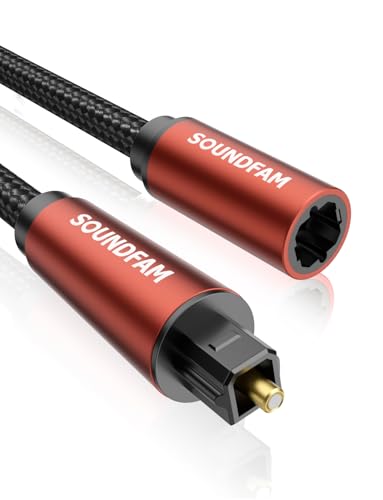
Best for standard, single-run extensions where a balance of length and durability is needed. The 6-foot core is designed to minimize signal loss and EMI, preserving the integrity of multi-channel audio formats like Dolby Digital and DTS-HD. It’s a good all-around choice for fixed TV setups with a soundbar or receiver stationed a bit farther from the TV. Limitation: Flexibility is good, but avoid excessive bending at cable ends to maintain optimal signal quality.
Buying Guide
What should you consider when choosing an optical extension cable?
- Distance and layout: Shorter runs are best with 3.3 ft cables; longer rooms may benefit from 10 ft or more.
- Signal compatibility: Look for support for PCM, LPCM, and surround formats like Dolby Digital Plus and DTS-HD.
- Connector quality: Ensure Toslink connectors are well-fitted to reduce potential signal loss.
- Durability: Flexible cores and durable sheaths help prevent wear from daily use.
- Adapter vs. direct extension: Couplers are handy for joining cables, while direct extensions minimize the number of joints.
Practical buyer questions you might ask:
- Which extension length is best for a small living room TV setup? Shorter lengths like 3.3 ft are typically sufficient and minimize signal risk.
- Can Toslink cables affect audio quality? High-quality cables and connectors preserve uncompressed PCM and surround formats without added noise.
- Is a two-pack extender useful? Yes, for longer routes or multi-device configurations where you need to connect more than one Toslink line.
- When should I avoid using an extender? If you only need a very short run, an extender isn’t necessary and may introduce unnecessary joints.
- What is the advantage of a coupler? It enables joining two cables when a single run isn’t long enough without replacing cables.
FAQ
- Do Toslink extenders degrade audio quality? Reputable extenders maintain digital signal integrity and should not affect uncompressed PCM or surround formats when used within recommended lengths.
- Can I use any Toslink cable with an extender? Most standard Toslink cables are compatible; verify connector type and length compatibility with your devices.
- Are there risks with longer optical runs? Longer distances can increase the chance of signal loss; choose high-quality extenders and avoid excessive bending.
- What is the best practice for cable management? Arrange cables to minimize kinks and ensure connectors are fully seated; use cable supports if needed.
- Should I buy a two-pack or a single extender? A two-pack provides flexible options for longer setups or multi-device routing.
- Which formats should I expect to pass through Toslink extenders? Typical formats include PCM, LPCM, Dolby Digital Plus, DTS-HD, and equivalent surround formats.