
The best piezo pickup for an archtop guitar depends on whether you want a quick, removable setup or a more involved installation. Contact pickups are practical starting points because they attach to the instrument’s surface rather than requiring a pickup routed into the body. GOGHOST is best for players who need a long cable, Imelod for a compact contact mic with a standard output socket, and JIPIS for players who want a built-in volume control. The listings do not specifically confirm archtop fit, so check the instrument’s surface and the pickup’s mounting method before buying.
| Product | Best for | Notable feature |
|---|---|---|
| GOGHOST KQ-15 | Flexible positioning and reach | 10.7-foot cable; adhesive mounting |
| PAGOW 3-in-1 | Buyers wanting multiple transducers | Three piezo disks |
| SATUY 2-Piece Set | Adhesive contact pickup options | Self-adhesive design |
| Imelod Contact Microphone | Compact, removable use | Female socket for a standard 1/4-inch plug |
| JIPIS Surface-Adhesive Pickup | On-pickup volume adjustment | Volume control and repositionable placement |
GOGHOST KQ-15 Contact Pickup

The GOGHOST KQ-15 is a surface-contact pickup with an adhesive installation style and a 10.7-foot cable. Its compact body measures 1.37 by 1.57 by 0.47 inches, and the listing says it can be connected directly to an amp or recording interface. It does not require batteries or permanent drilling.
Best for: Archtop players who want to experiment with pickup placement while keeping the instrument unmodified. The longer cable can provide more room between the guitar and connected equipment than the shorter leads listed for some alternatives.
Why it was selected: Its adhesive, non-drilling approach makes it a relevant option for players who do not want to install hardware in an archtop. The listing also names guitars among its intended instruments.
Limitation: The product details do not specify archtop-specific mounting instructions or tone controls. Confirm that the adhesive contact surface is suitable for your guitar’s finish before attaching it.
PAGOW 3-In-1 Piezo Transducer
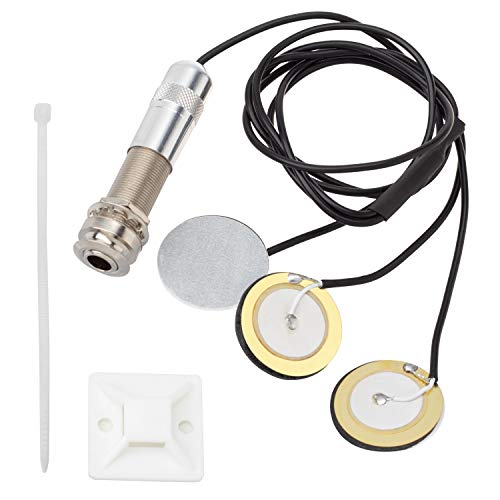
The PAGOW set is a three-in-one contact pickup system supplied with three piezo disks, each listed at approximately 27 millimeters in diameter. The product information names several string instruments, including resonator guitar, mandolin, banjo, violin, cello, and ukulele. Its cable is approximately 22.44 inches long, and the set includes an endpin jack.
Best for: Players who want several transducer disks to work with or who are considering a more customized pickup arrangement. It may be better suited to a player comfortable planning placement and installation than someone seeking a simple plug-and-play clip-on.
Why it was selected: Multiple disks provide more components to consider for a multi-contact setup, and the listing includes guitar-family instruments among its applications.
Limitation: The short listed cable and endpin-jack component mean this is not as straightforward a temporary setup as a pickup with a long attached lead. The listing does not confirm that it fits an archtop without modification.
SATUY Two-Piece Piezo Set

The SATUY set includes two piezo pickup configurations described as 3-in-1 and 2-in-1 contact microphones. Its product details say the discs pick up sound through direct contact with an instrument surface and feature self-adhesive installation. The listing also says the system does not require batteries or welding.
Best for: Players looking for an adhesive contact pickup and more than one configuration to compare. The set is a reasonable candidate for testing placement on an archtop without immediately committing to a permanent installation.
Why it was selected: Its self-adhesive design and contact-based operation align with the needs of players seeking a surface-mounted alternative to drilling or routing. The listing emphasizes use across instruments, though it does not name archtop guitars specifically.
Limitation: The supplied details do not state cable length, connector type, or exact installation locations. Verify those details and check adhesive compatibility with your guitar’s finish before purchase.
Imelod Contact Microphone Pickup

The Imelod is a small contact microphone intended to work by touching the sound source. Its listing names acoustic guitar, mandolin, cello, banjo, violin, and ukulele among compatible instrument types. It does not require drilling. The pickup has a female socket that accepts a cable with a standard 1/4-inch male plug.
The product description highlights an ABS body and a braided, shielded cable made with oxygen-free copper. The listed cable is 10 inches long, so users may need to supply an additional instrument cable to reach an amp or recording setup.
Best for: Players who want a compact contact pickup and already have a suitable 1/4-inch cable. Its separate socket-and-cable arrangement can be convenient when the pickup’s short lead alone is not enough.
Why it was selected: It is explicitly described for acoustic guitar and offers a no-drill contact method that can suit an archtop player exploring temporary amplification.
Limitation: The included lead is short, and the listing does not provide archtop-specific placement or finish guidance. Check how the pickup will attach before using it on a delicate surface.
JIPIS Surface-Adhesive Pickup

The JIPIS pickup is described as a small, surface-adhesive piezo with a volume control. The listing says it does not need batteries and that moving it to different sticking positions can produce different output sound effects. Its named applications include guitar, ukulele, mandolin, violin, kalimba, and handpan.
Best for: Players who want a pickup with a volume control and are willing to compare attachment positions. The ability to change placement may be useful when searching for a sound that suits a particular archtop, although the listing does not specify recommended positions.
Why it was selected: The adhesive mounting and lack of battery requirement make it relevant for a simple surface-mounted setup. Its volume control also distinguishes it from the basic contact pickups in this group.
Limitation: The product details do not give cable length, connector information, or specific finish-safe removal instructions. Confirm the connection requirements and attachment method before purchasing.
Buying Guide: Choosing a Piezo Pickup for an Archtop
Should you choose a contact pickup or an under-saddle pickup?
A contact pickup attaches to an instrument surface and senses vibration through direct contact. The products in this comparison are primarily contact or adhesive options, which can be useful when you want to avoid permanent alteration. An under-saddle pickup is a different style that sits beneath a saddle and may require a compatible bridge arrangement or installation work. The Musiclily listing describes an under-saddle model for acoustic and classical guitars, but it is less clearly suited to a removable archtop setup than the contact choices above.
For an archtop, check how the bridge and strings are arranged before considering any under-saddle design. Do not assume a product intended for a conventional acoustic guitar will fit an archtop bridge. If preserving the instrument matters, favor a pickup whose listed mounting method matches your willingness to use adhesive or make modifications.
How important is a non-permanent installation?
Installation method is a central decision for an archtop. Adhesive pickups can avoid drilling, but the supplied product details do not guarantee that an adhesive is safe for every finish or that removal will leave no trace. Read the seller’s instructions and, if the instrument has a delicate or valuable finish, consult a qualified repair professional before applying anything.
GOGHOST, SATUY, and JIPIS explicitly describe adhesive or self-adhesive installation. Imelod says it works by contact and requires no drilled hole, while PAGOW’s set includes an endpin jack and does not provide the same clear temporary-use description. Match the pickup’s installation method to your instrument and your comfort with setup work.
Where should a contact pickup go?
Placement affects the signal from a contact pickup. The JIPIS listing specifically notes that changing the sticking position changes the output sound effect, but it does not prescribe a single best location. Start by following the product’s instructions, test at a moderate volume, and compare positions before settling on one. Avoid repeatedly moving an adhesive pickup if doing so could affect the guitar’s finish.
Archtop construction and individual instruments vary, so there is no universally confirmed placement among these listings. Do not treat a placement recommendation for a flat-top acoustic guitar as an archtop-specific rule unless the maker says it applies.
What cable and connector details should you check?
Cable length determines how much room you have to move between the instrument and your amp or recording equipment. GOGHOST lists a 10.7-foot cable, while PAGOW lists a cable of about 22.44 inches and Imelod describes a 10-inch lead with a female socket for a separate 1/4-inch plug cable. The SATUY and JIPIS details supplied here do not specify cable length or connector type.
Before ordering, confirm whether the pickup’s connector matches your equipment and whether you need an additional cable. The listings mention direct connection for some products, but they do not establish that every pickup will work equally well with every amp or recording input.
Do you need a volume control or multiple pickup elements?
A volume control can let you adjust output at the instrument, which is the main distinguishing feature stated for the JIPIS model. The other products listed here do not specify an onboard volume control. PAGOW supplies three piezo disks, while SATUY offers two described pickup configurations; these may suit buyers who want multiple components to consider, but they can require more planning than a single adhesive unit.
Choose a multi-element set only if its installation and wiring requirements are clear to you. The available product details do not fully describe every configuration, wiring procedure, or output control, so verify those points before purchase.
Frequently Asked Questions
Can a piezo contact pickup work on an archtop guitar?
A contact pickup can be a practical option because it senses vibration through contact with the instrument. However, the product listings in this guide do not specifically guarantee compatibility with every archtop model. Confirm the pickup’s mounting method and connector requirements before buying.
Will these pickups require drilling?
Several products are described as adhesive, contact-based, or usable without drilling. GOGHOST says it requires no permanent drilling, and Imelod says no hole is needed. PAGOW includes an endpin jack, so review its installation requirements carefully if you want to avoid modifying the guitar.
Which option has the longest listed cable?
GOGHOST lists a 10.7-foot cable, the longest clearly stated cable length among the products compared here. Imelod’s listed lead is 10 inches, and PAGOW’s cable is approximately 22.44 inches.
Does a piezo pickup need a battery?
GOGHOST, Journey Instruments, SATUY, and JIPIS explicitly describe their pickups as not requiring batteries. Check the individual product details for any model not covered by that statement, and distinguish a passive pickup from other equipment in your signal chain.
Can I attach an adhesive pickup to any guitar finish?
The supplied product information does not confirm compatibility with every guitar finish or guarantee residue-free removal. Check the manufacturer’s instructions and test cautiously, or ask a guitar technician before attaching a pickup to a valuable or delicate instrument.
Is an under-saddle pickup automatically better for an archtop?
No. An under-saddle model must suit the instrument’s bridge and installation requirements. The products compared here do not establish that the Musiclily under-saddle pickup fits a particular archtop, so verify its fit before choosing it over a surface-contact pickup.