
The best pitch shifting guitar pedal depends on whether you want octave effects, quick pitch changes, harmonies, or subtle detuning. The Electro-Harmonix Pitch Fork is best for players who want selectable up, down, and dual shifts with expression control. Donner’s Harmonic Square offers multiple pitch and tone combinations, while the LEKATO and Mooer pedals combine harmony, pitch shift, and detune modes. The JOYO Tidal Wave is a bass preamp and DI pedal, not a pitch shifter, so it is included only as a product to distinguish from the options that actually shift pitch.
| Product | Best suited for | Key features |
|---|---|---|
| Electro-Harmonix Pitch Fork | Selectable transposition and expression control | Up, down, or dual modes; 11-position Shift knob |
| Donner Harmonic Square | Octave, semitone, and detune variations | Seven shift types; three tone modes |
| LEKATO Mini Pitch Shifter | Multiple modes and adjustable pitch range | Harmony, pitch shift, detune; 16 parameters |
| Mooer Drop Pitch Harmonizer | Harmony, pitch shift, and detune in one pedal | Three modes; ±2-octave range |
| JOYO Tidal Wave | Bass preamp and direct output, not pitch shifting | Blend, drive, EQ, XLR DI |
Electro-Harmonix Pitch Fork

The Electro-Harmonix Pitch Fork is best for guitarists who want direct control over transposition direction and interval. Its three shift modes are up, down, and dual. An 11-position Shift knob selects the transposition interval, making it a straightforward choice for players who want several shift options without relying on a long list of separate effect modes.
The EXP input allows pitch shift or glissando control with an optional expression pedal. That makes this model a better fit for players who want to shape pitch changes as they play, rather than only selecting a fixed shift. It was selected for its clearly described controls and expression input, which distinguish it from compact pedals focused on built-in presets or mode combinations.
- Best for: Upward, downward, or dual pitch shifts and expression-based control.
- Choose this if: You want an 11-position interval selector and the option to control pitch with an expression pedal.
- Consider: The expression pedal is optional, and the listed information does not specify its inclusion.
Donner Harmonic Square Octave Pedal

The Donner Harmonic Square is best for players who want octave, semitone, and detune sounds in a compact digital pitch shifter. It offers seven shift types and three tone modes—Sharp, Flat, and Detune—for 21 described combinations. Sharp shifts the pitch up, Flat shifts it down, and Detune shifts the pitch signal by 10 cents.
Separate Wet and Dry knobs let players adjust the harmonic signal level and the dry signal level. Those controls are useful when balancing the shifted sound against the original guitar signal. The Donner was selected for the number of available combinations and its dedicated mix controls, which make it a practical choice for experimenting with different pitch textures.
- Best for: Players seeking octave, semitone, and subtle detune options.
- Choose this if: You want distinct Wet and Dry controls and three tone modes.
- Consider: The listed features describe shift types and tone modes but do not name every interval available in each combination.
LEKATO Mini Pitch Shifter Pedal

The LEKATO Mini Pitch Shifter is best for players who want harmony, pitch shifting, and detune in one pedal. Its Harmony mode can shift tones up or down by as much as two octaves. Pitch Shift mode provides a 100% wet output for pitch changes, while Detune adds subtle variation to the tone.
The pedal has a stated ±2-octave pitch range and 16 optional parameters. Its listed features also describe polyphonic pitch conversion. This makes it a flexible option for guitarists who want to explore more than a single octave effect or who prefer a pedal with multiple modes. It was selected because its range and mode choices cover several common pitch-shifting uses.
- Best for: Players who want three effect modes and adjustable pitch choices.
- Choose this if: You want harmony, a fully wet pitch-shift mode, and detune in one unit.
- Consider: The product description lists 16 parameters but does not explain each parameter individually.
Mooer Drop Pitch Harmonizer
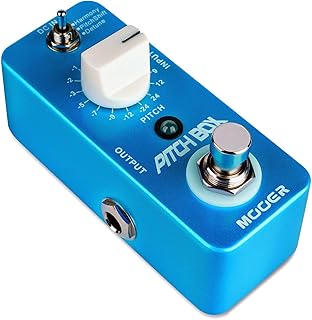
The Mooer Drop Pitch Harmonizer is best for guitarists looking for harmony, pitch shift, and detune modes in one pedal. Harmony mode combines tones shifted up or down by as much as two octaves. Pitch Shift mode provides a 100% wet shifted output, while Detune blends small variations into the sound.
The product description specifies precise polyphonic pitch conversion, a ±2-octave range, and 16 optional parameters. Its feature set is similar to the LEKATO pedal, so buyers comparing the two should focus on their preferred controls, listed features, and product details rather than assuming one has an advantage not supported by the descriptions. Mooer was selected as a relevant multi-mode pitch-shifting option with a clearly stated range.
- Best for: Players who want a broad pitch range and several effect modes.
- Choose this if: You need harmony, fully wet pitch shifting, and detune as selectable options.
- Consider: The supplied description does not detail the 16 parameters or explain how they are selected.
JOYO Tidal Wave Bass Preamp And DI

The JOYO Tidal Wave is not a pitch shifting pedal. It is a bass preamp and DI pedal, so it should not be chosen to transpose notes, create octave effects, or harmonize guitar parts. It appears in this comparison because its product information was supplied, but its features serve a different purpose from the four pitch-shifting models above.
Its stated features include a Blend control, Drive, a three-band EQ, Mid Shift and Bass Shift switches, a balanced XLR DI output, and a Ground Lift switch. Those controls shape bass tone and provide direct-output connections; they are not described as changing musical pitch. The product may suit a bassist seeking preamp and DI functions, but it is not a substitute for a pitch shifter.
- Best for: Bassists seeking preamp tone shaping and an XLR DI output.
- Do not choose this if: Your goal is octave effects, drop tuning, pitch transposition, or harmonies.
- Consider: A regulated, isolated 9V power supply is recommended in the listed features and is not included.
Buying Guide: How To Choose A Pitch Shifting Guitar Pedal
What kind of pitch change do you need?
Start by deciding what the pedal should do. An octave effect adds a note one or more octaves from the original. A transposition pedal shifts the overall pitch up or down by a selected interval. A harmonizer can combine the original note with shifted tones, while detune applies a small pitch difference for a thicker or more varied sound.
For selectable upward, downward, or dual shifts, the Electro-Harmonix Pitch Fork lists those modes and an 11-position Shift knob. For a mix of octave, semitone, and detune options, Donner lists seven shift types and three tone modes. LEKATO and Mooer offer harmony, pitch shift, and detune modes with a stated ±2-octave range.
Do you need the original guitar signal in the output?
Check how the pedal handles the dry, unshifted signal. Donner provides separate Wet and Dry knobs, letting the player adjust the levels of the harmonic and dry signals. The LEKATO and Mooer descriptions specify a 100% wet output in Pitch Shift mode. This distinction matters if you want only the transposed note or prefer to blend the original guitar with the effect.
Will you change pitch while playing?
If you want to control pitch movement during a performance, look for an expression input. The Pitch Fork has an EXP input for pitch shift or glissando control with an optional expression pedal. The other supplied product descriptions focus on mode and parameter selection and do not list an expression input.
For fixed shifts, compare the available intervals, modes, and adjustment options instead. Do not assume that a pedal offers a specific interval or live-control feature unless its product information explicitly states it.
How much adjustment do you want?
A simpler control layout can make it easier to choose a sound quickly. Donner emphasizes seven shift types, three tone modes, and separate Wet and Dry knobs. The Pitch Fork uses an 11-position Shift knob and three shift modes. LEKATO and Mooer list 16 optional parameters, but the supplied details do not explain every parameter.
When comparing controls, consider whether you need detailed adjustment or a few clearly identified functions. More listed parameters do not automatically mean a better fit if the relevant settings are not clear from the product description.
Are you shopping for guitar or bass?
Pitch shifters can be used for musical pitch effects, but check the product’s stated purpose and details before buying. The JOYO Tidal Wave listed here is specifically described as a bass preamp and DI, with EQ, drive, and output features. Its Mid Shift and Bass Shift controls refer to EQ frequency choices, not pitch transposition.
That distinction can prevent a common shopping mistake: a product with “shift” in its feature names is not necessarily a pitch-shifting pedal. Look for explicit terms such as pitch shift, octave, harmony, transposition, or detune when the goal is to change note pitch.
What should you verify before ordering?
- Confirm that the pedal offers the specific effect you need, such as octave, detune, harmony, or downward transposition.
- Check whether the original signal is mixed with the shifted signal or whether a mode is fully wet.
- Review the stated pitch range and available controls; do not infer unlisted intervals or features.
- Check whether any optional accessories mentioned in the description, such as an expression pedal or power supply, are included.
- Make sure the product is a pitch shifter rather than a preamp, EQ, or DI pedal.
Frequently Asked Questions
What does a pitch shifting guitar pedal do?
A pitch shifting pedal changes the pitch of an incoming guitar signal. Depending on its modes, it may shift notes up or down, add octave tones, create harmonies, or apply subtle detuning.
Which listed pedal has expression control?
The Electro-Harmonix Pitch Fork has an EXP input for controlling pitch shift or glissando with an optional expression pedal.
Which pedals list harmony, pitch shift, and detune modes?
The LEKATO Mini Pitch Shifter and Mooer Drop Pitch Harmonizer both list Harmony, Pitch Shift, and Detune modes.
What does “100% wet” mean on a pitch shifter?
A 100% wet output means the shifted signal is output without the unshifted dry signal mixed in, according to the descriptions for the LEKATO and Mooer Pitch Shift modes.
Is the JOYO Tidal Wave a pitch shifting pedal?
No. The JOYO Tidal Wave is described as a bass preamp and DI pedal with EQ and drive features. Its listed controls do not describe pitch transposition.