
Best Power Cables for Amplifiers: Clear Options for Reliable Audio Power
Answering your search for dependable power cables for amplifiers, this guide compares five top options suited for car, home, and studio amplification setups. Each pick is evaluated for compatibility, build quality, and best-use scenarios. Whether you need longer reach for your setup, or a heavy-gauge option for high-powered amps, you’ll find a solid choice here. The buyer profiles below help identify who benefits most from each cable.
| Product | Best For | Key Benefit |
|---|---|---|
| LitStar Power Cord Cable For Amplifier (6FT) | Small to mid-size amps; tighter spaces | 6-foot length with 18 AWG copper core |
| GGRD Power Cord Cable For Amplifier (10FT) | Standard home/studio setups; longer reach | 10-foot universal 3-prong with IEC/C13 connector |
| GEARit 4 Gauge Wire Power Cable (10 ft) | High current needs; DIY installations | CCA 4 AWG for car audio and amp wiring |
| Energeaster 8 Gauge Wire (25 ft) | Long runs; multiple devices | CCA 8 AWG with translucent jacket for inspection |
| BOSS Audio Systems KIT2 8 Gauge Wiring Kit | Complete install; car audio upgrades | Includes power cable, ground cable, turn-on wire, speaker wire |
LitStar 6-Foot Power Cord For Amplifier

The LitStar 6-foot power cord is designed for a range of amplifiers and 3-prong AC devices. It uses an 18 AWG copper core with a durable PVC jacket, aiming for reliable conductivity and longevity. This cable fits IEC-60320 C13 to NEMA 5-15P configurations, aligning with many consumer audio and instrument setups.
Best for: compact to mid-sized amplifiers and home studios where space is limited. Why chosen: its extra-long 6-foot length offers flexibility in placement without cluttering gear racks. Cautions: 18 AWG may be less ideal for very high current draws over long sessions; verify your amp’s power needs before use.
GGRD 10-Foot Power Cord For Amplifier

GGRD’s 10-foot universal 3-prong AC power cord offers flexibility for longer room layouts or studio rigs. It uses 18 AWG copper conductor with a 125V/10A rating and features a 3-prong shroud IEC 320 C13 to NEMA 5-15P connector. The black, durable jacket supports steady power delivery to amps, speakers, and related gear.
Best for: home studios or desktop setups needing more reach. Why chosen: longer length reduces strain on outlets and keeps cables organized. Cautions: 18 AWG is still a moderate gauge—avoid high-current, high-power amplifiers where more robust gauge may be required.
GEARit 4 Gauge Wire Power Cable (10 ft)

GEARit’s 10-foot 4 AWG power cable emphasizes higher current handling with copper-clad aluminum (CCA) construction. It is suitable for car audio, amps, and related 12V wiring projects. The soft-tack PVC jacket provides flexibility and durability for DIY installs while keeping costs down compared to pure copper options.
Best for: high-current applications where a thicker gauge is beneficial. Why chosen: 4 AWG improves power transfer for larger amps or installations with longer runs. Cautions: CCA is a compromise compared with pure OFC copper for peak performance, particularly under heavy loads.
Energeaster 8 Gauge Wire (25 ft)

Energeaster offers an 8 AWG CCA wire with a translucent jacket, making it easy to inspect the conductor. The 25-foot length supports longer runs in vehicles or home theater setups. Color-coded ground wire helps installers avoid polarity mistakes during connections to amplifiers and power supplies.
Best for: long-distance power runs or multi-component installations where visibility and safety checks matter. Why chosen: translucent jacket enhances safety checks and reduces installation errors. Cautions: as CCA, expect performance to be slightly lower than OFC copper in very demanding high-power scenarios.
BOSS Audio KIT2 8-Gauge Wiring Kit
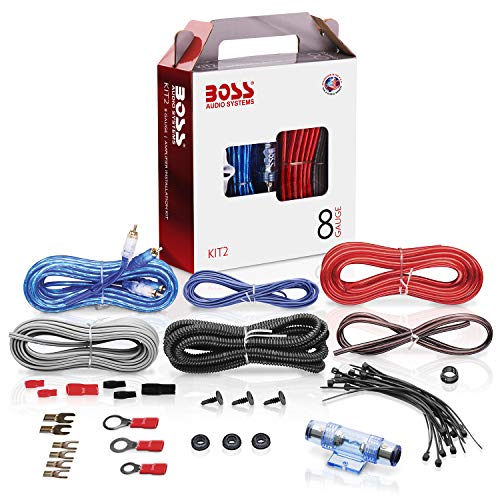
The KIT2 from BOSS Audio Systems provides a complete 8-gauge wiring package for car amplifier installation. It includes power and ground cables, a turn-on wire, speaker wire, and terminals, offering an all-in-one solution for upgrading a car audio system. This kit is best for a straightforward upgrade or initial install where a single purchase covers the essentials.
Best for: do-it-yourself car audio upgrades and beginners assembling an amp setup. Why chosen: a comprehensive kit reduces steering points for integration and ensures consistent gauge across power and signal paths. Cautions: content focuses on installation essentials; verify all components suit your specific vehicle and amp model before use.
Buying Guide
Gauge matters: Higher gauge (lower AWG number) wires carry more current with less resistance. For high-power amplifiers, 4–8 AWG wires are common; for portable or lower-power amps, 6–18 AWG cables may suffice. Choose based on your amp’s current draw and distance to the power source.
Length and layout: Longer cables give flexibility but add resistance. Pick lengths that minimize excess slack while avoiding tension near heat sources or moving parts. Consider organizers or cable management to maintain airflow and safety.
Conductor material: Copper (OFC) offers the best conductivity. Copper-Clad Aluminum (CCA) is a cost-effective alternative with acceptable performance for many home and car installations, though it may not suit the most demanding audio rigs.
Jacket and durability: A rugged PVC jacket resists wear and environmental exposure. In cars, look for flame-retardant jackets and strain relief at connector ends to reduce wear from vibrations.
Connectors: IEC 60320 C13/C14 and NEMA 5-15P are common in consumer electronics. Ensure the plug and receptacle match your equipment and outlet standards. For automotive use, verify compatibility with battery and fuse layouts.
Frequently Asked Questions
- What gauge should I use for a home amplifier?
For small to mid-size home amplifiers, 18–14 AWG is usually sufficient for short runs. For higher-power amps or longer distances, consider 8–6 AWG or heavier.
- Are CCA cables suitable for high-end audio?
CCA is adequate for many setups, but pure copper (OFC) offers the best conductivity for demanding or high-power configurations.
- How long should an amplifier power cord be?
Choose a length that reaches outlets without stretching or creating tension. Avoid excess slack that could snag or overheat nearby components.
- What safety features should I look for in power cables?
Durable jackets, proper insulation, and connector standards (IEC/NEMA) aligned with your devices reduce risk of shorts and overheating.
- Can I reuse speaker wires as power cables?
Power and speaker cables are designed for different loads and environments. It’s best to use purpose-built amplifier power cables to ensure safe performance.