
Best USB 2×2 24-Bit/192kHz Audio Interfaces for Home Studios
If you’re shopping for a USB audio interface that records at 24-bit/192kHz, this guide helps you pick the right one for your needs. It targets musicians, podcasters, streamers, and small-studio setups seeking clean conversion, real-time monitoring, and reliable phantom power when using condenser mics. The top picks below favor versatility, easy setup, and portability, with buyers ranging from beginners to more serious home studios. A quick summary table nearby highlights each option’s strengths to compare at a glance.
| Product | Brand | Best For | Key Benefit |
|---|---|---|---|
| Jolgoo 2×2 USB Audio Interface | JOLGOO | Compact studios and on-the-go recording | Direct monitoring with phantom power |
| Focusrite Scarlett Solo 3rd Gen | Focusrite | Premium front-end for vocals and guitar | Air mode and high-quality preamps |
| EBXYA 2×2 USB Audio Interface | EBXYA | Budget-friendly dual input setups | Low latency, 2-in/2-out with hi‑Z |
| MAONO PS22 Lite USB Audio Interface | MAONO | Streamer and podcasting with versatile inputs | High dynamic range, 24-bit/192kHz |
| NUOSIYA USB Audio Interface | NUOSIYA | Mac/PC creators needing flexible monitoring | Real-time monitoring and phantom power |
Jolgoo 2×2 USB Audio Interface, 24-Bit/192kHz
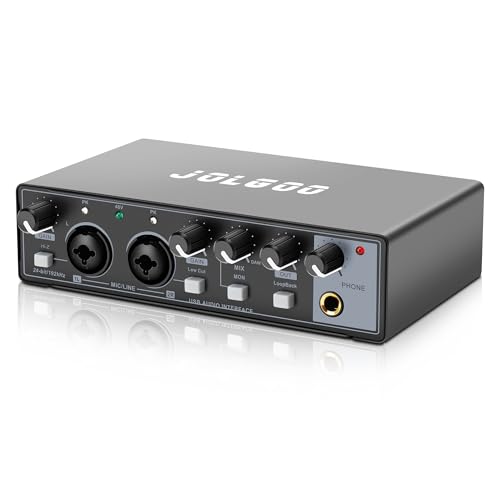
Best for portable, budget-friendly studios. Jolgoo offers studio-grade 24-bit/192kHz conversion with zero-latency direct monitoring and phantom power for condenser mics. The two XLR/Line combo inputs with independent gains are ideal for vocalists, acoustic guitarists, or podcasters who want clean, noise-free recordings without external gear.
Who it’s for: solo artists, small project studios, and mobile setups needing real-time monitoring and reliable power from USB. Why selected: strong combination of sample-rate capability, simple USB power, and phantom power for common mics.
Caution: While feature-rich, users should confirm driver compatibility with their operating system and ensure proper input gain to avoid clipping.
USB Audio Interface, Red 24-Bit/192kHz Plug & Play

This interface targets creators who want plug-and-play operation with professional-sounding results. It emphasizes real-time monitoring and two combo inputs with phantom power for microphones and instruments, all at 24-bit/192kHz fidelity. It’s a practical choice for podcasters, voice-over artists, and home recording enthusiasts who value workflow simplicity.
Who it’s for: creators who prefer quick setup and reliable monitoring. Why selected: strong emphasis on real-time monitoring and flexible inputs for a compact setup.
Caution: Compare the included software and driver requirements to ensure seamless integration with your DAW and OS version.
Focusrite Scarlett Solo 3rd Gen USB-C

Best for high-quality preamps and studio-grade vocal/guitar capture. The Scarlett Solo 3rd Gen provides improved mic pre-amps, Air mode for extra vocal clarity, and two instrument inputs. It records up to 24-bit/192kHz with converters that preserve sonic integrity, making it a top pick for home studios aiming for professional results.
Who it’s for: singers and guitarists seeking a premium front-end with clear, musical sound. Why selected: renowned Scarlett preamps, Air mode, and solid monitoring tools.
Caution: The Solo model has fewer inputs than 2×2 interfaces; if you need stereo keys or multiple mics, consider a larger interface.
EBXYA 2×2 USB Audio Interface

Focuses on a budget-friendly dual-input setup with low latency and 2-in/2-out capability. It’s suitable for beginners and learners, offering XLR/Line combo inputs, HI-Z support for guitars, and balanced outputs for speakers. The phantom power option supports condenser mics for more versatile recording sessions.
Who it’s for: students, hobbyists, or anyone starting a home studio on a budget. Why selected: affordable entry into 24-bit/192kHz recording with practical monitoring features.
Caution: Depending on platform and drivers, performance may vary; verify compatibility with your preferred DAW.
MAONO PS22 Lite USB Audio Interface

Designed for streamers and podcasters, MAONO PS22 Lite delivers 24-bit/192kHz fidelity with a dynamic range suited to vocals and instruments. It supports condenser mics via 48V phantom power and includes an instrument input for guitar work. Its USB-powered design emphasizes portability for desktop setups and on-the-go recording.
Who it’s for: streamers, voice actors, and musicians needing a straightforward, reliable interface with strong real-time monitoring. Why selected: strong 24-bit/192kHz performance in a compact, bus-powered package.
Caution: The XLR input gain may limit very loud sources; adjust gain carefully to avoid distortion.
PIYONE 2×2 USB-C Audio Interface

PIYONE offers a class-compliant, USB-C interface with 24-bit/192kHz fidelity and a stylish illuminated control design. The two XLR/Line inputs plus 48V phantom power and a monitor/mix loopback function make it suitable for directors, podcasters, and musicians who want a clean, professional signal path with easy wireless charging-ready compatibility on USB-C devices.
Who it’s for: creators who value aesthetics and a clear signal path for dual-channel projects. Why selected: modern USB-C convenience plus solid conversion and monitoring features.
Caution: The emphasis on aesthetics should not overshadow the need for robust driver support for complex DAW workflows.
NUOSIYA USB Audio Interface

NUOSIYA positions itself for PC and Mac users needing clear studio quality with real-time monitoring. It features 2-in/2-out config with 60 dB gain, 48V phantom power, and hi-Z support for instruments. The interface is suitable for podcasts, music, and streaming content that requires precise headphone monitoring and clean mic capture.
Who it’s for: podcasters and home-studio creators who require strong monitoring and phantom-powered mics. Why selected: robust monitoring plus phantom power in a compact 2×2 design.
Caution: User experience can depend on driver and DAW compatibility; verify your setup before committing to a workflow.
Buying Guide: Key Purchase Considerations
- What does 24-bit/192kHz mean for you? Higher bit depth and sample rate improve dynamic range and detail, especially in complex mixes. If your goal is pristine vocal or acoustic guitar capture, prioritize interfaces with solid converters and low-latency monitoring.
- How many inputs do you need? A 2-in/2-out setup covers basic dual-mic and instrument use. If you plan a full band or multiple mics, consider 2×4 or larger models. Phantom power is essential for most condenser mics.
- Which connection type matters? USB-C interfaces simplify power delivery and compatibility with modern laptops. USB-A remains common, so verify your computer’s ports and potential adapters.
- Monitoring options: Direct monitoring helps avoid latency during recording. Look for a dedicated direct monitor switch and reasonably transparent monitoring paths.
- Portability vs. upgrade path: USB-powered interfaces are ideal for mobile setups. If you foresee expanding your studio, choose a model with more inputs or better preamps to grow into.
- Driver and DAW compatibility: Ensure the interface supports your OS version and preferred DAW without requiring extra software or complex configurations.
Frequently Asked Questions
- Do all 24-bit/192kHz interfaces improve sound quality equally?
– They provide higher potential fidelity, but actual perceived improvement depends on your microphone, room, and monitoring chain. A well-matched front-end yields clearer results. - Is USB-C better than USB-A for audio interfaces?
– USB-C offers modern power delivery and broader compatibility with newer devices, but both can perform equally well when drivers and cables are quality. - What if I only need one mic input?
– A 2×2 interface like these can be more flexible, allowing a dedicated vocal mic and a guitar or instrument input with phantom power when needed. - Is phantom power necessary?
– For condenser microphones, phantom power (48V) is usually required. Dynamic mics typically don’t need it. - What performance should I expect in real-time monitoring?
- Can I use these interfaces with mobile devices?
– Some interfaces support iOS or Android via USB-C with appropriate adapters. Check each model’s compatibility specs before pairing with a mobile device.
– Good interfaces offer near-zero-latency monitoring, but total latency depends on your computer, DAW, and buffer settings. Select a device with low-latency drivers and monitor path.