
A 5000-watt, 12-volt power inverter can convert battery power into household-style AC power, but it requires a suitable battery system and correctly sized wiring; it is not a plug-in accessory for a standard dashboard outlet. The TOPBULL is best for buyers who want multiple connection types, while the EFFORTWAY model with an LCD and wireless remote suits users who value remote monitoring. Cantonape offers more outlets, and the second EFFORTWAY model has a wired remote. The 1000-watt OLTEANP is a lower-capacity alternative, not a 5000-watt option.
| Product | Listed continuous output | Notable features | Best suited for |
|---|---|---|---|
| EFFORTWAY 5000W, LCD and wireless remote | 5000W | Four AC outlets, LCD, wireless remote | Remote monitoring and control |
| Cantonape 5000W | 5000W | Five AC outlets, four USB ports, LCD | Several plug-in devices |
| TOPBULL 5000W | 5000W | AC outlets, USB-A, USB-C, terminal blocks | Multiple connection options |
| EFFORTWAY 5000W, wired remote | 5000W | Modified sine wave, LCD, wired remote | Control where wireless signals are obstructed |
| OLTEANP 1000W | 1000W | Six listed protections, temperature-controlled fan | Lower-power vehicle use |
EFFORTWAY 5000W With LCD And Wireless Remote
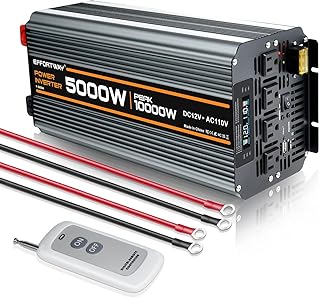
This 12-volt inverter is listed with 5000 watts of continuous output and 10,000 watts of peak output, converting DC power to 110/120-volt, 60-Hz AC. Its listed efficiency is greater than 90%. The feature set includes four AC outlets, one USB port, an LCD display, and a wireless remote.
Best for: RV, truck, or off-grid users who want to check operating information and switch the inverter remotely. The display reports input and output voltage, battery capacity, load capacity, and error codes, which can help users monitor operation and troubleshoot reported faults.
Limitation: The listed remote range is up to 150 feet, but the instructions specify that the inverter itself must be switched off before using the remote to turn it on. Its single USB port may be limiting for users charging several USB devices.
Cantonape 5000W With Five AC Outlets

The Cantonape converts 12-volt DC to 110/120-volt, 60-Hz AC and lists 5000 watts of continuous modified sine wave power, with 10,000 watts of surge power. It has five AC outlets and four USB ports. Its LCD reports input and output voltage, battery capacity, load capacity, output frequency, and fault codes.
Best for: Buyers who need several AC and USB connections in one inverter. The display’s listed fault codes include low-voltage, high-voltage, overtemperature, overload, and short-circuit conditions, giving users specific status information when an abnormal condition occurs.
Limitation: This is a modified sine wave inverter. Check the requirements of the equipment you plan to power, since the product information does not establish that every appliance or electronic device is suitable for this output type. The remote is included without its required 12V 23A battery.
TOPBULL 5000W With USB-C And Terminal Blocks

TOPBULL lists 5000 watts of continuous output and 10,000 watts of peak output for conversion from a 12- or 12.8-volt battery to 110/120-volt AC. The connection options include four 20-amp AC sockets, two USB-A ports, a 30-watt USB-C port, and three AC terminal blocks. Its listed protections cover low and high voltage, overload, short circuit, overheating, reverse connection, grounding, overcurrent, leakage, and battery protection.
Best for: Buyers who need a wider selection of output connections and a display that shows voltage, power, and working status. The listed 200-foot remote-control range may also appeal to people who want to operate the inverter from farther away.
Limitation: The extensive protection list does not replace correct installation or confirm that the inverter is appropriate for every vehicle or appliance. Verify battery capacity, cable requirements, and each device’s starting and running power before use.
EFFORTWAY 5000W With Wired Remote

This 12-volt inverter is listed as a 5000-watt continuous, 10,000-watt peak modified sine wave model. It has three AC outlets, a USB port, an LCD screen, and a wired remote with a stated reach of 16.4 feet. The display provides voltage, battery level, and frequency information.
Best for: Users who prefer a wired control connection, especially when they want to operate the inverter from a set location or are concerned about wireless signal obstruction. The listed AC outlets and USB port provide straightforward connection options for compatible loads.
Limitation: Its modified sine wave output may not suit every load, so check device requirements before buying. The listed remote reach is much shorter than the wireless models in this selection, making it less suitable when the control point needs to be far from the inverter.
OLTEANP 1000W For Lower-Power Loads

This OLTEANP model is a 1000-watt inverter, not a 5000-watt product. It converts 12-volt DC to 110/120-volt AC and lists 1000 watts continuous output with a 2000-watt peak. The product information positions it for electronics and small appliances under 1000 watts, including laptops, TVs, routers, game consoles, and similar devices. It lists undervoltage, overvoltage, overload, short-circuit, and overheat protection, plus temperature-controlled cooling.
Best for: Drivers who need a smaller inverter for lower-power devices and do not need 5000 watts. Its lower stated capacity makes it a more relevant comparison for modest loads than a high-output inverter.
Limitation: It cannot meet a 5000-watt continuous-power requirement. Do not select it for equipment whose running or startup demand exceeds its listed output.
Buying Guide: Choosing A 5000-Watt Car Inverter
Can a car inverter really provide 5000 watts?
A 5000-watt inverter can be listed for vehicle or RV use, but the “car” label does not mean it can draw that much power through a standard 12-volt accessory socket. At 12 volts, 5000 watts represents about 417 amps before accounting for conversion losses. The actual current demand can be higher. A high-output inverter therefore needs a suitable battery, correctly sized cables and connections, and an installation designed for heavy current.
Confirm the inverter’s installation instructions and battery-system requirements before purchase. Do not assume that a typical car battery, alternator, or accessory outlet can continuously supply the maximum load. If you need power while parked, consider how the battery will be recharged and how you will avoid draining it.
How much inverter capacity do your devices need?
Add the running wattage of the devices you expect to use at the same time. Then check whether any device has a higher startup or surge demand. Motors and compressors can require additional power when starting, so compare both running and startup requirements with the inverter’s continuous and peak ratings. A peak rating is not the same as continuous capacity.
Leave room between the expected load and the inverter’s maximum rating when practical. If the equipment’s wattage is unknown, check its label or manufacturer documentation rather than estimating from its size. Avoid connecting a load that exceeds the inverter’s stated limits.
Does modified sine wave output matter?
Two products in this selection explicitly list modified sine wave output: the Cantonape and the wired-remote EFFORTWAY. Check the appliance or electronics manufacturer’s requirements before choosing a modified sine wave inverter. The supplied product details do not specify the output waveform for every other model, so confirm that information with the seller or product documentation if waveform type is important to your devices.
Do not assume that a higher wattage rating guarantees compatibility. Capacity, waveform, voltage, frequency, and the device’s startup demand are separate considerations.
Which connections and controls should you compare?
Count the outlets and ports you will use at once. Cantonape lists five AC outlets and four USB ports. TOPBULL lists AC sockets, USB-A, USB-C, and terminal blocks. The first EFFORTWAY has four AC outlets and one USB port, while the wired-remote EFFORTWAY lists three AC outlets and one USB port.
Choose a remote based on where the inverter will be installed and where you need to control it. A wireless remote can offer greater stated range, while a wired remote avoids reliance on a wireless signal. Check whether the remote needs a battery or has any setup instructions. An LCD can provide useful information, but its listed readings differ by model.
What safety and installation details should you verify?
Read the manufacturer’s installation and operating instructions before connecting an inverter. Confirm polarity, battery voltage, ventilation needs, cable sizing, fuse or circuit protection requirements, grounding instructions, and clearance around the unit. Keep the inverter and battery installation secure and protected from conditions the instructions prohibit. Do not improvise wiring based on outlet count or wattage alone.
Compare each model’s stated protections, but treat those features as safeguards rather than a substitute for correct setup. The product descriptions list different protections and display information; they do not provide enough detail to establish that the models are equivalent in every safety or installation respect.
Should you buy a 5000-watt model or a smaller inverter?
Choose a 5000-watt model only if your combined loads and installation can support its substantial DC input demand. If you mainly power electronics or small appliances, a lower-capacity unit such as the 1000-watt OLTEANP may be a more appropriate category to compare. It is not an alternative when you genuinely need 5000 watts of continuous AC output.
Match the inverter to the actual equipment, battery system, and operating scenario—not to the highest number on the product listing. For vehicle use, also consider whether the inverter will operate while driving or while parked and how the battery will be replenished.
Frequently Asked Questions
Can I plug a 5000-watt inverter into a car cigarette-lighter outlet?
No. A standard accessory outlet is not intended to supply the hundreds of amps associated with a 5000-watt, 12-volt inverter load. Follow the product’s specified battery connection and installation requirements.
What does 10,000 watts peak mean?
Peak or surge output is a short-duration rating stated by the product, while continuous output is the listed ongoing rating. The product details here do not specify the exact duration of every peak rating, so consult the individual product documentation.
Will a 5000-watt inverter run a refrigerator?
It depends on the refrigerator’s running wattage, startup demand, and the inverter’s output characteristics. Check the refrigerator’s specifications and confirm that they fit within the inverter’s continuous and peak ratings.
Which listed model has the most AC outlets?
The Cantonape lists five AC outlets. TOPBULL lists four AC sockets, the first EFFORTWAY lists four AC outlets, and the wired-remote EFFORTWAY lists three.
Is the OLTEANP a 5000-watt inverter?
No. The OLTEANP is listed as a 1000-watt continuous inverter with a 2000-watt peak rating. It is included as a lower-power comparison, not as a 5000-watt choice.