
Best Powered Audio Mixer Amplifier Solutions for Your Live Sound
Looking for a powered audio mixer amplifier that can handle live performances, karaoke, or small venues? This buying guide highlights five strong options and explains who they’re best for, plus practical buying tips. Each product combines a built-in amplifier with a mixer, simplifying setup and minimizing gear. The top picks range from compact 150W models to robust 8-channel units, making it easy to match power, inputs, and effects to your needs. Use the quick-reference table below to compare key specs at a glance.
| Product | Power Output | Best For |
|---|---|---|
| Rockville RPM80BT | 500W RMS | Small venues, Bluetooth streaming |
| Rockville RPM870 | Up to 750W RMS per channel | Live bands, multi-mic setups |
| BOMGE Powr Mixers | Up to 400W per channel | DJ, karaoke, multi-source playback |
| Yamnweo X-960D | Dual 450W amplifiers | Large room events, live sound |
| Socodox 5 Channel | Integrated DSP, moderate power | Streaming, podcasts, small bands |
Rockville RPM80BT Powered 8-Channel Mixer/Amplifier

The Rockville RPM80BT is a compact, 8-channel powered mixer with built-in Bluetooth. It delivers 500W RMS total output (250W x 2 at 8 ohms) with 2400W peak, making it suitable for small clubs or rehearsal spaces. It includes 8 XLR/8 1/4″ inputs, RCA AUX input, USB, and an amplified speaker output, plus a 5-band master EQ and per-channel tone controls. Best for solo performers or small bands needing flexible Bluetooth playback and straightforward tone shaping. Caution: higher output configurations may require careful speaker matching to avoid clipping.
- Best for: small venues, Bluetooth streaming, easy setup
- Key strength: robust 500W RMS and flexible input options
- Limitation: user may need external DI boxes for certain mics
Yamnweo VR-6 PRO Amplifier Mixing Console

The Yamnweo VR-6 PRO combines two 550W high-power amplifiers with an integrated mixer and 99 DSP effects. It supports USB playback, Bluetooth streaming, and a large display for spectrum view. This model is best for conferences, performances, and KTV setups that need strong amplification with built-in processing. It is well-suited for venues where wireless playback and easy sound shaping are priorities. Caution: the DSP effects are extensive, so new users should allow time to learn the control layout.
- Best for: mid-sized events, wireless streaming, built-in effects
- Strength: high-power dual amps and extensive DSP
- Limitation: larger footprint than ultra-compact models
BOMGE Powr Mixers Audio, 6Channel Power Sound Mixer

The BOMGE Powr Mixers unit is a 6‑channel mixer with a built-in amplifier and 256 DSP effects. It supports 8-channel mixer expansion, 4/6/8 +1 mono inputs, USB/Bluetooth playback, and 8 mic preamps with +48V phantom power. It’s a solid pick for DJ setups, karaoke, or small concerts that require multiple mic inputs and wireless connectivity. One caveat: the control layout can be dense, so beginners may benefit from a quick-start guide and practice sessions.
- Best for: DJ setups, karaoke, multi-source playback
- Strength: integrated amplifier and broad DSP capabilities
- Limitation: complex to navigate for new users
Aveek 150W x2 Powered Amplifier Audio Mixer
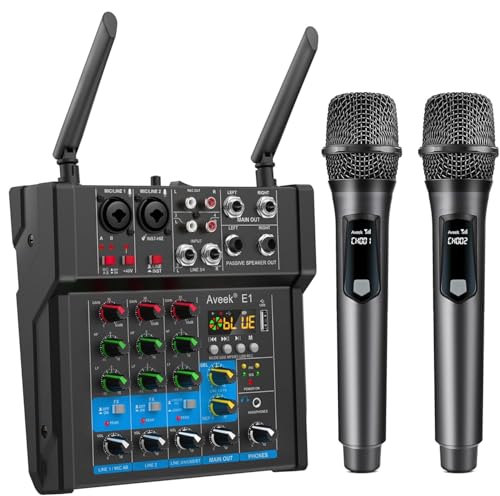
The Aveek model provides 150W x 2 RMS with built-in wireless mics. It’s designed for simple, one-step output to passive speakers, making it a practical option for small venues, classrooms, or home karaoke. It includes dual wireless mics with a long transmission range and a smart TV karaoke compatibility note. Choose this if you need an easy, all-in-one setup with two wireless mics and straightforward operation. Caution: power ceiling may limit very loud events or larger rooms.
- Best for: small rooms, home karaoke, quick setup
- Strength: built-in wireless mics and simple output
- Limitation: lower overall output compared to larger units
Socodox 5 Channel Audio Mixer With Bluetooth

The Socodox mixer features 5 channels with Bluetooth, USB, and 99 DSP studio effects. It’s well-suited for streaming, podcasts, and small-band performances, enabling easy music playback from Bluetooth devices and USB recording. This model is best for content creators or hobbyists who want integrated effects without needing external processors. One limitation: the number of physical inputs is modest, so you may need external sources for larger ensembles.
- Best for: streaming, podcasts, small bands
- Strength: built-in DSP and multi-format playback
- Limitation: fewer channels than larger live-sound units
Buying Guide: Key Considerations For Powered Mixer-Amplifiers
Power needs depend on venue size and system goals. Always match amplifier wattage to speaker ratings to avoid distortion. Consider the number of inputs required, whether you need wireless playback, and if built-in DSP effects save space and cost. Pay attention to mic preamps quality and phantom power if you plan to use condenser mics. If you perform in larger venues, prioritize higher wattage and multiple mic channels. For portable setups, a compact unit with Bluetooth can simplify on-the-go use.
Power, inputs, and processing capabilities should align with your typical performances. The best choice balances ease of use, expansion potential, and reliable sound shaping. When comparing units, ask: Do I need Bluetooth? How many mics will I use? Is USB recording important? Will I connect passive or active speakers?
Key Comparisons At A Glance
- Power output: higher watts enable louder sound with headroom; ensure compatibility with your speakers.
- Inputs: count XLR/1/4″ jacks and whether you need RCA, USB, or Bluetooth.
- Built-in effects: DSP and EQ can reduce external gear; assess ease of use.
- Portability: consider weight and size for transport needs.
- Reliability: look for units with solid preamps and stable protection features.
FAQ
- What is a powered mixer amplifier? – It is a single unit that combines a mixer and built-in amplifier to drive speakers, simplifying setup and reducing gear needs.
- How many channels do I need? – It depends on how many microphones or inputs you plan to use simultaneously; more channels offer greater flexibility for live performances.
- Should I choose Bluetooth-enabled models? – Bluetooth is convenient for wireless playback from phones or tablets, but ensure Bluetooth audio quality meets your needs for gigs.
- Is DSP necessary? – DSP effects help shape sound and reduce feedback; they are especially helpful for live settings and podcasts.
- Do I need phantom power? – If you plan to use condenser mics, you will typically need +48V phantom power from the mixer.
- Can I run passive speakers directly? – Yes, many powered mixers are designed to drive passive speakers directly; check your speaker’s impedance and power rating.