
Best Powered Line Out Converters for Car Audio Upgrades
Answering the question most buyers have when upgrading a factory stereo: which powered line out converter best meets your needs? This guide highlights five top options, each suited for different installations and goals—from maximizing bass to preserving signal quality at high volumes. Whether you’re adding a subwoofer, upgrading to a more capable amplifier, or integrating OEM radios with aftermarket gear, these converters help you unlock better sound without a full head-unit replacement. The brief table below helps you compare core strengths at a glance.
| Product | Best For | Key Benefit |
|---|---|---|
| Kicker 46KISLOC2 K-Series | Overall upgrade with remote turn-on | Legacy radio compatibility and strong signal conversion |
| AudioControl LC2i | High-output systems with AccuBASS | Bass restoration and compact install |
| CT Sounds CT-LC2 | Bass-focused installations | BassLift for factory bass restoration |
| Skar Audio SKE2LOC | Customizable turn-on and controls | Active stage with adjustable outputs |
| Kicker 47KEYLOC | Visual feedback for wire signals | LED readouts to identify hi/mid/low |
Introduction: The following five products are selected for broad compatibility with common factory radios and aftermarket amplifiers. They cover turn-on control, bass enhancement, signal integrity, and straightforward installation. Each entry explains who it’s best for and why it was chosen, with practical cautions where applicable.
Kicker 46KISLOC2 K-Series Stereo Line-Out Converter

The KISLOC2 converts the factory speaker signal into both RCA outputs and a 12-volt remote wire with DC offset. It accepts up to 55 watts (16 volts) of input, making it suitable for moderate aftermarket amplifier installations. Best for buyers who want a straightforward, reliable conversion with a dedicated remote turn-on line and simple wiring from existing speaker leads. Caution: ensure your factory head unit’s signal level is compatible with this converter’s input range to avoid distortion at high volumes.
AudioControl LC2i 2-Channel Line Output Converter
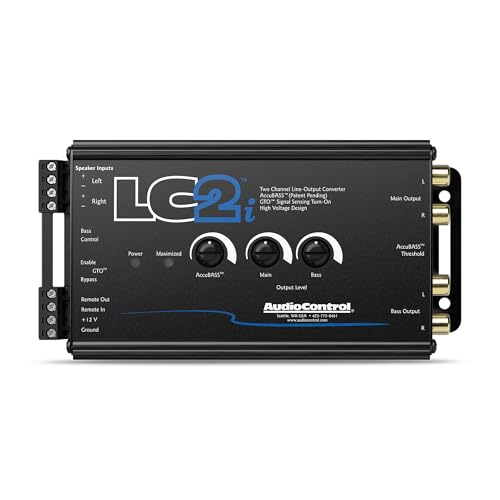
The LC2i supports up to 400W per channel signal conversion (speaker-level to RCA) and includes AccuBASS to correct bass roll-off as you raise volume on the OEM radio. It’s best for systems where preserving or restoring bass is a priority, especially when pairing with aftermarket subwoofers or amplifiers. Caution: its advanced features may require careful setup to avoid overloading aftermarket amplifiers in very high-power builds.
CT Sounds CT-LC2 2-Channel Premium Line-Out Converter

This 2-channel converter includes BassLift technology to restore and compensate for factory bass roll-off, plus separate bass output for subwoofers. It’s best for users who want a dedicated bass path alongside full-range main outputs. Caution: installation height and heat in compact dashboards can affect performance; ensure adequate clearance behind panels.
Skar Audio SKE2LOC 2-Channel Active Line Output Converter

The SKE2LOC features 2-channel active conversion with selectable turn-on options (DC Offset, Audio Sense) and a remote 12V output, plus fully adjustable bass and main channel control. Best for users who want flexible installation and precise tone shaping, especially in builds with multiple amplifiers. Caution: the owner should verify that the remote turn-on behavior aligns with other devices in the vehicle to avoid nuisance drain.
Kicker 47KEYLOC Key Series Smart Powered Line-Out Converter

The KEYLOC automatically detects the frequency range of speaker leads and includes a test-tone LED readout to indicate Hi, Mid, or Lo from each speaker wire pair. It’s best for installations where quick, visual verification is preferred and you want a smart, automated approach to signal routing. Caution: LED indicators may require interpretation in bright dashboards; rely primarily on actual tonal output for tuning decisions.
Buying Guide
What to consider when selecting a powered line-out converter:
- Output needs: How many channels do you require, and do you need a dedicated subwoofer feed?
- Input compatibility: Confirm your factory radio’s signal level and whether the converter accepts speaker-level inputs without distortion.
- Signal integrity features: Look for BassLift or AccuBASS to preserve or enhance bass as volume changes.
- Turn-on control: Remote turn-on compatibility with your amplifier setup reduces dimming or parasitic draw.
- Installation footprint: Some models are slim and compact; others provide mounting brackets—choose based on dashboard or glove box space.
- Ease of use: Visual indicators, adjustable controls, and clear documentation help with installation and tuning.
FAQ
- What is a line-out converter used for?
It converts speaker-level signals to RCA line-level signals to drive aftermarket amplifiers or subwoofers from a factory radio.
- Do I need a bass-boost feature?
If your factory head unit lacks deep bass at higher volumes, a converter with BassLift or AccuBASS helps restore bass response.
- Can these converters be dangerous to my system?
When wired correctly and matched to your amplifier’s load requirements, they are safe. Incorrect wiring or overdriving inputs can cause distortion or damage.
- How do I choose between DC offset and signal-sense turn-ons?
DC offset turn-ons are simple and reliable for most systems; signal-sense offers automatic activation when audio is detected and can be more versatile in complex installs.
- Is installation easy for beginners?
Basic wiring and mounting are straightforward, but complex systems may require professional tuning to avoid noise or interference.
- What’s the advantage of an integrated BassLift or AccuBASS feature?
These features compensate for bass loss caused by OEM radio processing, helping maintain tight, punchy bass as volume climbs.