
Best Powered Speakers and Subwoofer for Rich, Deep Sound in Any Room
Answering your need for clear, powerful bass and seamless integration with existing speakers, this guide highlights top powered subwoofers and speaker bundles. It’s ideal for small home theaters, desktop setups, and living rooms. The best picks balance deep bass, ease of setup, and compatibility with multiple audio sources. Suitable buyers include home theater enthusiasts, music lovers seeking punchy low end, and compact-room listeners who still want room-filling sound. Below is a quick table of the five products chosen for this article to help you compare at a glance.
| Product | Best For |
|---|---|
| Polk Audio PSW10 | Small-to-mid rooms; home theaters |
| Edifier T5s Powered Subwoofer | Compact, versatile home audio |
| Klipsch R-100SW | Deep bass, compact setup |
| BESTISAN Powered Subwoofer | All-around home theater and TV audio |
| Klipsch R-120SW Subwoofer | Higher output in small-to-medium rooms |
Polk Audio PSW10 10″ Subwoofer
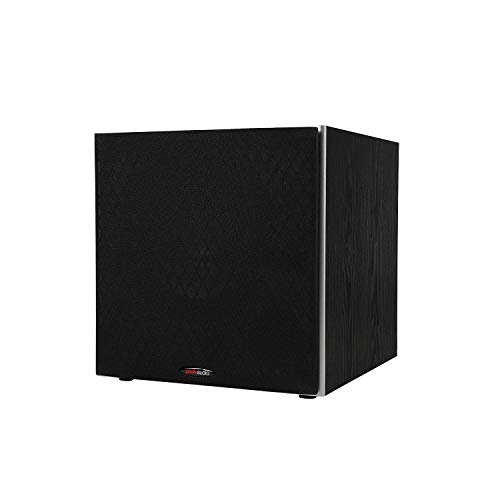
Best for compact home theaters or music systems needing a contained, assertive bass boost. The 10-inch Dynamic Balance woofer and a direct port deliver depth without excessive distortion at higher listening levels. The built-in 50-Watt RMS amp effectively drives the woofer for more than adequate room-filling sound. Use this when you want a straightforward, plug-and-play sub that blends with most satellite or bookshelf speakers. Caution: the design prioritizes mid-sized rooms; very large spaces may require stronger bass output.
Edifier T5s Powered Subwoofer
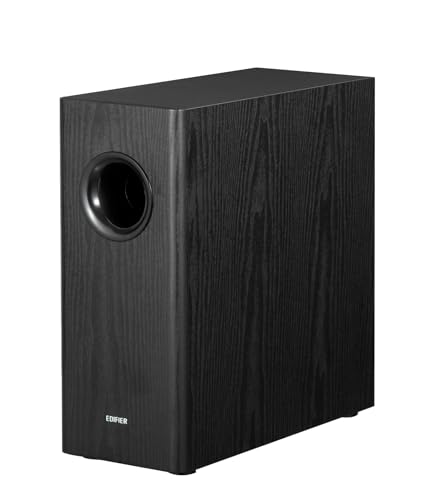
Best for space-saving living rooms and multimedia setups. The 8-inch woofer delivers 35 Hz deep bass with a 70W RMS Class-D amplifier, providing tight, controlled low end suitable for music and home theater. It includes low-pass and phase controls to tailor integration with other speakers. The compact MDF cabinet minimizes resonance, and front-firing design supports versatile placement. Choose this if you want a compact, elegant sub that remains easy to blend with various speakers while preserving clean aesthetics. Limitation: small footprint offers less ultimate bottom end compared to large subs.
Klipsch R-100SW 10″ Subwoofer

Best for listeners who want robust bass with a compact footprint. This 10″ front-firing spun-copper IMG woofer handles deep frequencies efficiently, powered by an all-digital amplifier delivering up to 300 watts peak. Features include a low-pass crossover and phase control for precise system tuning. It’s well-suited for small-to-medium rooms that demand strong, articulate bass with minimal distortion. Caution: exact bass performance depends on room acoustics and placement relative to furniture and walls.
BESTISAN Powered Subwoofer
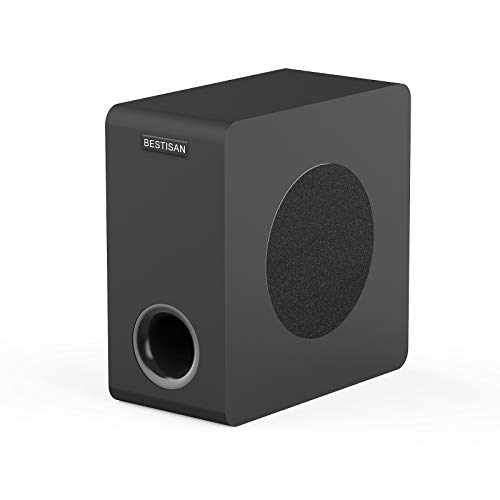
Best for versatile setups needing broad compatibility. The 6.5″ side-firing woofer and a bottom ported cabinet deliver deep, tight bass from 35 Hz to 200 Hz, suitable for home theaters, music streaming, and TV audio. It includes RCA, 3.5mm AUX, LFE inputs, and high-level speaker inputs/outputs for easy integration with receivers, TVs, soundbars, and bookshelf speakers. Choose this if you want flexible connectivity and a compact design that still delivers room-filling bass. Limitation: side-firing woofer may require careful placement away from corners for optimal bass response.
Buying Guide
What should you consider when choosing powered speakers and a subwoofer?
- Room size and subwoofer goal: Larger rooms benefit from higher wattage and bigger drivers; smaller rooms benefit from compact, well-tuned subs.
- Speaker compatibility: Ensure the subwoofer’s crossover and phase controls align with your current speakers or AV receiver.
- Placement and acoustics: Front-firing vs side-/down-firing designs affect placement flexibility and bass localization.
- Connectivity: Look for multiple inputs (RCA, LFE, 3.5mm) to support TVs, computers, and gaming consoles.
- Control options: Subwoofers with adjustable low-pass filters and phase controls help achieve seamless integration with satellites or full-range speakers.
- Power and distortion: More wattage can improve headroom, but room acoustics and placement strongly influence perceived bass quality.
FAQ
- What is the difference between a powered subwoofer and a passive subwoofer?
- How do I connect a subwoofer to a TV or soundbar?
- Where should I place a subwoofer for best bass?
- How do I know if my subwoofer blends well with my speakers?
- Can I use a powered subwoofer with multiple audio sources?
- Is bigger always better for bass?
A powered subwoofer includes its own built-in amplifier, simplifying setup and reducing the need for a separate amp. A passive subwoofer requires an external amplifier to drive it.
Use the LFE or RCA subwoofer output on your AV receiver or soundbar. If your device only has 3.5mm outputs, you may need an adapter or a receiver with subwoofer pass-through.
Common placements include near a wall or corner for stronger bass, but placement varies by room. For accurate bass, try corner placement briefly, then move to a side wall or front of room and test.
Set the sub’s low-pass filter to a range that complements your main speakers (often 80–120 Hz). Use phase control to align the timing of bass with the main speakers and reduce localization.
Yes. Many models offer multiple inputs, allowing you to switch sources without reconnecting cables. Ensure your receiver or mixer can route signals accordingly.
No. Bigger drivers require more space and better room calibration. The right size depends on room dimensions, listening distance, and how tight you want the bass to feel.