
Best Pro Studio Home Speakers for Accurate Sound in Any Room
When shopping for pro-grade studio speakers for a home setup, you want models that deliver clean, accurate sound and versatile placement. This guide highlights five solid choices suited for hobby studios, desktop workstations, and home theater alike. Each entry includes who it’s best for, key features, and a concise caution to help you decide quickly. The following table summarizes the highlighted options for quick comparison:
| Product | Speaker Type | Best For |
|---|---|---|
| JBL Professional C1PRO | Passive 2-Way Studio/Bookshelf | Small studios and desk setups needing accurate playback without built-in amplification |
| Edifier R1280T | Powered Bookshelf Studio Monitor | Budget-conscious desk setups and near-field monitoring |
| Edifier MR3 | Active Studio Monitor | Compact monitoring with versatile inputs for creators |
| Ortizan C7 | Powered Studio Monitors with Bluetooth | Wireless-friendly setups and multi-source listening |
| JBL 305P MkII | Active 5″ Studio Monitor 2-Way | Professional-grade near-field monitoring with wide sweet spot |
JBL Professional C1PRO High Performance 2-Way 150W 5.25” Passive Speakers

The JBL C1PRO is a compact, passive bookshelf pair designed for versatile placement in small studios or desktop systems. Key features include a 5.25” woofer, a 3/4″ tweeter, and a wide frequency response of 100 Hz to 18 kHz, delivering clear, accurate sound without built-in amplification. Best for users who already own an amplifier or audio interface and want reliable, studio-grade reference sound in a compact footprint. A notable limitation is the need for external amplification and mounting accessories if you require wall or ceiling placement.
Who this is best for: Home producers and desk setups that already have an amplifier or want a budget-friendly passive option with solid midrange clarity.
Edifier R1280T Powered Bookshelf Speakers
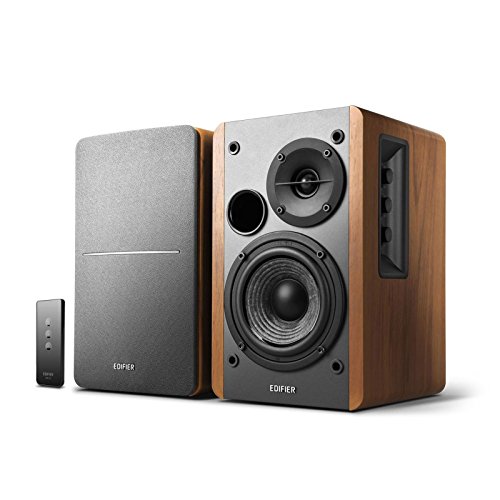
The Edifier R1280T delivers true-powered performance with dual RCA and AUX inputs for easy device switching. Its 13mm silk-dome tweeter and 4″ full-range unit provide natural midrange with smooth highs, suitable for near-field listening and desktop music production. A rear/on-side bass and treble adjustment adds flexibility for room treatment. Best for budget-minded creators who need plug-and-play convenience and volume control in a compact, classic-styled pair. Limitation: fewer advanced monitoring features than professional-grade studio monitors.
Who this is best for: Entry-level studios, home offices, and students seeking reliable, straightforward sound with easy connectivity.
Edifier MR3 Powered Studio Monitor

The Edifier MR3 is a compact active studio monitor designed for precise listening with Hi-Res Audio certification. It offers multiple inputs (TRS, RCA, AUX) and Bluetooth connectivity, enabling easy integration into multi-source desks. The MR3 is a solid choice for creators who value a flat monitoring response, plus the flexibility of wireless and wired connections. Caution: Bluetooth can introduce latency; use wired connections for critical monitoring when possible.
Who this is best for: Small studios and creators who need flexible input options and wireless playback without sacrificing monitoring accuracy.
Ortizan C7 Powered Studio Monitors with Bluetooth 5.3

The Ortizan C7 pair provides multiple inputs, including RCA and 3.5mm AUX, plus Bluetooth 5.3 for wireless playback. It includes a built-in 24-bit DAC and a 3.5″ mid-low driver with a 0.75″ silk tweeter, delivering clear midrange and smooth highs. Best for flexible listening setups where wireless streaming is a priority without sacrificing monitor-style clarity. Limitation: Some users may prefer higher-end monitors for critical mixing in larger rooms.
Who this is best for: Home studios needing easy wireless connectivity and compact form factors for desktop workflows.
JBL 305P MkII 5″ 2-Way Active Studio Monitors

The JBL 305P MkII offers a dedicated 5″ woofer with dual Class-D amplifiers and a Slip Stream port for strong bass with a clean, wide imaging field. The Image Control Waveguide helps create a precise, immersive soundstage with a broad sweet spot, making it well-suited for music production, podcasting, and creative mixing in small to mid-size rooms. Best for near-field professionals who want reliable reference monitoring with wide listening comfort. Caution: Requires an interface or amplifier to power the monitors, as they are active units.
Who this is best for: Professional-grade near-field monitoring for music production, mixing, and multimedia work in compact spaces.
Buying Guide: Key Considerations for Pro Studio Home Speakers
- Powered vs. passive: Choose powered monitors for simplicity and fewer components, or passive pairs if you already own a compatible amp and want flexible channel management.
- Size and room: Smaller monitors (4–5″) fit desks and small rooms, while larger monitors provide more low-end detail in bigger spaces.
- Frequency response: Look for a flat or near-flat response within the range most relevant to your work; extended bass isn’t always better for critical monitoring.
- Connectivity: Ensure the speakers support your devices—RCA, AUX, TRS, and Bluetooth are common. Consider models with multiple inputs for easy source switching.
- Imaging and dispersion: Monitors with a well-designed waveguide and wide sweet spot reduce the need for perfect listening positions.
- Build and placement: Choose sturdy cabinets and consider isolation pads or stands to minimize desk vibrations that color the sound.
- Use-case alignment: For near-field editing, prioritize accuracy and imaging. For casual listening or multi-room setups, Bluetooth and room-correction features may matter more.
Frequently Asked Questions
- What is the difference between active and passive studio speakers?
Active speakers have built-in amplification; passive speakers require an external amp. Choose based on your current gear and space needs. - Is a subwoofer necessary for near-field monitoring?
Not always. For desks, 5″ or 6″ monitors can cover most mid-bass needs, but a sub can extend bass accuracy for larger rooms or cinematic use. - Can Bluetooth monitors be used for serious mixing?
Bluetooth is convenient for casual listening, but wired connections and room-accurate monitors are preferred for critical mixing due to potential latency and compression. - How important is the room treatment for these speakers?
Room acoustics significantly affect monitoring. Consider absorptive panels and careful speaker placement to minimize reflections. - What is a good budget-friendly option for beginners?
Powered, entry-level monitors like Edifier R1280T and compact JBL options provide reliable sound without high costs, suitable for learning and practice. - Do I need a dedicated audio interface with these monitors?
It depends on whether the monitors are powered or passive. Passive models require an external amp/interface; active monitors integrate amplification and can connect directly to a computer or audio interface.