
Push button speaker terminals make it easier to connect and disconnect speaker wire without screw clamps. For a speaker-box replacement or subwoofer enclosure, the Zyghjort terminal cups are best suited to buyers who want a pair of cups with red and black spring terminals. CESS and TAODAN offer compact spring-loaded posts, while uxcell and BokWin are better suited to smaller terminal-board installations. Compare the mounting style, wire range, and dimensions with your project before ordering.
| Product | Best For | Key Detail |
|---|---|---|
| Zyghjort 2-Piece Terminal Cups | Speaker or subwoofer box projects | Red/black spring terminals and two cups |
| CESS Spring Loaded Binding Posts | Replacing or adding individual posts | Four posts; 13 mm diameter, 40 mm length |
| uxcell 2-Way Spring Terminal Blocks | Compact low-voltage wiring | Rated AC 50V / 3A; fits AWG 24–16 |
| TAODAN Spring-Loaded Posts | Multi-post DIY builds | Four posts; 13 mm diameter, 40 mm length |
| BokWin 2-Way Push-Release Connector | Fast mounting to a project panel | Two mounting holes and red/black tabs |
Zyghjort 2-Piece Subwoofer Box Terminal Cups

Best for: Buyers building or updating speaker and subwoofer enclosures who want a pair of terminal cups with clearly marked positive and negative connections. The package includes two cups with red and black spring terminals, so the polarity is easy to identify at the connection point.
The listed construction combines sturdy plastic and aluminum alloy, with a 3.8 mm bottom plate. The product description also identifies the cups as shockproof and anti-resonance, and states that the contacts are gold-plated. Wires are connected by pressing the spring terminal and inserting the wire.
- Two terminal cups are included.
- Red and black terminals indicate polarity.
- Spring loading supports press-and-insert wiring.
This option was selected for its enclosure-oriented format and two-piece package. Limitation: The provided information does not give cutout or outer dimensions. Confirm the required fit and mounting measurements before choosing it for an existing box.
CESS Spring Loaded Binding Posts, Four Pack

Best for: DIY builders who need individual spring-loaded binding posts rather than a complete terminal cup. The four-pack can suit a project that requires multiple posts or spare connectors, provided the mounting arrangement matches the enclosure or panel.
The listed features describe the posts as amplifier terminal connectors, banana-plug jacks, and spring-loaded press terminals for a subwoofer basket. Each has a 13 mm diameter and a 40 mm length. The press mechanism is intended to hold speaker wire when the button is released.
- Four spring-loaded posts are listed in the product name.
- Dimensions are stated as 13 mm diameter by 40 mm long.
- Described for amplifier and subwoofer-basket terminal use.
This product was selected for buyers who want separate posts and have a specific mounting plan. Limitation: The supplied details do not specify a wire-gauge range, panel cutout size, or included mounting hardware. Check those requirements before ordering.
uxcell 2-Way Spring Speaker Terminal Blocks

Best for: Buyers who need a small two-position terminal block and want a stated wire-size range and electrical rating. The uxcell block is a more specification-focused choice than the terminal cups in this list, which may help when matching a connector to a low-voltage project.
The product is described as a two-pin, two-position, spring-loaded push-type speaker terminal board. Red and black color coding identifies polarity. Its listed load rating is AC 50V / 3A, its actuating force is 1 Kgf, and it fits AWG 24–16 cable.
- Two pins and two positions.
- Fits AWG 24–16 wire, according to the listing.
- Rated load: AC 50V / 3A.
This terminal block was selected for its explicit cable and load specifications. Limitation: The rating is AC 50V / 3A; do not assume it is suitable for a project that exceeds the stated specification. The listed details do not provide panel cutout dimensions.
TAODAN Four Spring-Loaded Binding Posts

Best for: DIY audio builders looking for four separate spring-loaded posts for an amplifier or subwoofer-basket installation. Its stated size matches the CESS posts in this selection, making those two options easier to compare when dimensions are a deciding factor.
TAODAN describes these connectors as amplifier terminal connectors, banana-plug jacks, sockets, and spring-loaded pressure terminals. The listed dimensions are 13 mm (0.51 inch) in diameter and 40 mm (1.57 inches) in length. The product name specifies four pieces.
- Four posts are identified in the product name.
- 13 mm diameter and 40 mm length are listed.
- Spring-loaded push action is specified.
Choose this if the post format and stated dimensions fit your build and you want a four-piece set. It was selected as another compact-post alternative to the enclosure-style cups. Limitation: The supplied features do not state wire-size limits, cutout requirements, or mounting hardware details. Verify fit before purchasing.
BokWin 2-Way Push-Release Connector
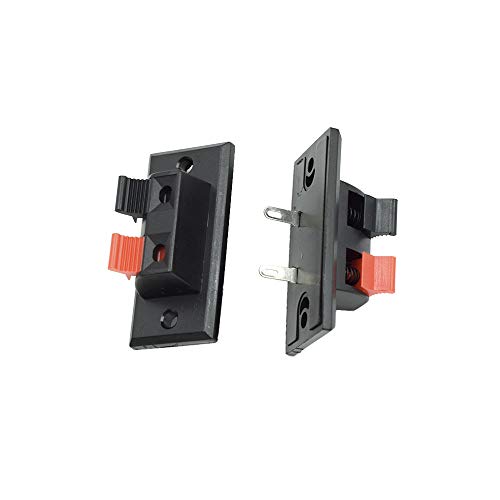
Best for: Builders who want a compact two-position terminal board that can be fixed to a project using mounting holes. BokWin lists two mounting holes, one at each end, and describes the connector as a single-row, two-pin, two-position spring-loaded board.
The red and black release tabs provide color-coded polarity identification. The spring push-release design is intended to create a stable wire connection and allow quick connection or removal. The listing presents it as a DIY audio accessory for a speaker connector plate.
- Two-pin, two-position configuration.
- Red and black push-release tabs.
- Two mounting holes for fixing the block to a project.
This connector was selected for panel or project installations where the two-hole mounting style is useful. Limitation: The provided features do not list a supported wire gauge, electrical rating, or terminal-board dimensions. Compare the product’s physical size with your available mounting area.
Buying Guide: How to Choose Push Button Speaker Terminals
Do you need a terminal cup, post, or terminal block?
Start with the part of the speaker or project that needs a connection. A terminal cup is a panel-style component intended for a speaker or subwoofer enclosure. It combines the connection points with a mounting plate. The Zyghjort product is the cup-style option among these picks.
Individual binding posts are separate connectors that may suit a build with a planned mounting arrangement. CESS and TAODAN are listed as spring-loaded posts. A terminal block, such as the uxcell or BokWin option, is a compact connector board. It may be preferable when the project calls for a small two-position component rather than a full enclosure cup.
Will the terminal fit the enclosure or panel?
Check the cutout, outer dimensions, hole spacing, and available depth before ordering. These measurements are not interchangeable: a cup’s outside size does not necessarily match its required cutout. The supplied details list a 13 mm diameter and 40 mm length for CESS and TAODAN, but do not provide cutout information. The Zyghjort listing details provided here also do not specify its dimensions.
If exact fit is important, look for a product listing that states the relevant measurements and compare them with your project. Do not assume two products with similar names have the same mounting footprint.
What wire size and electrical rating should you check?
Match the connector to the wire and the requirements of the intended audio project. The uxcell block is the only product in this group with a stated wire range and load rating: AWG 24–16 and AC 50V / 3A. For the other products, the supplied details do not identify a supported wire gauge or electrical rating. Consult the full product specifications when those limits matter.
Make sure the conductor can be inserted securely without loose strands extending beyond the terminal. Follow the connector and equipment instructions when wiring, and observe positive and negative polarity.
Are the terminals color-coded?
Red and black markings or tabs help identify the positive and negative connections. Zyghjort and BokWin explicitly list red/black spring terminals or release tabs, and uxcell lists red/black polarity coding. Color coding can make wiring easier to follow, but it does not replace checking the labels and maintaining consistent polarity across the system.
How do push terminals work?
On a spring-loaded push terminal, press the button or tab to open the wire entry, insert the stripped conductor, and release the control to clamp the wire. The exact operation can vary by connector design. Confirm the manufacturer’s instructions, use an appropriate wire preparation, and check that the connection is secure before closing an enclosure.
Push terminals can be convenient when frequent access or quick wiring is useful. They are not automatically the best choice for every project: a product must still match the wire, electrical requirements, mounting style, and available space.
Which option is better for a DIY subwoofer box?
For a box that needs a terminal cup, start by comparing cup dimensions and cutout requirements; the Zyghjort product is the clearest cup-style choice in this selection. For a build designed around separate posts, compare the CESS and TAODAN dimensions and verify how each post mounts. Choose a compact terminal block when the project specifically needs a two-position board.
Frequently Asked Questions
What are push button speaker terminals?
They are spring-loaded connectors that use a button or release tab to open a wire entry. The user inserts speaker wire and releases the button so the spring holds the conductor.
Can push terminals accept bare speaker wire?
The listed products are described as push-type or spring-loaded speaker wire terminals, but wire-size limits vary. Check the individual product specifications. The uxcell listing states a range of AWG 24–16.
Are a binding post and a terminal cup the same thing?
No. A binding post is a connection point. A terminal cup is a mounting component for an enclosure that can hold one or more connection points.
How do I identify positive and negative terminals?
Use the product’s markings or color coding. Red and black are listed on several products here, but check the terminal labels and keep polarity consistent throughout the system.
What should I measure before buying a terminal cup?
Measure the cutout opening, the available mounting area, hole spacing if applicable, and the clearance behind the panel. Compare those measurements with the product’s stated dimensions before ordering.