
The best quarter-inch jack to XLR cable depends on the connector direction, balanced input and output types, and the length you need. The Smithok 6.6-foot two-pack is best for anyone who wants two TRS-to-XLR-male cables, while the Tisino 3.3-foot XLR-female cable suits short connections in the opposite direction. The options below cover both connector orientations and different cable lengths, so check the ends before choosing.
| Product | Best for | Direction and length |
|---|---|---|
| Smithok 2-Pack | Two cables and longer reach | TRS male to XLR male, 6.6 ft |
| Tisino XLR Female | Short XLR-output connections | XLR female to TRS, 3.3 ft |
| Tisino XLR Male | Short balanced connections | TRS to XLR male, 3.3 ft |
| Smithok 6.6-Foot Cable | Flexible studio or live routing | TRS to XLR male, 6.6 ft |
| HUALEU 2-Pack | Two short XLR-female cables | TRS male to XLR female, 3 ft |
Smithok 2-Pack 6.6-Foot TRS To XLR Male Cables
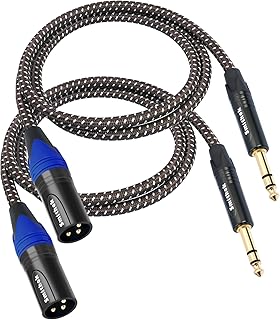
Best for: Buyers who need a pair of longer balanced cables with a 1/4-inch TRS plug at one end and a three-pin XLR male connector at the other. The stated use is connecting balanced TRS outputs, such as mixer outputs, to balanced XLR inputs, including active speakers.
Each cable is 6.6 feet long and has a nylon-braided exterior, shielded 24 AWG oxygen-free copper conductors, and gold-plated plugs. The listing also describes a reinforced, drag-resistant plug tail intended to help secure the cable at the connector.
Why it was selected: The two-cable pack and longer length make it a practical option for setups that need matched connections or some routing distance between equipment. Choose it if both devices have the connector genders and balanced connections this cable requires.
Limitation: Both ends are male connectors, so avoid this option if your equipment requires an XLR female end. Its 6.6-foot length may also be excessive for a very compact setup.
Tisino XLR Female To TRS Cable

Best for: A short balanced connection from an XLR output to a 1/4-inch TRS input. This cable is 3.3 feet long, making it a better fit for equipment placed close together than for routing across a room or stage.
Tisino lists a high-strength aluminum alloy die-cast housing, gold-plated connections, a 20 AWG oxygen-free copper core, and multilayer shielding. The shielding is described as reducing interference and helping limit hum and noise during signal transmission. The listing identifies applications in stage and studio audio, including connections involving active speakers.
Why it was selected: Its XLR-female-to-TRS orientation fills a different need from the male-XLR cables in this list. Choose it when the source has an XLR male output and the receiving device has a balanced TRS input.
Limitation: The short 3.3-foot reach is not suited to every setup. Confirm that the source connector is XLR male and the destination accepts a 1/4-inch TRS plug before ordering.
Tisino 3.3-Foot TRS To XLR Male Cable

Best for: Short balanced runs from a 1/4-inch TRS output to an XLR input. The listing describes this orientation for connecting equipment such as a mixer to an active speaker, provided the devices have matching balanced input and output connections.
The cable is 3.3 feet long and uses shielded 20 AWG oxygen-free copper. Tisino also lists gold-plated 1/4-inch and XLR connectors and a copper shell intended to block interference. The stated design goal is stable signal transmission for studio or live-performance use.
Why it was selected: This is the shorter alternative to the 6.6-foot TRS-to-XLR-male options. It can reduce excess cable in a nearby equipment layout while retaining the same basic connector orientation.
Limitation: It has an XLR male connector, not an XLR female connector. At 3.3 feet, it may not reach between equipment positioned farther apart.
Smithok 6.6-Foot TRS To XLR Male Cable

Best for: A single 6.6-foot cable for a balanced TRS output-to-XLR-input connection. The product is described for use with equipment such as mixers and powered speakers, as well as other audio devices with the corresponding 1/4-inch and three-pin XLR sockets.
Smithok lists a 24 AWG oxygen-free copper conductor, copper braided shielding, and a flexible PVC jacket. The listing also describes a self-locking XLR connector and says it was tested through repeated plug-and-pull cycles. Its wiring description connects XLR pin 1 to the TRS sleeve, pin 2 to the tip, and pin 3 to the ring.
Why it was selected: It provides more reach than the 3.3-foot options and is sold as an individual cable rather than a pair. Choose it if that length and male XLR termination match your setup.
Limitation: The cable does not provide an XLR female end. Check the connector gender and signal direction required by your equipment rather than relying on the phrase “1/4 to XLR” alone.
HUALEU 3-Foot TRS To XLR Female 2-Pack

Best for: Buyers who need two short cables with a 1/4-inch TRS male plug and an XLR female connector. The product listing describes connections involving XLR-output equipment and TRS inputs, and also mentions microphones and powered speakers. Confirm your particular devices’ connector genders and signal requirements.
The cables are 3 feet long. HUALEU lists 4N oxygen-free copper wire with double aluminum and copper shielding, a gold-plated 1/4-inch plug, and nickel-plated XLR connectors. The stated purpose of the shielding is to reduce interference and hum.
Why it was selected: It offers two cables and an XLR-female end, unlike the male-XLR products above. Choose this set when both cables need to be short and the connector orientation matches your equipment.
Limitation: The 3-foot length limits placement flexibility. This cable is not the right choice if the device requires an XLR male plug or a 1/4-inch TS connector.
Buying Guide: How To Choose A Quarter-Inch-To-XLR Cable
Which connector direction do you need?
Read the connector ends and signal path before buying. “TRS to XLR male” means a 1/4-inch TRS plug at one end and an XLR male plug at the other. “XLR female to TRS” describes the reverse connector orientation. Cable listings may name the direction differently, so use the actual connector genders and your device’s input and output sockets as the final check.
Connector gender matters because plugs must fit the equipment’s sockets. An XLR male plug has pins; an XLR female connector has holes. A cable with the wrong XLR gender will not connect directly, even if its other end is the right size.
Do you need TRS or TS?
A 1/4-inch jack can be TRS or TS. TRS has three contact sections—tip, ring, and sleeve—and is commonly used for balanced mono audio connections. TS has two contact sections—tip and sleeve—and is commonly used for unbalanced signals. The products in this list specify TRS, so do not assume they are the right choice for equipment that calls for a TS cable.
Also check the equipment manual or input-panel labels to determine whether a 1/4-inch input is balanced. A TRS plug’s physical shape alone does not prove that the connected equipment uses a balanced signal.
What cable length works for your setup?
Measure the route between devices, allowing enough slack for connector access and movement. The products here range from 3 to 6.6 feet. A shorter cable can keep a close setup tidy, while a longer cable gives more room to position equipment. Avoid stretching a cable tightly between devices, which can place strain on connectors.
Consider the cable count too. The Smithok and HUALEU products are sold as two-packs, while the other listed products are single cables. A pair is useful when you need two matching runs, but a single cable may be a more direct fit when you only need one connection.
How should you compare shielding and construction?
The listed cables describe different construction details, including oxygen-free copper conductors, braided or multilayer shielding, metal connector housings, and braided or PVC outer jackets. These are product specifications, not a guarantee that a cable will solve every noise problem. Noise can also come from the connected equipment, power setup, routing, or an unbalanced signal path.
For a busy setup, consider the cable’s stated shielding and how its jacket suits your handling needs. A braided outer covering may be useful if you prefer that style, while a flexible jacket can help with routing. Do not select a cable based on plating or conductor claims alone; connector type, direction, length, and balanced operation come first.
Will this cable work with a microphone?
Do not assume that every quarter-inch-to-XLR cable is a microphone cable for every microphone. Check the microphone’s output connector, the mixer or interface input, and whether the connection requires a balanced signal. The products listed here have different connector orientations, and the supplied product descriptions identify several as interconnect or speaker cables.
What should you check before ordering?
- Identify the output socket and input socket on the two devices.
- Confirm whether the 1/4-inch connection must be TRS or TS.
- Check whether the XLR end must be male or female.
- Verify that the cable’s direction matches the signal path.
- Measure the required cable run and decide whether you need one cable or a two-pack.
- Check the equipment documentation if balanced or unbalanced operation is unclear.
Frequently Asked Questions
Is a quarter-inch-to-XLR cable always balanced?
No. The connector names alone do not guarantee balanced operation. These five products are described as balanced TRS-to-XLR or XLR-to-TRS cables, but the connected devices must also support the intended balanced signal path.
Can I connect a 1/4-inch TRS output to an XLR input?
Yes, when the cable has the correct XLR gender and the equipment connections support the intended signal. For a TRS output to an XLR input, select a cable with TRS on the output-device side and the required XLR connector at the input-device side.
What is the difference between XLR male and XLR female?
An XLR male connector has pins, while an XLR female connector has sockets. Match the cable end to the XLR socket on your equipment; connector gender is separate from whether the signal is balanced.
Can I use a TRS-to-XLR cable for speakers?
The product descriptions identify several cables for connecting mixers to active or powered speakers. Confirm that the speaker has the required input, that the mixer output matches the cable, and that the cable is intended for the specific signal connection.
Which cable is best for a short connection?
The 3- or 3.3-foot Tisino and HUALEU options are shorter choices. Select between them based on whether you need an XLR male or female end and whether one cable or a two-pack better fits the setup.