
The RTS-200C is the clearest fit for someone seeking a radio audio delay: it is designed to sync radio or internet sporting-event audio with TV video, with an adjustable delay from 0 to 86 seconds. The other radios below offer listening, reception, or connectivity features, but their listed information does not specify an audio-delay function. They may suit everyday radio listening, not correcting audio-and-video timing by themselves.
| Product | Best For | Delay Information |
|---|---|---|
| RTS-200C RadioTVsync | Syncing radio audio with TV video | 0–86 seconds |
| MangoKit SR40 | Internet radio and portable listening | Not specified |
| Retekess TR629 | AM/FM/shortwave and recording | Not specified |
| Yewrich Portable AM/FM Radio | Large controls and multiple playback options | Not specified |
| Sangean RCR-40 | Clock-radio features and Bluetooth | Not specified |
RTS-200C RadioTVsync Audio Delay

The RTS-200C is the most directly relevant choice for a radio-with-audio-delay search. Its stated purpose is to synchronize radio or internet sporting-event audio with the video on a television. It provides an adjustable delay range of 0 to 86 seconds, which lets the listener add delay to the incoming audio when the broadcast sound is ahead of the TV picture.
- Inputs and outputs: Line-level audio in and line-level audio out.
- Audio specification: High-quality 48 kHz audio, according to the supplied product details.
- Intended use: Matching radio or internet sports commentary to TV video.
Best for: A viewer who wants radio commentary while watching a televised sporting event and needs to adjust its timing. It was selected because it is the only listed product explicitly described as an audio-delay device for syncing radio audio and television video.
Limitation: The listed connections are line-level, so check that the radio or audio source and the destination equipment provide compatible connections. The delay is specified up to 86 seconds; no greater range is stated.
MangoKit SR40 Internet Radio

The SR40 is a portable stereo internet radio with Wi-Fi, Bluetooth, FM, podcasts, and an AUX input, according to its supplied product description. It is designed for everyday listening rather than specifically for delaying audio. The product information describes more than 10 hours of playback per charge and USB-C recharging, as well as an integrated carry handle.
- Access to more than 50,000 internet radio stations and podcasts is stated in the listing.
- Bluetooth supports streaming from a smartphone or tablet; AUX-in connects external audio sources.
- The description says listeners can search stations by country, genre, or popularity and save favorites.
Best for: Someone who wants a portable internet radio for stations, podcasts, or Bluetooth listening around the home. It is included as a potential audio source, not as a substitute for an audio-delay unit.
Limitation: The supplied features do not identify adjustable audio delay or television synchronization. Do not assume it can correct a radio-to-TV timing mismatch.
Retekess TR629 Shortwave Radio

The Retekess TR629 is a digital portable radio covering AM, FM, and shortwave bands. Its listed FM range is 76–108 MHz, AM is 522–1620 kHz, and shortwave is 2.3–21.19 MHz. It supports automatic or manual station search, and the product details describe manual station storage. A DSP chip and long antenna are also listed as reception features.
The radio can record shows, talk programs, or sports commentary to USB for later playback. This can help a listener save a broadcast, but recording is not the same as applying a selectable live audio delay to synchronize commentary with a television.
Best for: A listener who wants multiple broadcast bands and the option to record radio audio to USB. It is a more suitable choice for finding and saving radio programming than for correcting live TV synchronization.
Limitation: The supplied product information does not state that the TR629 has an adjustable audio-delay function or a TV-sync feature. Choose a dedicated delay device if live synchronization is the main requirement.
Yewrich Portable AM/FM Shortwave Radio
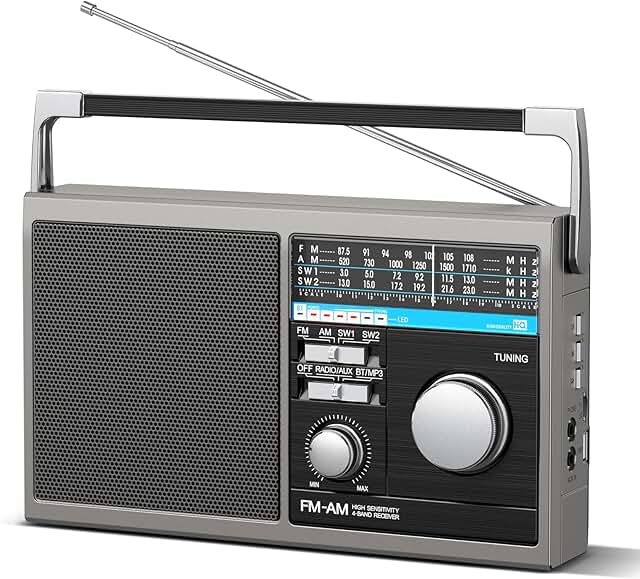
This portable radio is described as supporting AM, FM, SW1, and SW2 bands. Its listing specifies a 39.4-inch antenna and large tuning controls, plus a handle for carrying. The product information also lists Bluetooth, USB, TF-card playback, an earphone jack, AUX input, and battery or AC power.
Those features make it a flexible radio and playback device, especially for listeners who prefer physical tuning controls or want several ways to play audio. However, the listing does not say that the radio can delay its output or synchronize it with television video.
Best for: A buyer seeking a portable multi-band radio with large knobs and several listed playback options. It is included as a general radio alternative, not as a confirmed audio-delay solution.
Limitation: The listing’s reception language is promotional; actual reception can vary with location and conditions. No adjustable delay or TV-sync capability is specified.
Sangean RCR-40 Bluetooth Clock Radio

The supplied product name identifies the Sangean RCR-40 as an AM/FM-RDS (RBDS) Bluetooth and AUX digital-tuning wooden clock radio with battery backup. That makes it a relevant option for someone comparing radios with Bluetooth and clock-radio functions. The provided information does not include further specifications, so buyers should verify the details they need before choosing it.
Best for: Someone looking for a named clock-radio format with AM/FM tuning, Bluetooth, AUX, and battery backup listed in the product title. It is included as an everyday radio option, not as a product confirmed to add audio delay.
Limitation: No adjustable audio-delay range, line-level connections, or TV-sync function is stated in the supplied details. Do not select it as a dedicated synchronization device without confirming those capabilities.
Buying Guide: How To Choose A Radio With Audio Delay
Do you need an actual delay device or just a radio?
Start by identifying the problem. If radio commentary plays before or after the picture on a television, a standard radio may not fix the mismatch. Look for a product that explicitly states it can delay audio and synchronize radio or internet audio with TV video. In this product list, the RTS-200C is the only item with that stated purpose and a specified delay range.
If you simply want to listen to stations, podcasts, or stored audio, a conventional radio may be sufficient. The SR40 focuses on internet radio, podcasts, Bluetooth, and portability. The Retekess and Yewrich models list broadcast-band reception, while the Sangean is identified as a clock radio.
How much delay do you need?
Estimate the timing gap before choosing a delay unit. The RTS-200C lists a 0-to-86-second range, but the information provided does not say how much delay a particular broadcast or setup will require. A delay control is useful only when its range covers the mismatch you need to correct. Do not assume a radio that records audio can apply delay to a live signal.
Which connections should you check?
The RTS-200C lists line-level input and output. Before buying, check whether the radio or internet audio source can provide a line-level output and whether the equipment receiving the delayed signal has a suitable input. The supplied information does not detail adapters or every possible connection arrangement, so verify the actual ports on your devices.
Other radios list connections for different purposes. The SR40 has AUX-in for an external audio source, while the Yewrich listing names AUX input, USB, TF-card playback, and an earphone jack. These features do not by themselves establish that the radios can send audio through an external delay processor or accept a delayed return signal.
Do recording, Bluetooth, or internet radio mean audio delay?
No. Recording saves audio for later playback; Bluetooth sends audio wirelessly; internet radio provides access to online stations. None of those features necessarily provides an adjustable delay for live TV synchronization. Confirm that a product specifically describes a delay function and its range rather than inferring it from general audio features.
Which features matter for regular listening?
For portable listening, compare battery operation, stated playback time, carrying design, and charging method. The SR40 listing specifies more than 10 hours of playtime and USB-C charging. For band selection, the Retekess lists AM, FM, and shortwave, while the Yewrich lists AM, FM, SW1, and SW2. For saved broadcasts, the Retekess listing specifically describes recording to USB.
For simpler everyday use, consider the controls and listening environment. The Yewrich listing emphasizes large tuning knobs and a handle. The Sangean’s product name identifies it as a clock radio and lists Bluetooth, AUX, and battery backup. Compare only features that are important to your use; the supplied details are not equally complete for every model.
Frequently Asked Questions
What is the best listed product for delaying radio audio to match TV?
The RTS-200C is the best-documented match because its description explicitly says it syncs radio or internet sporting-event audio with TV video and specifies a 0-to-86-second delay range.
Can a regular AM/FM radio fix audio that is out of sync with a TV?
Not necessarily. A radio must have an adjustable audio-delay function, or be used with a compatible delay device, to correct timing. The listed features for the Retekess, Yewrich, and Sangean do not specify this function.
Does recording a radio program create an audio delay?
Recording allows playback of saved audio later, but it is not the same as applying a controlled delay to a live audio signal. The Retekess TR629 listing describes USB recording, not TV synchronization.
What does the RTS-200C’s 0-to-86-second range mean?
It is the delay range stated in the supplied product details. The device is described as adding delay to radio or internet audio for syncing with TV video. The details do not specify a recommended setting for each broadcast.
Can Bluetooth or internet radio automatically sync with a television?
Not based on the listed features alone. Bluetooth and internet-radio access describe audio connections or sources, not an adjustable delay function. Look for explicit TV-sync and delay specifications.