
Best RCA Audio Splitter Box Options for Multi-Device Setups
Answering the need for reliable, lossless distribution of analog audio, these RCA splitter boxes help you route a single source to multiple sinks. They are best for home studios, multi-room setups, gaming rigs, and casual listening where clean, mirrored sound is important. The top picks below are chosen for stability, ease of use, and compatibility across common AV gear.
| Product | Best For | Key Benefit |
|---|---|---|
| Cubilux AS-R1 4 Way RCA | Multi-sink projects | Lossless 1→4 distribution with aluminum housing |
| BolAAzuL 4-Way Bidirectional | Flexible source routing | Bi-directional and versatile input/output configurations |
| FlyroadUp 2 in 4 Out | Independent level control | Built-in gain and per-channel volume control |
Note: The table highlights practical use cases rather than technical specs. Each product section below expands on who benefits most and why it was selected for its category.
Cubilux AS-R1 4 Way RCA Audio Splitter Box

The Cubilux AS-R1 is a 1-in, 4-out passive RCA splitter designed for clean signal distribution. It is best for home studios, dubbing setups, and small-stage environments where a single source must drive multiple outputs without introducing latency or noise. The aluminum alloy enclosure provides durability and EMI/RFI shielding, helping maintain signal integrity across long runs.
Best for: Small to medium multi-sink projects, such as recording overdubs or distributing a single tone to several speakers or recorders. The rugged shell and lossless circuit design support precise, clear sound distribution.
Why chosen: It offers a straightforward, passive design with a durable build and a focus on preserving original audio quality. The trade-off is minimal, with no active boosting or cross-talk suppression, which suits simple distribution needs.
Notes: It is a 1→4 passive splitter, so ensure your source can comfortably drive multiple sinks without significant impedance changes.
BolAAzuL 4-Way RCA L/R & 3.5mm Bi-Directional Switcher

This bi-directional 4-port switcher broadens routing options by letting you connect up to four inputs to a single output or route one source to four outputs. It supports flexible 3.5mm and RCA configurations and is ideal for gamers, home theater enthusiasts, and content creators managing multiple devices. It preserves pure analog audio with a passive design, minimizing signal loss and latency.
Best for: Users who want flexible routing between multiple devices and a single listening target, such as a soundbar, monitor speakers, or headphones. It is particularly useful when you need to switch sources quickly without changing cables.
Limitations: Only one output plays at a time, and avoid plugging 3.5mm and RCA into the same channel simultaneously to prevent crosstalk.
FlyroadUp 2 in 4 Out RCA L/R Splitter with Gain

The FlyroadUp 2×4 RCA splitter distributes one or two inputs to four outputs with an integrated amplifier chip offering up to +15 dB gain. It includes independent volume control per channel, enabling real-time sound balancing. This makes it suitable for DJ setups, home studios, or classrooms where multiple listening devices need synchronized, strong output.
Best for: Systems requiring per-channel level adjustments and reliable distribution without introducing noticeable noise. The built-in gain helps compensate for longer cable runs or marginal outputs.
Limitation: Active gain can amplify noise if inputs are not clean or properly matched; keep input sources clean and protect gain settings.
PROZOR RCA Stereo Audio Switcher

The PROZOR switcher offers two inputs and two outputs or four inputs and two outputs, with a rotary selector to determine which inputs reach the chosen outputs. It is designed for straightforward, stable connections and easy operation, focusing on dedicated, lossless transmission. This box is well-suited for expanding output options in compact setups where multiple devices need to be routed to a single or dual destinations.
Best for: Users who require clear, simple routing with a compact footprint. It is appropriate for home entertainment centers and small studios where you want quick input-to-output selection without complexity.
Limitation: It does not support simultaneous output to multiple devices, so plan usage around one active output per input during operation.
FlyroadUp 4×1 RCA L/R + 3.5mm Bi-Directional Switcher
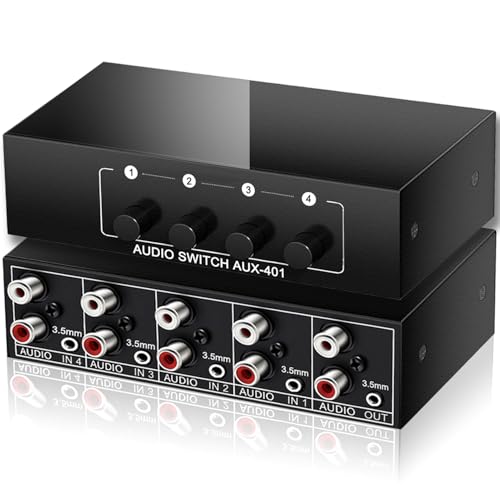
This bi-directional switcher supports four input sources to a single output or one input to four outputs, with a practical, no-power-needed design. It supports flexible combinations of 3.5mm and RCA connections, enabling broad compatibility with TVs, PCs, game consoles, and audio gear. It is a practical choice for multi-device listening without the need for external power.
Best for: Quick, plug-and-play routing when you want to mix 3.5mm and RCA devices in a compact box. It is especially convenient for shared listening environments where ease of use is a priority.
Limitation: Only one output plays at a time, so use when you do not need simultaneous multi-room distribution from a single source.
Buying Guide: Key Considerations for Selecting an RCA Splitter Box
- Passive vs. active: Passive splitters preserve signal quality with fewer components, but may rely on source strength to drive multiple outputs. Active options or built-in gain can help with long cable runs or lower-output devices but may introduce subtle noise if not properly matched.
- Number of inputs/outputs: Determine whether you need 2→4, 1→4, or more complex bi-directional routing. Choose a model that matches your current setup and allows future expansion.
- Connection types: Check compatibility with RCA L/R and 3.5mm jacks. Some switches offer flexible combos (RCA to 3.5mm, 3.5mm to RCA) to maximize device compatibility.
- Isolation and shielding: Aluminum enclosures provide EMI/RFI shielding and durability. This helps maintain signal integrity in environments with electrical interference.
- Output behavior: Many devices operate in mono vs. stereo, and some support only one active output at a time. Plan your routing needs to avoid unintended channel behavior.
- Physical design: Consider desktop footprint, ease of use (push-button vs. rotary selector), and whether a powered solution is preferred for long-term reliability.
- Best-use scenarios: Home theaters, DJ setups, studio monitoring, and multi-speaker configurations each benefit from different levels of control and gain.
Frequently Asked Questions
- What is the main difference between a passive and an active RCA splitter?
Passive splitters split the signal without external power, relying on the source’s strength. Active splitters include amplification or buffering to maintain signal quality across multiple outputs, especially with long cables or weak sources. - Can I use multiple RCA splitters at once in the same system?
It’s generally not recommended to chain several splitters in series, as impedance changes and signal loss can occur. Use a single splitter box per source and route to the required destinations. - Is it safe to connect RCA and 3.5mm devices to the same splitter simultaneously?
Most models advise against mixing 3.5mm and RCA into the same channel at the same time to avoid cross-talk or signal interference. - Do these boxes introduce noticeable latency or distortion?
When used as designed (passive or with proper gain), they typically do not introduce audible latency. Distortion is usually avoided with proper matching and avoiding excessive gain. - Which setup is best for a home DJ or recording studio?
A model with independent channel gain and clear input/output labeling (such as a 2-in/4-out with per-channel control) is advantageous for balancing levels across monitors and recording devices. - Do these devices require power?
Most listed options are passive and do not require power. A few models with built-in gain may rely on passive operation but could benefit from a powered design in larger installations.